


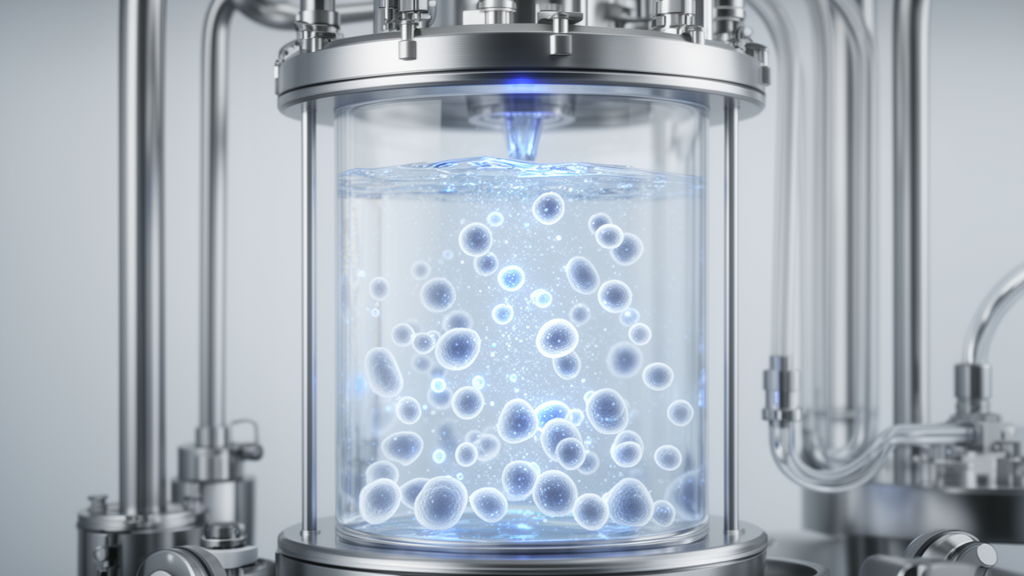
Extracellular vesicles (EVs) — nanosized, lipid-enclosed particles released by virtually all cells — have rapidly become one of the most compelling candidates for next-generation regenerative medicine. Unlike the living cells from which they are derived, EVs cannot form tumors, are less thrombogenic and immunogenic, and can reach tissues that whole cells cannot access. Now, a team of Spanish researchers has taken a decisive step toward making these particles a real clinical product: they have designed and validated a complete, good manufacturing practice (GMP)-compliant platform for producing extracellular vesicles from mesenchymal stromal cells (MSCs) derived from Wharton’s jelly, the gelatinous tissue of the umbilical cord.
The work, published in iScience, addresses one of the most stubborn bottlenecks in the field. Although MSC-derived EVs have shown remarkable regenerative and immunomodulatory effects in preclinical models — including the modulation of ischemic injury after myocardial infarction — clinical translation has been hampered by the absence of standardized, scalable, and regulatory-compliant manufacturing processes. There is no consensus on a single optimal isolation method, and existing techniques involve trade-offs between purity, yield, and preservation of functional activity. The new study tackles this problem head-on by building an integrated, semi-automated workflow that spans the entire production chain, from cell expansion to final product storage.
The platform begins with clinical-grade Wharton’s jelly-derived MSCs from a validated Master Cell Bank, expanded in a single-use 0.5-liter stirred-tank bioreactor on GMP-grade polystyrene microcarriers, using a chemically defined, serum-free medium. This upstream design is significant for two reasons. First, the microcarrier-based bioreactor configuration supports future scale-out, a critical requirement for commercial production. Second, the chemically defined medium eliminates animal-derived components such as fetal bovine serum or human platelet lysate, which dramatically reduces the risk of contamination by exogenous vesicles or adventitious agents and improves batch-to-batch reproducibility — both essential for therapeutic use.
Over seven days of culture, the cells grew from an initial seeding of 1.8 × 10⁷ to an average of 7.1 × 10⁷ cells, an expansion factor of roughly 2.8. Cell viability remained consistently above 70 percent across all batches, and phenotypic analysis confirmed stable expression of MSC markers (CD90, CD105, CD73) with no detectable hematopoietic or endothelial contaminants. One recurring operational challenge was the formation of cell–microcarrier aggregates, which complicated cell enumeration; the researchers compensated by monitoring lactate levels as a surrogate for metabolic activity, and they note that future optimization of detachment conditions and hydrodynamic parameters could further reduce this counting bias.
The conditioned medium harvested from the bioreactor — designated Intermediate Product 1 — was then concentrated using tangential flow filtration (TFF), a technique in which fluid flows parallel to a semi-permeable membrane rather than perpendicular to it. This crossflow design reduces membrane fouling and allows efficient retention of EVs while smaller molecules pass through. The team used a 750-kDa hollow-fiber cartridge, a higher cut-off than many comparable studies, which helps minimize soluble-protein retention and improves downstream purity. Each batch was processed in two consecutive TFF runs with an intermediate cleaning-in-place step, achieving a volumetric concentration factor of about 31 and a protein concentration factor of about 16, with remarkably low variability between batches.
Following concentration, the material was purified by automated size-exclusion chromatography (SEC) on an ÄKTA go system equipped with two HiLoad Superdex 200 columns. SEC separates particles based on size: larger vesicles elute first because they travel the shortest path through the porous matrix, while smaller contaminating proteins are retained longer. The system’s in-line sensors — monitoring UV absorbance, conductivity, pH, and pressure — enabled real-time process control, and a predefined UV threshold of 10 mAU automatically triggered collection of the EV-enriched fraction. This level of automation minimized operator presence in the cleanroom and reduced operator-introduced variability, a notable advance over previous GMP-aligned processes that relied on manual fraction collection.
The final product was then subjected to a rigorous panel of critical quality attributes (CQAs) aligned with both GMP standards and the Minimal Information for Studies of Extracellular Vesicles (MISEV) recommendations. Bead-based flow cytometry confirmed expression of EV-associated tetraspanins (CD9, CD63, CD81) and MSC markers (CD90, CD105, HLA-ABC), while non-specific markers remained undetectable. Nanoparticle tracking analysis revealed a mean particle concentration of 2.01 × 10¹⁰ particles per milliliter and a median size of 146.2 nanometers. Cryogenic transmission electron microscopy confirmed intact, bilayer-enclosed vesicles with minimal non-vesicular background. Protein and lipid concentrations, along with their ratios to particle number, remained stable across all four manufacturing batches.
Crucially, the researchers also demonstrated functional potency. CD73 enzymatic activity — which catalyzes the conversion of the proinflammatory molecule AMP into anti-inflammatory adenosine — was robustly detected and abolished by a specific inhibitor, confirming that the vesicles carry a defined immunomodulatory mechanism. In parallel, the EVs inhibited the proliferation of stimulated T cells from healthy donors by an average of about 18 percent, though without a consistent dose-response pattern. The authors are careful to note that these two assays interrogate distinct aspects of EV bioactivity and should not be expected to correlate directly; they propose CD73 activity as a promising candidate for routine batch release, while positioning the T cell assay as a complementary, higher-order biological readout.
Stability testing over 12 months of storage at −80°C in PlasmaLyte 148 — an excipient-free, parenteral-grade electrolyte solution — showed that protein concentrations, particle size, particle concentration, and CD73 activity were largely preserved. The authors emphasize that this one-year window represents the maximum duration experimentally validated to date, not a definitive expiry date, and that dedicated post-thaw in-use stability studies will be required before clinical administration. For now, they have adopted a conservative maximum post-thaw holding time of two hours.
The platform’s design is deliberately transposable. The three core unit operations — bioreactor-based cell expansion, tangential flow filtration, and size-exclusion chromatography — are individually well-established in regulated biomanufacturing environments, which may facilitate regulatory acceptance. Switching to a different MSC source or cell line would require re-tuning of upstream and downstream critical process parameters and re-definition of quality attributes, but the overall architecture can be retained. The authors acknowledge that their evaluation was limited to four manufacturing batches from two donors, and that formal cleaning validation under worst-case conditions remains necessary. Nevertheless, the demonstrated process control, product consistency, and frozen stability provide a robust foundation for advancing MSC-EV-based therapeutics from the laboratory bench toward the clinic — a milestone that could reshape how regenerative medicines are manufactured and delivered in the years ahead.
Subject of Research: GMP-compliant manufacturing and validation of extracellular vesicles from mesenchymal stromal cells
Article Title: Design and validation of a GMP-compliant manufacturing platform of extracellular vesicles from mesenchymal stromal cells
Article References: Design and validation of a GMP-compliant manufacturing platform of extracellular vesicles from mesenchymal stromal cells. (n.d.). https://doi.org/10.1016/j.isci.2026.117881
Image Credits: AI Generated
DOI: Not provided
Keywords: extracellular vesicles, mesenchymal stromal cells, GMP manufacturing, Wharton's jelly, tangential flow filtration, size-exclusion chromatography, regenerative medicine, advanced therapy medicinal products, immunomodulation, CD73, bioreactor, clinical translation
Cite Scienmag News
Denise Maddox. (October 15, 2026). GMP-Compliant Platform Turns Wharton’s Jelly Stem Cells Into Clinical-Grade Extracellular Vesicles. Scienmag. https://scienmag.com/gmp-compliant-platform-turns-whartons-jelly-stem-cells-into-clinical-grade-extracellular-vesicles/
Denise Maddox. "GMP-Compliant Platform Turns Wharton’s Jelly Stem Cells Into Clinical-Grade Extracellular Vesicles." Scienmag, 15 October 2026, https://scienmag.com/gmp-compliant-platform-turns-whartons-jelly-stem-cells-into-clinical-grade-extracellular-vesicles/. Accessed 15 October 2026.
Denise Maddox. "GMP-Compliant Platform Turns Wharton’s Jelly Stem Cells Into Clinical-Grade Extracellular Vesicles." Scienmag. October 15, 2026. https://scienmag.com/gmp-compliant-platform-turns-whartons-jelly-stem-cells-into-clinical-grade-extracellular-vesicles/


