


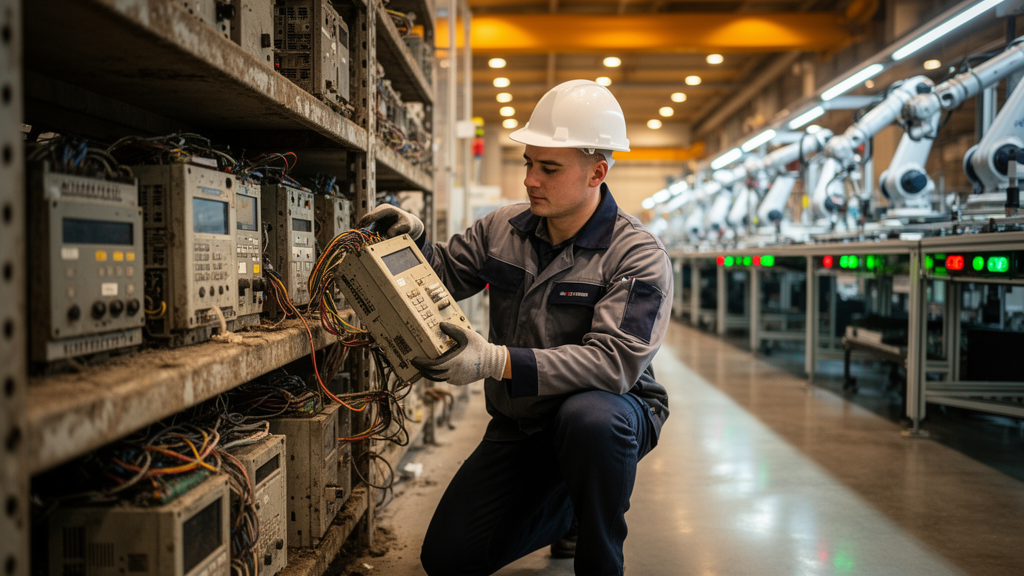
Factories are racing to plug artificial intelligence into their production lines, from machine-learning systems that predict when equipment will fail to image-recognition tools that inspect assemblies in real time. Yet a striking pattern keeps repeating across the industrial world: promising AI prototypes dazzle in the lab and then quietly die before they ever reach the shop floor. Researchers call these failures “AI graveyards,” and a new study argues that the problem is not the algorithms themselves but the way humans and AI are brought together—or fail to be—during development.
The study behind this framework was carried out by researchers at Mälardalen University in Eskilstuna, Sweden, together with a colleague at Research Institutes of Sweden in Kista, and it appears in the journal Frontiers in Manufacturing Technology as part of the journal’s Digital Manufacturing section. The team set out to address a gap they identified directly in the manufacturing literature: while staged process models for AI development in industrial settings already exist, they tend to describe recommended activities at a level of abstraction that leaves practitioners guessing about what to actually do on Monday morning. Other scholarly efforts have produced detailed methods, but those methods typically cover only narrow slices of the development journey, such as the elicitation of requirements, leaving the rest of the process undocumented.
To build something more complete, the researchers began with a systematic review of development frameworks that had already proven useful in adjacent fields. AI applications in clinical medicine, human-AI interaction design, and software engineering have each generated mature bodies of work on how to structure the creation of intelligent systems, and the authors mined these traditions for transferable insights. They then combined and modified the existing frameworks to fit the particular realities of manufacturing, where production engineers, quality specialists, machine operators, data scientists, interface designers, and software developers must all coordinate around systems whose data pipelines, machine-learning models, and user interactions are deeply interdependent.
The result is a framework of 147 task recommendations organised into six conceptual stages of development progression. Each stage functions as what methodologists call a determinant framework: rather than prescribing a rigid sequence, it lays out factors and tasks that have been found to influence development outcomes, giving project leaders a detailed and actionable map they can adapt to their own circumstances. The granularity matters because the framework’s intended users are development project leaders with manufacturing backgrounds—people who may be experts in production engineering but who must nonetheless orchestrate contributions from specialists whose vocabularies and priorities differ sharply from their own.
The choice of project leaders as the primary audience reflects a deliberate theory about where AI implementation succeeds or fails. When front-line employees such as operators and technicians are the ultimate users of an AI system, the person driving the project must understand those employees’ operational workflows, work contexts, and cognitive processes well enough to communicate the system’s benefits, concerns, and limitations in language the front line actually uses. In the researchers’ conceptualisation, an AI solution system contains both a technical subsystem—the AI-enabled software or hardware itself—and a social subsystem encompassing the human actors and workflows that interact with it. Human actors can augment AI components by providing control and feedback on inference results, while AI components can in turn enhance human situation awareness, data analysis, and decision-making. Neither subsystem can be developed in isolation from the other.
Transparency emerges as a second guiding principle. The authors argue that a major barrier to effective collaboration in cross-functional AI teams is the lack of knowledge overlap: each participant can comprehend only the parts of the solution immediately relevant to their own expertise, so nobody anticipates what colleagues are doing or how their own activities ripple outward. By making the entire development process visible and legible to all participants, the framework aims to let a quality engineer understand why a data scientist needs certain labelling conventions, or let an operator see how their feedback loops shape model retraining. Transparency also pays dividends when manufacturing organisations must rely on external parties to acquire or co-develop AI systems, because an internal team that understands the full development process can set realistic, well-scrutinised requirements for vendors and research partners rather than accepting vague promises.
The empirical grounding of the framework came through two complementary routes. First, external reviewers examined the framework and assessed its coherence and practical relevance. Second, the researchers applied the framework in pilot form to two real-world development projects, observing how its task recommendations played out against the messy contingencies of actual industrial work. These pilots were preliminary rather than definitive validations, but they surfaced concrete patterns of utility. In early-phase project planning, the framework prompted deep multi-domain dialogues in which participants from different disciplines confronted questions they might otherwise have deferred until late in the project, when course corrections are far more expensive. Midway through projects, the framework supported reflective planning, giving teams a structured occasion to step back and assess whether their trajectory still matched operational realities.
The pilots also generated candid remarks about limitations. The researchers note that the framework’s use in iterative development environments requires care: modern AI development rarely proceeds in a clean linear sequence, and teams that work in agile or spiral patterns must adapt the six stages to cycles of prototyping, testing, and revision rather than treating them as a one-way march. The authors also confine the post-deployment stage—what happens after a system goes live in production—outside the detailed scope of the model, meaning organisations will need complementary guidance for maintaining, monitoring, and retraining systems once operational.
One of the study’s sobering findings is its characterisation of the current state of practice: the development of human-integrated AI systems in industrial environments remains immature. This immaturity helps explain the AI graveyard phenomenon. When early prototypes demonstrate inspiring potential but applications rarely cross into real operational environments, the fault often lies not in model accuracy but in the unmanaged seams between data collection, curation, inference-based decision-making, error handling, and system maintenance—activities in which shop-floor personnel are deeply embedded. Operators and technicians who collect data and handle errors are not peripheral users; they are components of the solution system itself, and treating them as afterthoughts undermines the socio-technical harmony the technology requires.
The stakes of getting this right are amplified by the environments in which manufacturing AI operates. These systems are frequently intended for high-stakes operational processes where faulty decisions or controls can severely damage production performance. A mis-classified part, an erroneous maintenance prediction, or an ill-timed control adjustment carries consequences that a failed recommendation engine in a consumer application never would. This asymmetry raises the cost of the knowledge gap: a data scientist who does not understand quality engineering constraints, or a production engineer who cannot articulate what the model needs, each introduce risks that compound silently until deployment.
Application areas for AI in manufacturing span production planning, automation, quality inspection, process control, and predictive maintenance, and each domain brings its own patterns of human involvement. In quality inspection, for instance, image-recognition systems may flag defects that human inspectors must verify, creating a division of labour that must be designed rather than assumed. In predictive maintenance, technicians’ tacit knowledge about machine behaviour may be essential for curating the training data, yet that contribution is often invisible in conventional project plans. The framework’s 147 recommendations give project leaders a vocabulary for surfacing these hidden dependencies early, converting what would otherwise be implicit assumptions into explicit, discussable tasks.
For manufacturing organisations weighing whether to adopt such structured approaches, the study suggests that the investment in process discipline may be what separates systems that create lasting value from those that stall at the prototype stage. The framework does not promise to eliminate the challenges of harmonising human and AI work, but it offers a shared map that lets diverse experts see the whole journey, anticipate one another’s contributions, and catch misalignments while they are still cheap to fix. As manufacturers continue to experiment with machine learning across their operations, the evidence from this research indicates that the organisations most likely to escape the graveyard are those that plan for the human side of the system with the same rigour they apply to the algorithms themselves.
Subject of Research: A development framework for integrating human work into AI systems in manufacturing
Article Title: A development framework for human work integrated AI systems in manufacturing
Article References: Yamamoto, Y., Aranda-Muñoz, Á., & Sandström, K. (2025). A development framework for human work integrated AI systems in manufacturing. Frontiers in Manufacturing Technology, 5, Article 1601903. https://doi.org/10.3389/fmtec.2025.1601903
Image Credits: AI Generated
DOI: 10.3389/fmtec.2025.1601903
Keywords: artificial intelligence, manufacturing, human-AI collaboration, socio-technical systems, machine learning, development framework, Industry 4.0, technology readiness levels, workflow integration, digital manufacturing, project management, predictive maintenance
Cite Scienmag News
Denise Maddox. (October 15, 2026). New Framework Maps 147 Tasks to Rescue Factory AI Projects From the Graveyard. Scienmag. https://scienmag.com/new-framework-maps-147-tasks-to-rescue-factory-ai-projects-from-the-graveyard/
Denise Maddox. "New Framework Maps 147 Tasks to Rescue Factory AI Projects From the Graveyard." Scienmag, 15 October 2026, https://scienmag.com/new-framework-maps-147-tasks-to-rescue-factory-ai-projects-from-the-graveyard/. Accessed 15 October 2026.
Denise Maddox. "New Framework Maps 147 Tasks to Rescue Factory AI Projects From the Graveyard." Scienmag. October 15, 2026. https://scienmag.com/new-framework-maps-147-tasks-to-rescue-factory-ai-projects-from-the-graveyard/


