


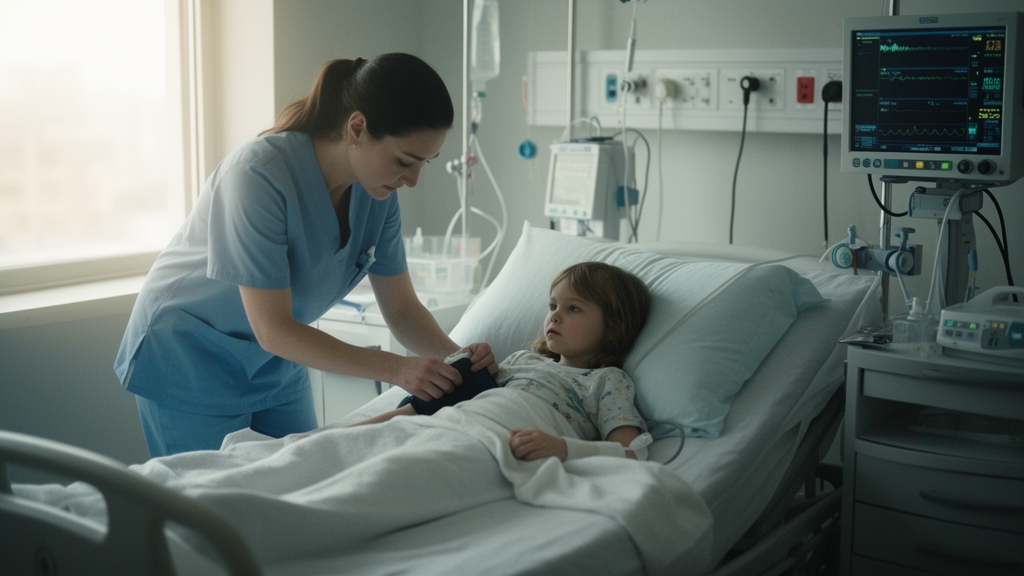
A strikingly simple intervention—briefly inflating a standard blood pressure cuff on a child’s leg—may one day help protect the brains of children struck by one of East Asia’s most feared febrile illnesses. In a new commentary published in Pediatric Research, neonatal researchers Brian T. Kalish of Boston Children’s Hospital and Nicola J. Robertson of University College London weigh the significance of the first prospective trial of remote ischemic postconditioning in children with acute encephalopathy with biphasic seizures and late reduced diffusion, a devastating infection-triggered brain condition known as AESD. Their verdict: the technique is safe and feasible in this population, and the field now has enough evidence to justify moving toward properly powered randomized trials.
AESD is the most common infection-triggered encephalopathy in East Asian children, typically erupting after prolonged febrile seizures. Its signature is cruel timing: an initial seizure phase is followed by a deceptive period of apparent recovery, and then, days later, a second cluster of seizures coincides with the emergence of distinctive MRI changes in the brain’s white matter. Even with therapeutic hypothermia—deliberate cooling of the body to slow metabolic injury—lasting neurological deficits remain common, and existing neuroprotective strategies are limited. For families and clinicians confronting the condition, the therapeutic landscape has remained stubbornly barren.
The pathophysiology of AESD is incompletely understood, but the prevailing view holds that excitotoxic white matter injury is triggered by extracellular glutamate released during early febrile status epilepticus, with subcortical damage appearing days later. That delayed secondary injury phase has attracted intense interest as a therapeutic target, because it opens a window during which intervention might still alter the trajectory of brain damage. Remote ischemic postconditioning, abbreviated RIPoC and also called remote ischemic conditioning, fits this window remarkably well.
The technique itself sounds almost too simple to be credible. A blood pressure cuff is inflated on a limb—here, the lower extremity at 200 mmHg—cutting off blood flow for five minutes before being deflated to allow reperfusion. The cycle is repeated several times. This controlled, repeated ischemia and reperfusion at a distant site triggers cascades of protective signaling that reach the brain through neuronal, humoral, and immune pathways. In rodent and piglet models of neonatal hypoxic-ischemic encephalopathy, the approach has been shown to reduce cerebral edema, attenuate neuroinflammation and oxidative stress, stabilize the blood-brain barrier, and preserve white matter integrity, as measured by cerebral ATP levels and lactate-to-N-acetylaspartate ratios. Those mechanisms closely resemble the pathological features of AESD, providing a reasonable biological rationale for testing the technique outside its traditional ischemia-reperfusion context.
The trial under scrutiny, conducted by Kawano and colleagues, enrolled a prospective single-arm cohort of children with AESD and compared outcomes against a historical control group from the same center. Remote ischemic postconditioning was administered as four cycles of five-minute cuff inflation and deflation to one lower extremity, starting at the initiation of therapeutic hypothermia. The safety results were unambiguous: no thrombotic events, no hemodynamic instability, and no coagulation disturbances were recorded. The only adverse finding was transient skin redness at the cuff site. Safety data from pediatric RIC trials in neonatal encephalopathy, cardiac surgery, and necrotizing enterocolitis have been similarly reassuring, and this report adds AESD to that growing list. Taken together, the commentators argue, there is now sufficient basis to proceed to randomized trial design in this population.
The outcome data, however, demand a more cautious reading. The Kyoto Scale of Psychological Development, the neurodevelopmental assessment used in the study, did not differ significantly between groups across any developmental domain, though the RIPoC group showed numerically higher scores overall in postural-motor, cognitive-adaptive, and language-social developmental quotients. Multiple linear regression identified a lower Tada score—a measure of illness severity—and RIPoC receipt as independent predictors of better developmental outcomes. But Kalish and Robertson urge restraint here: the model contains four predictor variables across only 25 patients and is substantially underpowered. The different time periods of the two cohorts also introduce confounding from changes in supportive care and neuroimaging practice that cannot be fully controlled. These limitations do not compromise the safety findings, but the commentators suggest the multivariate signal should not be read as preliminary efficacy evidence.
Dosing presents another open question that could determine whether the technique ever delivers measurable benefit. The protocol used in the AESD study—a single session of four cycles to one lower extremity—is considerably less intensive than the bilateral upper-limb, five-cycle-twice-daily regimen applied for 10 to 14 days in the RICAMIS trial of adult acute ischemic stroke, which was published in JAMA in 2022. Whether a single brief application activates the relevant neuronal, humoral, and immune pathways to a clinically meaningful degree is simply not known, and a more intensive schedule may ultimately be needed. Timing matters as well: arterial spin-labelling studies have documented hypoperfusion within 24 hours of early seizures in some AESD patients, before the MRI changes and late seizure cluster that define the clinical syndrome. That perfusion abnormality suggests a narrow early window in which conditioning stimuli might need to be delivered to do any good.
Measurement poses its own challenge for the field. The Kyoto Scale of Psychological Development is well validated within Japan and covers the right age range for AESD patients, but its limited international uptake will complicate cross-national trial design. Future multicenter studies, the commentators argue, should include internationally recognized developmental measures alongside the KSPD to enable pooled analyses and meet regulatory expectations outside East Asia. Without such harmonization, the evidence base risks fragmenting along geographic lines just as the technique approaches its decisive tests.
What makes remote ischemic conditioning so attractive—especially in pediatrics—is its radical practicality. It requires only a blood pressure cuff, no additional pharmacology, no anesthesia, and is inexpensive enough to be deployed in low-resource settings where advanced neurocritical care is scarce. The accumulating safety record now spans neonatal hypoxic-ischemic encephalopathy, cardiac surgery, moyamoya disease, necrotising enterocolitis, and now AESD, each representing a distinct pathophysiological context. The absence of harm across this remarkably diverse range is itself informative, and it matters particularly when treating children, in whom any treatment-related risk demands a high threshold of justification.
The path forward, according to the commentary, is a randomized controlled trial in a larger, multicenter AESD cohort, with a protocol that refines the timing, cycle number, duration, and laterality of the conditioning stimulus, and uses internationally validated primary outcome measures. Biomarker sub-studies measuring inflammatory markers, oxidative stress, and neuroimaging correlates of white matter injury would help identify which patients benefit most and clarify the underlying mechanism. Kalish and Robertson credit Kawano and colleagues with doing what a good pilot study should do: establishing safety, raising a plausible efficacy signal, and defining the questions a definitive trial needs to answer. For a condition where treatment options remain limited and the children affected are among the most vulnerable, a blood pressure cuff may yet prove to be an unlikely instrument of neuroprotection.
Subject of Research: Safety and feasibility of remote ischemic conditioning as adjunctive neuroprotection in acute pediatric neurological conditions
Article Title: Accumulating safety data for remote ischemic conditioning in acute pediatric neurological conditions
Article References: Kalish, B. T., & Robertson, N. J. (2026). Accumulating safety data for remote ischemic conditioning in acute pediatric neurological conditions. Pediatric Research. https://doi.org/10.1038/s41390-026-05402-9
Image Credits: AI Generated
DOI: 10.1038/s41390-026-05402-9
Keywords: remote ischemic conditioning, AESD, pediatric encephalopathy, therapeutic hypothermia, neuroprotection, febrile status epilepticus, white matter injury, Pediatric Research, clinical trial design, neonatal encephalopathy, blood pressure cuff, hypoperfusion
Cite Scienmag News
Cassandra Pierce. (October 15, 2026). Blood Pressure Cuff Technique Shows Early Safety Promise for Severe Childhood Brain Condition. Scienmag. https://scienmag.com/blood-pressure-cuff-technique-shows-early-safety-promise-for-severe-childhood-brain-condition/
Cassandra Pierce. "Blood Pressure Cuff Technique Shows Early Safety Promise for Severe Childhood Brain Condition." Scienmag, 15 October 2026, https://scienmag.com/blood-pressure-cuff-technique-shows-early-safety-promise-for-severe-childhood-brain-condition/. Accessed 15 October 2026.
Cassandra Pierce. "Blood Pressure Cuff Technique Shows Early Safety Promise for Severe Childhood Brain Condition." Scienmag. October 15, 2026. https://scienmag.com/blood-pressure-cuff-technique-shows-early-safety-promise-for-severe-childhood-brain-condition/


