


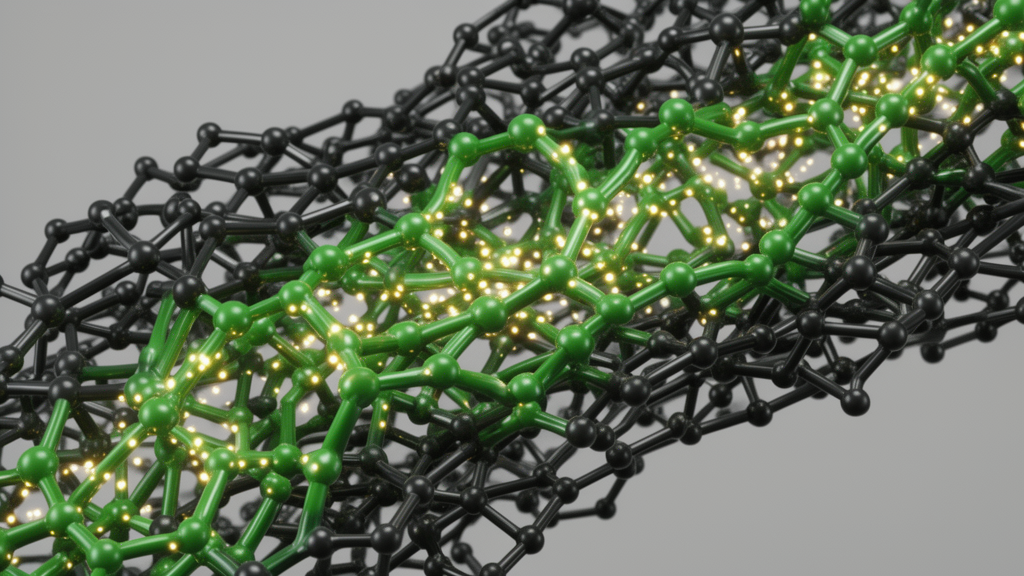
Polyaniline has been a scientific curiosity for more than 160 years, since Henry Letheby first produced what became known as aniline black by oxidizing aniline in sulfuric acid in 1862. Yet despite its low cost, easy synthesis and tunable conductivity, the conducting polymer has never quite delivered on its commercial promise. A new comprehensive review published in Frontiers in Carbon argues that the missing ingredient is carbon itself: by fusing polyaniline with carbon nanomaterials ranging from graphene sheets to carbon dots, researchers are now achieving performance gains that were once thought impossible for this humble polymer.
The review, authored by Asma Nouira of the University of Évora and University of Tunis El Manar and Imene Bekri-Abbes of the CNRSM Technopole of Borj Cédria, systematically analyzes how different carbon structures transform the properties of polyaniline, known to materials scientists as PANI. The numbers are striking. A composite of polyaniline anchored covalently inside a three-dimensional porous skeleton of reduced graphene oxide and helical carbon nanotubes achieved a specific capacitance of 696.75 farads per gram, compared with 274.75 farads per gram for pure PANI. More dramatically, the composite retained 93.57 percent of its capacitance over 3,500 charge-discharge cycles, while the pristine polymer managed only 72.3 percent retention after just 2,500 cycles.
The roots of the problem lie in polyaniline’s own chemistry. The rigid conjugated backbone that makes the polymer electrically conductive also renders it mechanically brittle, prone to cracking and delamination when strained. Its highly conductive emeraldine salt form is stable only below pH 4, which severely limits biomedical and environmental uses that operate near neutral conditions. During electrochemical cycling, the polymer swells and contracts with each doping and dedoping event, generating mechanical stress that destroys films over time. And because PANI chains aggregate into densely packed granules, many potentially useful electroactive sites are simply locked away from the electrolyte.
Carbon nanomaterials attack each of these weaknesses in a different way. One-dimensional carbon nanotubes act as electron highways, allowing charge to travel through the nanotube network rather than relying solely on the polymer backbone, while simultaneously reinforcing the composite like nanoscale rebar. Two-dimensional graphene offers exceptional conductivity and mechanical strength, though its pristine hydrophobic surface must usually be functionalized, most commonly through oxidation to graphene oxide and subsequent reduction, to disperse in water and bind with aniline monomers. Zero-dimensional carbon dots and graphene quantum dots introduce quantum confinement effects and, when covalently linked to aniline molecules before polymerization, serve as multifunctional crosslinking nodes that prevent chain aggregation.
The choice of synthesis route turns out to matter as much as the choice of carbon. In situ polymerization, in which aniline is polymerized directly in the presence of dispersed carbon nanomaterials, remains the most scalable and industrially viable method, though achieving uniform dispersion at large volumes is challenging. Electrochemical polymerization offers exquisite control over film thickness and doping level by driving aniline oxidation on a conductive substrate with cyclic voltammetry, but it is fundamentally limited to thin films on conducting electrodes. Microwave-assisted synthesis, which heats polar molecules directly through dielectric heating, can be extraordinarily fast: one recent study prepared CNT/Ag/PANI composite electrodes in just 50 seconds.
More exotic techniques push performance further. Cryo-polymerization carries out oxidative polymerization at temperatures between minus 20 and minus 78 degrees Celsius, using growing ice crystals as a sacrificial template to create lightweight, three-dimensional macroporous aerogels. Composites of polyaniline with carbon nanofibers made this way reached gravimetric capacitances of 201 farads per gram, three to six times higher than carbon-fiber-free counterparts. Gamma radiation-assisted fabrication, meanwhile, generates free radicals that initiate polymerization and crosslinking without any chemical oxidant, a clean route recently used to produce flexible energy-storage electrodes from sugarcane bagasse waste.
Perhaps the strongest message of the review is that covalent bonding between the polymer and its carbon scaffold yields qualitatively better materials than simple physical mixtures. Where the two phases are chemically linked, phase separation and delamination under mechanical load largely disappear. The synergy is visible across applications: a ternary composite of polyaniline, reduced graphene oxide and single-walled carbon nanotubes raised electrochromic optical contrast from 0.38 to 0.52 and cut switching times to as fast as 0.78 seconds, enabling smart windows and low-power displays that change color on demand.
The applications extend well beyond electronics. Nitrogen-rich polyaniline binds carbon dioxide through acid-base and dipole-quadrupole interactions, and when combined with hierarchically porous carbon aerogels containing ultramicropores of 0.54 to 0.64 nanometers, it achieved a CO2 capture capacity of 6.04 millimoles per gram. In microbial fuel cells, a polyaniline coating on a covalent organic framework-carbon nanotube cathode delivered power densities 8.65 times higher than a blank cathode, using bacteria to convert wastewater organic matter into electricity. Magnetic activated carbon composites functionalized with polyaniline removed lead ions from water at 348.39 milligrams per gram, while biomass-derived activated carbons from coconut husk and date seeds are turning agricultural waste into supercapacitor electrodes with retention above 98 percent after 50,000 cycles.
The review’s authors are candid about what still stands between the laboratory and the factory. Long-term operational stability under realistic conditions, with high current densities, neutral pH and repeated mechanical deformation, remains poorly characterized, and few studies subject materials to simultaneous electrochemical and mechanical fatigue. Only in situ polymerization is currently suitable for tonne-scale production; covalent conjugation, despite its superior interfacial quality, has been demonstrated only at milligram-to-gram scale and relies on hazardous solvents and coupling reagents. The authors also point to machine learning as an underexploited accelerator: with a design space spanning carbon type, dimensionality, loading, dopant acid and processing parameters, data-driven models trained on hundreds of composite systems could predict conductivity and sensing performance far faster than trial-and-error experimentation.
What emerges from the analysis is a portrait of a mature field at an inflection point. The fundamental science, linking the dimensionality and surface chemistry of carbon nanomaterials to the electrochemical, mechanical and optical behavior of the resulting composites, is now well established. Biomass-derived porous carbons, green oxidants and continuous-flow reactors are beginning to address the sustainability deficits of conventional synthesis. If scalable manufacturing and rigorous durability testing catch up with the materials themselves, polyaniline’s century-and-a-half-long journey from an obscure blue-black precipitate to the backbone of flexible supercapacitors, electrochromic windows and carbon-capturing aerogels may finally reach its commercial destination.
Subject of Research: Polyaniline-carbon nanocomposite synthesis, properties and emerging applications
Article Title: Design and functional performance of polyaniline-carbon nanocomposites: synthesis, properties, and emerging applications
Article References: Design and functional performance of polyaniline-carbon nanocomposites: synthesis, properties, and emerging applications. (n.d.). https://doi.org/10.3389/frcrb.2026.1925654
Image Credits: AI Generated
DOI: 10.3389/frcrb.2026.1925654
Keywords: polyaniline, carbon nanomaterials, supercapacitors, graphene, carbon nanotubes, electrochromic devices, CO2 capture, energy storage, nanocomposites, conducting polymers, biomass-derived carbon, electrochemical stability
Cite Scienmag News
Neil Sanderson. (October 15, 2026). Carbon Nanomaterials Supercharge Conductive Polymer Polyaniline. Scienmag. https://scienmag.com/carbon-nanomaterials-supercharge-conductive-polymer-polyaniline/
Neil Sanderson. "Carbon Nanomaterials Supercharge Conductive Polymer Polyaniline." Scienmag, 15 October 2026, https://scienmag.com/carbon-nanomaterials-supercharge-conductive-polymer-polyaniline/. Accessed 15 October 2026.
Neil Sanderson. "Carbon Nanomaterials Supercharge Conductive Polymer Polyaniline." Scienmag. October 15, 2026. https://scienmag.com/carbon-nanomaterials-supercharge-conductive-polymer-polyaniline/


