


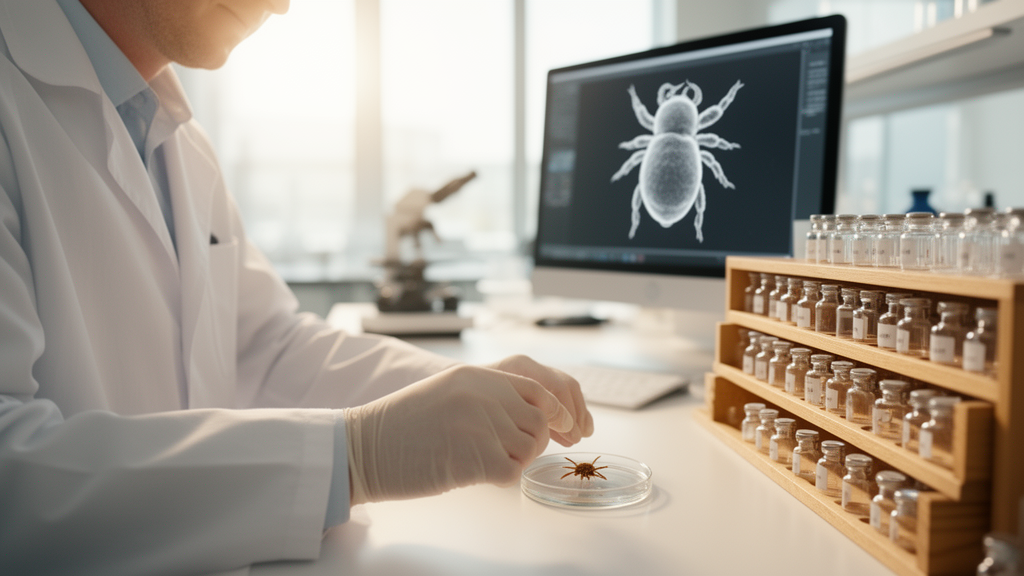
Deep in the basement of the Federal University of Minas Gerais in Belo Horizonte, one of Brazil’s most remarkable scientific repositories has just completed a quiet digital revolution. The UFMG Acarological Collection, home to more than 16,000 catalogued mite specimens gathered from 18 countries and nearly every Brazilian state, has been transformed from a set of messy spreadsheets into a fully standardised, openly published dataset now accessible through the Global Biodiversity Information Facility and the Brazilian Biodiversity Information System. The effort, documented in a new study in Natural History Collections and Museomics, offers a blueprint that any underfunded regional collection could follow to bring its hidden treasures to the world.
Mites may lack the glamour of jaguars or orchids, but they are among the most abundant and ecologically important animals on Earth, thriving in soil, leaf litter, freshwater, the deep sea and even on the bodies of other animals. The UFMG-AC collection captures this extraordinary diversity. Formally established in 2012 around the private collection of Professor Almir Pepato, it has grown to include mounted slide specimens, alcohol-preserved material and even fossils, alongside 14 holotypes and 316 paratypes that anchor formal species descriptions. The collection also houses 3,711 voucher specimens linked to molecular studies, and more than 1,500 DNA sequences derived from its holdings have been deposited in international genetic databases such as GenBank and BOLD.
Its geographic reach is astonishing for a young regional collection. Roughly 90 percent of specimens come from Brazil, with Minas Gerais alone accounting for nearly 77 percent of national records, but the remainder spans continents, from Russia, Spain and Australia to New Zealand, Chile and the United States. Some specimens were collected near hydrothermal vents in the Indian Ocean; others come from Antarctica. The holdings span parasitic, marine, aquatic and cave-dwelling mites across six orders of the subclass Acari, with the marine family Halacaridae predominating in line with the institution’s research focus.
Yet like many biological collections worldwide, UFMG-AC faced a problem that has nothing to do with the specimens themselves. Over more than a decade, cataloguing data accumulated in yearly spreadsheets on a shared cloud drive, edited by many hands. The result was a familiar litany of informatics headaches: misspelled locality names, dates written in five different formats within the same file, geographic coordinates expressed in incompatible reference systems, and entries such as a Baltic Sea locality filed under the wrong column for municipality. Left uncorrected, such errors would render the data unusable for automated analysis and barred from integration with global biodiversity platforms.
The solution combined old-fashioned manual curation with modern automation. Researchers first conducted a painstaking review of every spreadsheet, correcting typographical errors, unifying column headers and converting all dates and coordinates into consistent formats. Then they wrote a suite of Python scripts, built on the pandas library, that automated the restructuring of the entire dataset into Darwin Core, the international standard vocabulary for sharing biodiversity data. The scripts normalised Brazilian state names, filled in missing contextual fields such as country and continent, split compound entries like sex and life stage into separate machine-readable fields, and harmonised inconsistent collector names using dictionary-based mappings.
Taxonomy posed its own traps. A mite identified only to the family Halacaridae needed a correctly ranked scientific name and a complete hierarchical classification, from kingdom Animalia down through every intermediate rank used in acarology. To solve this, the team built a validation pipeline that queries the NCBI Taxonomy database and the Taxallnomy API, retrieving unique taxon identifiers and filling gaps in the hierarchy with placeholder names when needed. The pipeline even catches subtle errors: when a query for the freshwater mite Porolohmanella violaceae risked returning data for Violaceae, the plant family, the ambiguity was flagged and logged for manual correction.
The finished dataset, comprising 89 columns with all Darwin Core-compliant fields published and auxiliary internal fields stripped out, was uploaded through the Integrated Publishing Toolkit, the standard conduit for feeding data to GBIF and SiBBr. More than 16,000 occurrence records are now available in machine-readable format under an open licence, complete with the metadata these platforms require: taxonomic and geographic scope, data licence, contacts and methodological descriptions. The system is built to keep updating automatically, with a Google Apps Script refreshing the modification timestamp whenever a record changes, ensuring the published dataset stays current as curation continues.
The analysis of the digitised records also revealed telling patterns about how a modern collection actually grows. Cataloguing has averaged a steady 1,339 new entries per year since 2012, but the timing is revealing: 2016 saw the highest number of specimens collected, while 2017 recorded the peak in catalogued items, reflecting the slow, labour-intensive processes of DNA extraction, identification and slide preparation. On average, nine years elapse between a specimen’s collection and its formal identification. Even type material, the holotypes and paratypes underpinning species descriptions, waits an average of 1.95 years between collection and cataloguing, a delay taxonomists call shelf life. This lag matters enormously in biodiversity hotspots, where undescribed species may sit unseen for years, postponing conservation assessments.
The data also exposed geographic and social biases woven into the collection’s history. Contributions from Equipe Carste, a private company providing scientific services to mining companies required to comply with Brazilian environmental law, boosted collection rates in years such as 2016 by supplying specially collected mites from caves, helping explain annual fluctuations. Proximity to the university explains the dominance of Minas Gerais records, since local fieldwork is cheaper and more frequent. The authors argue such biases must be openly acknowledged, and they call for targeted funding to support sampling in under-represented regions such as the Centre-West and parts of the North and Northeast.
Perhaps the most sobering context is Brazil’s recent loss of irreplaceable collections. The 2018 fire at the National Museum in Rio de Janeiro destroyed priceless specimens and type material, and the Instituto Butantan has also suffered devastating fires. Digitisation and open publication are, in a very real sense, insurance against catastrophe: even if physical specimens are lost, the data they embody can survive. The UFMG-AC team demonstrates that this insurance is within reach of any modestly resourced institution, using nothing more exotic than cloud spreadsheets, Python scripts and freely available publishing tools. In an era of accelerating biodiversity loss, turning the world’s drawers and jars of specimens into searchable, citable, globally shared data may be one of the most consequential acts of scientific preservation a collection can undertake.
Subject of Research: Standardisation and publication of acarological occurrence data using the Darwin Core standard at a Brazilian university collection
Article Title: From collection to sharing: Strategies for standardising and publishing occurrence data in biodiversity platforms in the UFMG-AC Acarological Collection
Article References: Assis-Silva, M. H., Góes-Neto, A., & Pepato, A. R. (2026). From collection to sharing: Strategies for standardising and publishing occurrence data in biodiversity platforms in the UFMG-AC Acarological Collection. Natural History Collections and Museomics, 3, Article e195668. https://doi.org/10.3897/nhcm.3.195668
Image Credits: AI Generated
Keywords: biodiversity informatics, Darwin Core, GBIF, SiBBr, acarology, mite collection, natural history collections, digitisation, taxonomic validation, Python automation, open science, Brazil
Cite Scienmag News
Albert Anderson. (October 15, 2026). Brazil’s Mighty Mite Collection Goes Digital, Sharing 16,000 Specimens with the World. Scienmag. https://scienmag.com/brazils-mighty-mite-collection-goes-digital-sharing-16000-specimens-with-the-world/
Albert Anderson. "Brazil’s Mighty Mite Collection Goes Digital, Sharing 16,000 Specimens with the World." Scienmag, 15 October 2026, https://scienmag.com/brazils-mighty-mite-collection-goes-digital-sharing-16000-specimens-with-the-world/. Accessed 15 October 2026.
Albert Anderson. "Brazil’s Mighty Mite Collection Goes Digital, Sharing 16,000 Specimens with the World." Scienmag. October 15, 2026. https://scienmag.com/brazils-mighty-mite-collection-goes-digital-sharing-16000-specimens-with-the-world/


