


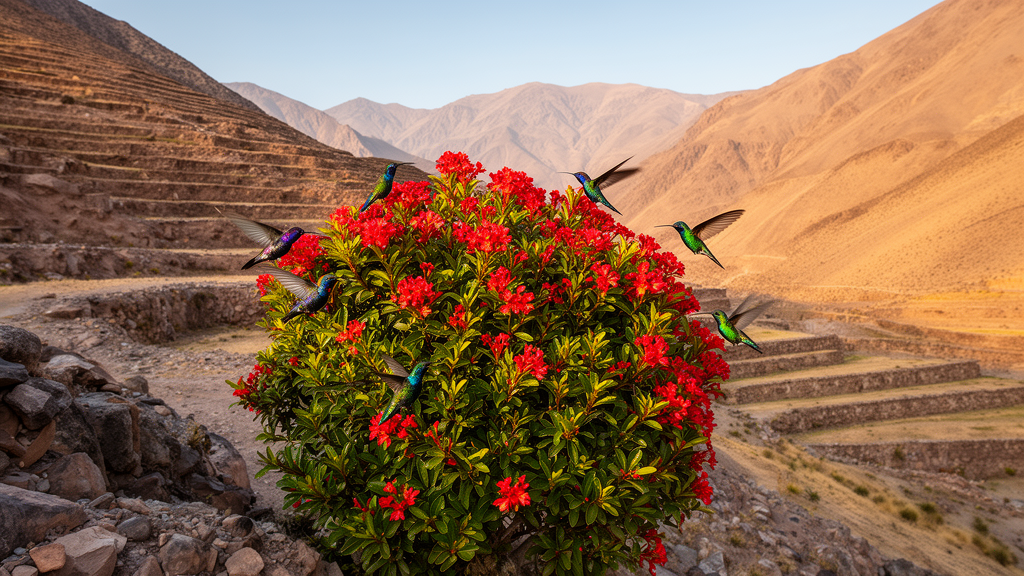
In an arid inter-Andean valley of southern Peru, a six-month field study has captured one of the most detailed portraits yet of how hummingbirds and flowering plants organize their relationships through time in a harsh, seasonal landscape. The research, conducted in the Sogay-Quequeña valley near Arequipa at roughly 2,500 to 3,000 meters above sea level, documented 349 interactions between four hummingbird species and 19 plant species, and revealed a feeding network whose structure shifted markedly from month to month even as a single shrub species anchored nearly half of all nectar visits.
The findings, published in Neotropical Biology and Conservation, are significant because arid valleys wedged between Andean ridges remain among the most poorly documented pollination systems in the Neotropics. These landscapes experience strongly seasonal rainfall concentrated between December and March, and the flowering that follows the wet season creates a brief, spatially concentrated window of floral abundance. Understanding which species carry the weight of pollination interactions during this window matters for conservation, because the loss of ecological interactions can degrade ecosystem function even before any species goes locally extinct.
Between March and August 2025, researchers completed 24 weekly surveys along a fixed transect of approximately three kilometers, accumulating about 120 observation hours. Each survey ran from 06:00 to 11:00, the interval when hummingbird foraging activity peaks. Using 10 x 42 binoculars and a superzoom camera, observers recorded every feeding event, perching event, and competitive encounter, noting the species involved, foraging strategy, interaction height, and effective feeding time. Feeding was defined as any event in which a hummingbird inserted its bill into a flower or accessed nectar directly.
The quantitative feeding network comprised 10 plant species, four hummingbird species, and 21 observed links out of 40 possible pairings. Network connectance reached 0.525, meaning more than half of all possible interactions among the species present were actually recorded, a sign of considerable floral resource sharing. Complementary specialization, measured with the H2′ index, came in at an intermediate 0.550, while modularity of Q = 0.386 suggested some internal organization into subsets of more strongly interacting species. Presence-absence nestedness was relatively high at NODF = 65.23, although weighted nestedness dropped when interaction frequencies were considered, indicating that nested organization was more evident in which interactions occurred than in how often they happened.
What stands out most is how unevenly visits were distributed. Tecoma fulva, a shrub with tubular orange flowers, absorbed 47.5 percent of all feeding records. Ligaria cuneifolia, a mistletoe-like hemiparasite, took 25.1 percent, and Nicotiana glauca, the tree tobacco, contributed 10.3 percent. Together these three species accounted for 83 percent of all nectar visits, while each remaining floral resource drew less than 7 percent. At the hummingbird level, the Peruvian sheartail Rhodopis vesper was the most frequent visitor, followed by the giant hummingbird Patagona gigas, the Peruvian piedtail Thaumastura cora, and the sparkling violetear Colibri coruscans. The three most frequent pairings, including the Tecoma fulva-Rhodopis vesper link at 25.1 percent of all records, jointly made up 63.2 percent of feeding activity.
Dependence analysis exposed striking asymmetries within these dominant interactions. Rhodopis vesper directed 73.7 percent of its visits to Tecoma fulva, while the plant received visits from multiple hummingbird species, producing a negative asymmetry value of -0.209 that indicates the bird depends more heavily on the plant than the plant does on the bird. The giant hummingbird showed even stronger reliance, with 76.3 percent of its visits aimed at Tecoma fulva and an asymmetry of -0.338. In contrast, the Ligaria cuneifolia-Thaumastura cora pairing was nearly balanced, with asymmetry close to zero. Rarely visited plants such as Tarasa capitata, Nicotiana paniculata, Mutisia acuminata, Cantua volcanica, and Tropaeolum tuberosum showed complete dependence on a single recorded visitor, though these may represent exploratory resource use rather than established mutualisms.
Centrality metrics, combining degree, species strength, betweenness, and closeness into a composite index, confirmed the structural roles suggested by raw visit counts. Rhodopis vesper scored highest among hummingbirds with a composite centrality of 1.184, reflecting its eight floral partners, high interaction frequency, and important position connecting different network sectors. Among plants, Tecoma fulva dominated with a composite index of 1.748, followed by Nicotiana glauca at 0.926 and Ligaria cuneifolia at 0.748. These species appear to contribute disproportionately to network connectivity, meaning their persistence may be critical for maintaining the interaction web in the valley.
Temporal dynamics proved equally revealing. Feeding records climbed from 17 in March to peaks of 68 in May and 82 in June, then collapsed to 17 in July and just seven in August. Unique interactions followed the same trajectory, rising from four in March to twelve in May before falling to three in August. Monthly network comparison using Bray-Curtis dissimilarity showed May and June were the most similar months, with a temporal similarity of 0.733, while August was the most differentiated, showing almost no resemblance to any other month. The identity of central species also rotated: Thaumastura cora led in March, Rhodopis vesper in April, Colibri coruscans in May, and Rhodopis vesper again from June onward. Tecoma fulva held the central plant role consistently from April through July before yielding to Nicotiana glauca in August.
Perhaps the most counterintuitive result concerns floral traits. Eight of the ten plants in the feeding network were classified as ornithophilous, bearing the tubular flowers, conspicuous colors, and accessible nectar classically associated with bird pollination. Yet neither nectar sugar concentration, measured in degrees Brix with a portable refractometer, nor floral length showed a significant association with visitation frequency. The Spearman correlation between nectar concentration and visits was essentially zero (rho = 0.018, p = 0.969), and exploratory count models found that the null model outperformed all trait-based alternatives. Tecoma fulva was the most visited resource despite not having the highest nectar concentration, while Nicotiana paniculata showed high sugar values but few visits. This aligns with recent evidence that nectar traits do not necessarily predict interaction frequency, and suggests that factors such as flower abundance, phenological overlap, and plant architecture likely govern resource use in this system.
The study also documented that plants serve functions far beyond nectar. Of the 349 records, 36.1 percent were perching events, with Schinus molle, the Peruvian peppertree, absorbing 43.7 percent of perch use despite playing almost no role in the feeding network. Tecoma fulva fulfilled a dual role as both the most visited floral resource and the second most used perch, hosting feeding, resting, vigilance, and territorial defense near its flowers. Twenty-one competitive events, including chases and displacements, clustered around the most visited plants, and even a nectar-robbing event by the cinereous conebill Conirostrum cinereum was recorded. For conservation in arid Andean landscapes, the message is clear: preserving heterogeneous vegetation matters not only for the flowers that feed hummingbirds but for the branches that structure their daily lives, and maintaining a small set of key plant species may buffer these interaction networks through the seasonal swings that define life between the Andes.
Subject of Research: Ecology
Article Title: Temporal dynamics and central species in a plant-hummingbird interaction network in an inter-Andean valley in the southern Peruvian Andes
Article References: Quispe-Puma, M. A., & Luque-Fernández, C. R. (2026). Temporal dynamics and central species in a plant-hummingbird interaction network in an inter-Andean valley in the southern Peruvian Andes. Neotropical Biology and Conservation, 21(3), 271-296. https://doi.org/10.3897/neotropical.21.e202837
Image Credits: AI Generated
DOI: 10.3897/neotropical.21.e202837
Keywords: hummingbirds, pollination, ecological networks, Peru, Andes, mutualism, seasonality, conservation, Temporal, dynamics, central, species
Cite Scienmag News
Drew Townsend. (October 15, 2026). Arid Andean Valley Reveals Shifting Hummingbird Network Built Around One Shrub. Scienmag. https://scienmag.com/arid-andean-valley-reveals-shifting-hummingbird-network-built-around-one-shrub/
Drew Townsend. "Arid Andean Valley Reveals Shifting Hummingbird Network Built Around One Shrub." Scienmag, 15 October 2026, https://scienmag.com/arid-andean-valley-reveals-shifting-hummingbird-network-built-around-one-shrub/. Accessed 15 October 2026.
Drew Townsend. "Arid Andean Valley Reveals Shifting Hummingbird Network Built Around One Shrub." Scienmag. October 15, 2026. https://scienmag.com/arid-andean-valley-reveals-shifting-hummingbird-network-built-around-one-shrub/


