


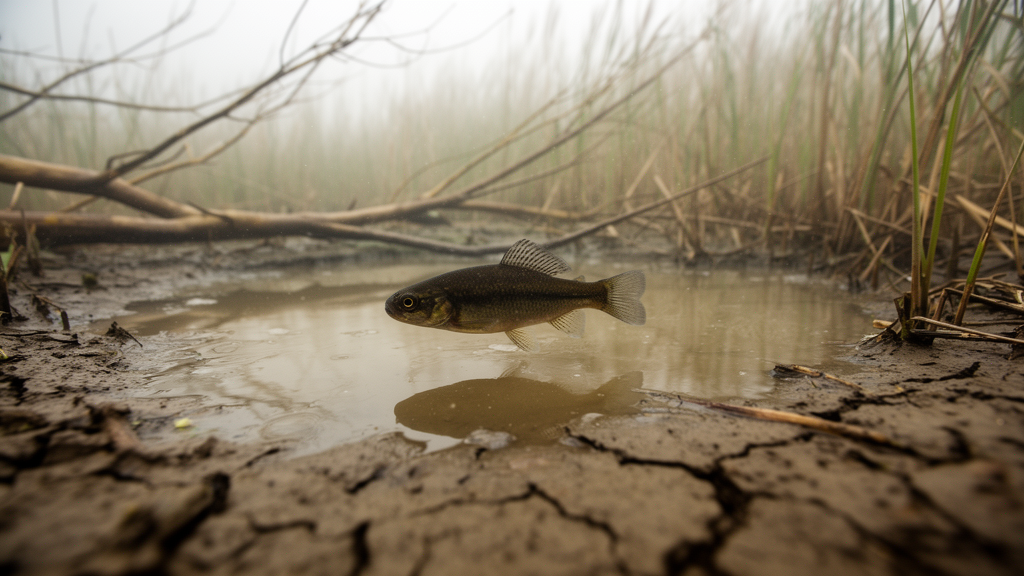
Thirty years after the first international workshop on the European mudminnow, a sweeping new review published in Nature Conservation delivers a sobering verdict on one of Central Europe’s rarest freshwater fish. The species, Umbra krameri, a small relict fish endemic to the lowlands of the Danube catchment and the lower Dniester basin, has been tracked intensively since the landmark 1995 monograph. The update synthesizes three decades of research on the fish’s biology, distribution, genetics, ecology, and conservation, incorporating findings presented at the second international workshop in 2025. The picture that emerges is one of substantial scientific progress running parallel to an increasingly alarming conservation trajectory, with the authors arguing that the species’ IUCN Red List status should be reassessed and upgraded from Vulnerable to Endangered, or possibly even Critically Endangered.
The European mudminnow is a quintessential wetland specialist. Its typical habitats are ponds and lakes at the outer margins of floodplains, so-called paleopotamon water bodies, characterized by dense vegetation, thick mud layers, shallow water depths, and difficult accessibility. These conditions make standardized fish sampling particularly challenging, especially during low-water periods. Conventional survey techniques such as electrofishing, designed to assess entire river fish communities, routinely fail to detect the species in its preferred microhabitats. As a consequence, the mudminnow is an elusive species with generally low catchability, and nonspecialists often avoid sampling such habitats or do not expect fish to occur there. The species is sometimes detected incidentally during surveys targeting other organism groups, such as amphibians, using specialized trapping methods.
This detectability problem has produced a dynamic distribution pattern across several countries, with many local populations seemingly disappearing while new populations continue to be documented. However, many of these newly recorded occurrences likely represent previously overlooked remnant populations rather than genuine range expansions. Despite the uncertainty associated with detectability, the overall distribution pattern of U. krameri clearly reflects a large-scale process of range contraction and habitat fragmentation across most of its native range. The persistence of the species increasingly depends on isolated wetland fragments, drainage canals, small marshes, and artificial refuge habitats, whereas formerly connected floodplain systems have undergone extensive hydromorphological degradation. Across the species’ range, hydrological alteration, desiccation, and habitat fragmentation emerge as the most consistent drivers of decline, frequently acting together with pressures from invasive species.
Country-by-country accounts reveal the severity of the contraction. In Austria, only two native populations remain: one in the Danube floodplain between Vienna and Bratislava, known as the Fadenbach population, and one southeast of Vienna in the Jesuitenbach near the village of Moosbrunn. A third population established at the Austrian-Hungarian border east of Lake Neusiedl during a conservation project persisted for approximately 15 years but was no longer detectable during recent monitoring in 2023. In Slovakia, the species disappeared from eastern Slovakia because of droughts and the invasion of the Amur sleeper, with the last record reported in 2010. In Hungary, the mudminnow now persists at only approximately one-third of its historically recorded localities over the past five decades. In Serbia, all 10 historically known populations recorded since 1860 had disappeared by 1995, with three new native populations since reported. In Romania, most previously known populations in the northwest have disappeared, primarily because of drainage activities and, more recently, severe droughts during the last five years, which in several cases led to the complete desiccation of suitable habitats.
Meanwhile, the species’ range has expanded in the literature to include Bulgaria, where it was rediscovered in 2004 in Srebarna Lake, representing the first record there since 1923, and Bosnia and Herzegovina, where two new native populations were identified in the Sava River system in 2008 and 2016. Some reports mention introductions into Germany, Czechia, and Poland; however, at least in Poland, it remains unclear whether these stockings involved U. krameri or the North American eastern mudminnow, U. pygmaea, which was introduced into other parts of Europe such as Denmark, northwestern Germany, the Netherlands, and Belgium. At present, there is no confirmed overlap between the distributions of the two species in Europe.
Recent phylogeographic and population genetic studies have fundamentally improved understanding of the species by revealing pronounced drainage-based structuring, limited contemporary gene flow, and the existence of distinct evolutionarily significant units, or ESUs, corresponding to the Danube, Sava, and Tisza drainages. Their divergence was likely driven by Pleistocene glacial cycles and tectonic processes that reshaped central and southeastern European river systems. Mitochondrial analyses identified these three major evolutionary lineages, whose strict geographic segregation mirrors present-day drainage boundaries. Microsatellite analyses further corroborate strong population genetic structuring, with populations often highly differentiated even across short geographic distances, reflecting limited dispersal capacity and strict habitat specialization. Notably, despite severe habitat loss over the past century, many populations still retain appreciable neutral genetic diversity, with the highest allelic richness and heterozygosity found in the Danube and Dniester deltas, whereas upstream sections tend to harbor reduced diversity.
Bayesian clustering of microsatellite data from 33 Hungarian stocks revealed a clear separation of populations and minimal recent admixture, supporting long-term isolation. An estimate of effective migration suggested very low contemporary gene flow, indicating that populations function largely as independent demographic units. These results demonstrate that natural migration is severely constrained by habitat fragmentation and hydrological disconnection and that recolonization potential is extremely limited without the restoration of connectivity. Historical hydrological connectivity has shaped present-day patterns of variation: populations situated within the former floodplain of the Tisza tended to exhibit weaker differentiation from one another than populations located outside this historically connected area, supporting the interpretation that past floodplain dynamics facilitated gene flow, whereas subsequent river regulation and habitat alteration intensified isolation.
The development of genomic resources has created entirely new opportunities for monitoring and conservation. In 2025, a high-quality chromosome-level reference genome for U. krameri was made publicly available through the European Reference Genome Atlas within the Biodiversity Genomics Europe project. The complete mitogenome has also been assembled and annotated, forming the basis for environmental DNA primer development. Recent molecular approaches, particularly eDNA analysis, hold considerable promise for improving the detection and monitoring of mudminnow populations. The collection of DNA fragments from water samples, followed by quantitative PCR or digital droplet PCR analysis, enables highly sensitive detection of rare and elusive species that are difficult to sample using conventional approaches. Similar workflows have already proven effective for other cryptic wetland fishes, including the weatherfish.
Ecological studies conducted during the last three decades consistently indicate that U. krameri is strongly associated with shallow, densely vegetated, hydrologically stable wetland habitats characterized by low competition pressure and structurally complex littoral zones. The species exhibits limited dispersal capacity, low contemporary gene flow, and a strong dependence on habitat connectivity, making populations highly vulnerable to fragmentation and drought. Quantitative examinations of feeding ecology indicate that benthic prey items dominate both in frequency and biomass, reflecting bottom-oriented foraging, with seasonal variation in diet composition following prey availability and water-level dynamics. Growth studies characterize the species as slow-growing and small-bodied, with an asymptotic length of approximately 86 millimeters and a theoretical maximum body mass of approximately 17 grams in Hungarian wetland populations. Population dynamics studies highlight the pronounced temporal instability of many populations, with considerable fluctuations in abundance, recruitment success, and spatial distribution documented even within relatively small habitat systems, often in close association with hydrological conditions, drought periods, and habitat management interventions.
Conservation breeding and translocation programs have been initiated in several countries across the species’ range, with particularly promising results in habitats where long-term water supplies and habitat stability could be maintained. In Hungary, more than 8,700 individuals from five mudminnow populations have been produced at various life stages and reintroduced into original and surrogate habitats in the Szada Pilot Area, with two of the six stocked ponds establishing self-sustaining populations. In Slovakia, rescued juveniles were stocked at several sites where the species had not previously been recorded, and a highly successful population was established at the Zelienka site. In Serbia, approximately 1.3 kilometers of canal was mechanically dredged to prolong water retention during the summer and autumn, with the removal of thick silt deposits leading to groundwater penetration and refilling of the habitat. However, many projects also highlighted the vulnerability of small, isolated populations and the limited effectiveness of short-term interventions lacking sustained hydrological management or long-term follow-up monitoring. Across much of the species’ range, climate-driven water shortages, habitat fragmentation, decreasing genetic diversity caused by isolation, and the spread of the invasive Amur sleeper increasingly interact as synergistic threats. The long-term conservation of U. krameri cannot rely solely on local translocations or isolated habitat restoration actions but requires landscape-scale hydrological management, maintenance of wetland connectivity, suppression of invasive species, comprehensive habitat assessment, and coordinated long-term conservation strategies integrating both in situ and ex situ approaches. Given the highly fragmented distribution of the species and the transboundary nature of many floodplain systems, effective long-term conservation will also depend on coordinated international cooperation across the entire native range.
Subject of Research: Conservation Biology
Article Title: Biology and conservation of the European mudminnow ( Umbra krameri Walbaum, 1792): an update of the monograph 30 years after the first international workshop
Article References: Wanzenböck, J., Rund, H., Jung, M., Ratschan, C., Nagy, A. A., Trombitsky, I., Moshu, A., Gubanov, V., Marić, S., Stanković, D., Sekulić, N., Donabaum, R., Koblmüller, S., Pekárik, L., Tatár, S., Müller, T., & Takács, P. (2026). Biology and conservation of the European mudminnow (Umbra krameri Walbaum, 1792): an update of the monograph 30 years after the first international workshop. Nature Conservation, 65, 197-226. https://doi.org/10.3897/natureconservation.65.193904
Image Credits: AI Generated
DOI: 10.3897/natureconservation.65.193904
Keywords: European mudminnow, Umbra krameri, IUCN Red List, wetland conservation, phylogeography, environmental DNA, Amur sleeper, habitat fragmentation, Biology, conservation, European, mudminnow
Cite Scienmag News
Margaret Porter. (October 15, 2026). European Mudminnow Slides Toward Extinction as Wetlands Collapse Across the Danube Basin. Scienmag. https://scienmag.com/european-mudminnow-slides-toward-extinction-as-wetlands-collapse-across-the-danube-basin/
Margaret Porter. "European Mudminnow Slides Toward Extinction as Wetlands Collapse Across the Danube Basin." Scienmag, 15 October 2026, https://scienmag.com/european-mudminnow-slides-toward-extinction-as-wetlands-collapse-across-the-danube-basin/. Accessed 15 October 2026.
Margaret Porter. "European Mudminnow Slides Toward Extinction as Wetlands Collapse Across the Danube Basin." Scienmag. October 15, 2026. https://scienmag.com/european-mudminnow-slides-toward-extinction-as-wetlands-collapse-across-the-danube-basin/


