


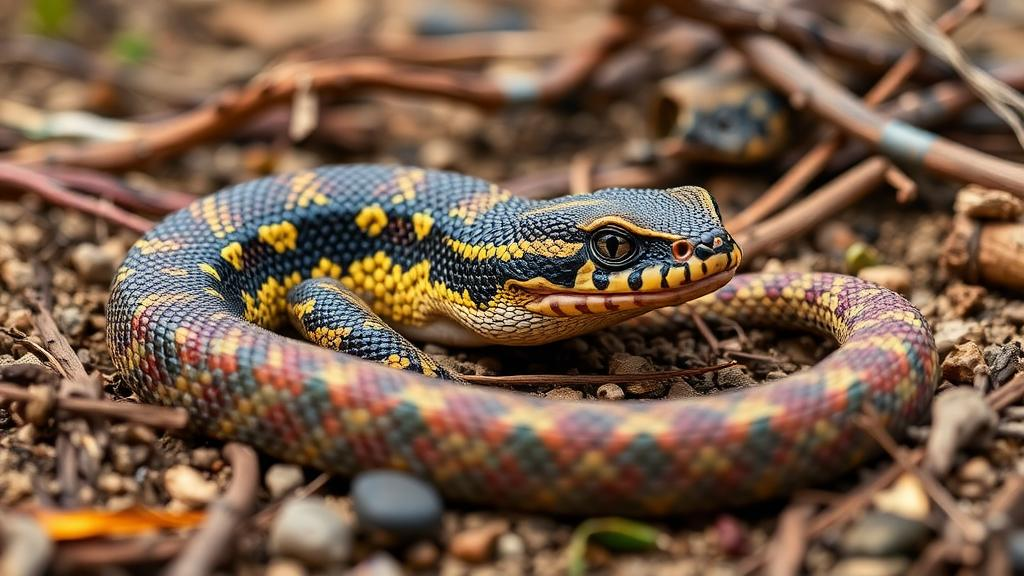
In the sun-baked hills of southeastern Bulgaria, where the Sakar Mountains and Dervent Heights roll toward the borders with Turkey and Greece, scientists have completed the most detailed census ever attempted of the region’s amphibians and reptiles. The results, published in the journal Herpetozoa, paint a vivid picture of a landscape teeming with snakes, lizards, turtles and frogs, and simultaneously reveal the mounting human pressures that could unravel this ecological wealth. Drawing on more than ten thousand georeferenced observations collected over two decades, the study confirms that this modest corner of Europe harbors roughly half of Bulgaria’s entire herpetofaunal diversity, while documenting the first fire salamander ever recorded there and exposing a grim toll of roadkill, wildfire and habitat destruction.
The research team compiled 10,649 records gathered between 2003 and 2025, the vast majority from SmartBirds, Bulgaria’s largest repository of biological field observations, supplemented by 150 records from the Global Biodiversity Information Facility. The observations span four adjacent Special Areas of Conservation within the European Union’s Natura 2000 network: Sakar, the Tundzha River gorge, and the two Derventski vazvishenia sites, which together cover approximately 2,337 square kilometers. Unlike earlier national-scale mapping efforts that plotted species presence on coarse 10-kilometer grids, the new analysis mapped every record onto a fine 2-kilometer grid, revealing for the first time exactly where these cold-blooded animals live and which corners of the landscape matter most for their survival.
The tally came to 34 taxa: ten amphibians, including three salamander and newt species and seven frogs, and twenty-four reptiles, comprising four turtle species, nine lizards and eleven snakes. Records fell within 91 percent of the 10-kilometer grid cells and 60 percent of the 2-kilometer cells encompassing the study area. Relative to Bulgaria’s native herpetofauna, the region supports every turtle species in the country, about 56 percent of its lizards and 64 percent of its snakes. Among the standout figures, Hermann’s tortoise was documented in 205 of the 432 occupied 2-kilometer cells, the Balkan wall lizard in 193, and the green lizard in 186, confirming that these low-elevation hills are among the most important herpetological strongholds in the country.
Perhaps the most exciting single discovery was a fire salamander, Salamandra salamandra, found as five larvae in a man-made stone-walled spring near Dripchevo Village in May 2021. The species had been predicted for the region but never confirmed, and its scarcity is unsurprising: the area’s hot, dry summers and mild winters, classified predominantly as humid subtropical in the Köppen-Geiger system, offer little of the cool, moist forest habitat that fire salamanders prefer. The study also confirmed four other species that had been predicted but never documented there, including the yellow-bellied toad, the slow worm Anguis colchica, the meadow lizard and the smooth snake, each represented by only a handful of records. The easternmost known Bulgarian locality of the snake Platyceps najadum, near Golyam Dervent Village, further underscores the region’s biogeographic significance.
Not every species revealed itself easily. Eight taxa were entirely absent from the opportunistic citizen-science data downloaded from GBIF yet were detected by targeted expert surveys, and these secretive animals ranked among the ten least frequently recorded in the dataset. The javelin sand boa, the worm snake and the Balkan spadefoot toad are fossorial or crepuscular, spending their lives underground or under cover, while species like the meadow lizard appear genuinely rare in a landscape that lacks the cooler, more humid deciduous forests found closer to the Strandzha Mountains. The authors conclude that citizen-science platforms, though invaluable for gathering records from private land and inaccessible sites, cannot substitute for systematic expert surveys when the quarry is cryptic amphibians and reptiles.
To understand which habitats sustain this diversity, the researchers applied coverage-standardized Hill numbers, a modern statistical framework that measures taxon richness, Shannon diversity and Simpson diversity on a common scale, and used non-metric multidimensional scaling to compare reptile communities across twelve habitat categories. The verdict was unambiguous: structurally complex, transitional habitats are the engines of reptile diversity. Ecotones between forest and grassland, shrub-encroached meadows, and microhabitats such as stone walls, rock piles and scattered bushes all supported high richness and relatively even communities. Rocky habitats retained high diversity as well, while grasslands and forests showed stronger dominance by a few habitat specialists, notably the Balkan wall lizard in open grasslands and Hermann’s tortoise in woodlands. Farmlands and human settlements consistently scored lowest across all diversity measures.
That finding carries a warning, because the very habitats that reptiles depend on are disappearing. Shrub-filled meadows have been under intense anthropogenic pressure for the past twenty years, destroyed by poorly managed agri-environmental practices, large-scale mechanical clearing with shredders and mulchers, and the conversion of permanent grasslands into arable fields. The study’s fire analysis makes the scale of the problem stark. Between 2016 and 2025, the European Forest Fire Information System recorded 73 fire events affecting areas equivalent to up to 17.2 percent of the study area, and activity accelerated dramatically in recent years: 52 of those fires, 71 percent of the total, occurred between 2022 and 2025, with 2024 alone burning an area equal to 7.2 percent of the region. A key driver is the intentional burning of shrubs to maintain open grasslands, a practice that kills animals outright and strips survivors of shelter, basking sites and refugia from predators.
Roads emerged as the other lethal threat, and the numbers are sobering. Of the 10,499 SmartBirds observations, 3.7 percent were of road-killed animals, representing 19 of the 34 recorded taxa. Large, active snakes fared worst: 46.2 percent of all records of the eastern montpellier snake were of dead individuals, as were 27.4 percent of records of the Caspian whip snake, with 102 road-killed specimens documented. These snakes bask on warm asphalt, forage in open habitats by day and grow to impressive sizes, all traits that put them in the path of vehicles. The single most affected species overall was the scheltopusik, or legless lizard, Bulgaria’s largest lizard at up to 1.4 meters long, with 154 roadkill records amounting to 22.4 percent of all observations of the species. Its limbless body and smooth scales make crossing asphalt slow and perilous, a fatal disadvantage compared with its small, agile relatives.
The spatial analysis also identified the region’s crown jewels for conservation. The 45 grid cells containing more than 47 records each, just 6.3 percent of all cells, likely mark hotspots of local abundance, and the authors single out the vicinity of Levka Village and the Levchenska River, the limestone hills near Topolovgrad, the Tundzha River gorge near Srem, Ustrem and Lesovo, and the areas around Momina Tsarkva and Golyam Dervent as key herpetological localities. Twenty-four taxa, more than two-thirds of those recorded, occurred across all four protected areas, suggesting the Natura 2000 network collectively has real potential to safeguard regional diversity, provided that proper conservation-oriented management plans are developed and implemented in time.
The authors are careful to acknowledge the biases inherent in their dataset: survey effort was uneven, concentrated near roads and in sites expected to be biodiverse, and further sampling will almost certainly refine the maps. They also note that invasive freshwater turtles, increasingly released by pet owners as the red-eared slider falls out of favor under EU rules, were not recorded but could appear and should be monitored. The core message, however, is clear and urgent. The Sakar Mountains and Dervent Heights are a national treasure of reptile and amphibian diversity, and their survival hinges on retaining shrub patches, scattered trees and stone structures within grassland landscapes, halting broad-scale mechanical clearance and burning, and taming the road mortality that is quietly erasing some of Europe’s largest and most charismatic reptiles from one of its least-known biodiversity hotspots.
Subject of Research: Distribution, diversity and conservation threats of amphibians and reptiles in the Sakar Mountains and Dervent Heights, southeastern Bulgaria
Article Title: Reptiles and amphibians in Sakar Mountains and Dervent Heights, SE Bulgaria: distribution, diversity, and threats
Article References: Popgeorgiev, G. S., Plachiyski, D., Nedyalkov, N., & Kornilev, Y. V. (2026). Reptiles and amphibians in Sakar Mountains and Dervent Heights, SE Bulgaria: distribution, diversity, and threats. Herpetozoa, 39, 401-418. https://doi.org/10.3897/herpetozoa.39.e206655
Image Credits: AI Generated
DOI: 10.3897/herpetozoa.39.e206655
Keywords: herpetofauna, Bulgaria, Sakar Mountains, Dervent Heights, Natura 2000, road mortality, wildfires, habitat loss, citizen science, reptile conservation, amphibians, biodiversity
Cite Scienmag News
Margaret Porter. (October 15, 2026). Roads, Fires and Bulldozers Threaten One of Bulgaria’s Richest Reptile Hotspots. Scienmag. https://scienmag.com/roads-fires-and-bulldozers-threaten-one-of-bulgarias-richest-reptile-hotspots/
Margaret Porter. "Roads, Fires and Bulldozers Threaten One of Bulgaria’s Richest Reptile Hotspots." Scienmag, 15 October 2026, https://scienmag.com/roads-fires-and-bulldozers-threaten-one-of-bulgarias-richest-reptile-hotspots/. Accessed 15 October 2026.
Margaret Porter. "Roads, Fires and Bulldozers Threaten One of Bulgaria’s Richest Reptile Hotspots." Scienmag. October 15, 2026. https://scienmag.com/roads-fires-and-bulldozers-threaten-one-of-bulgarias-richest-reptile-hotspots/


