


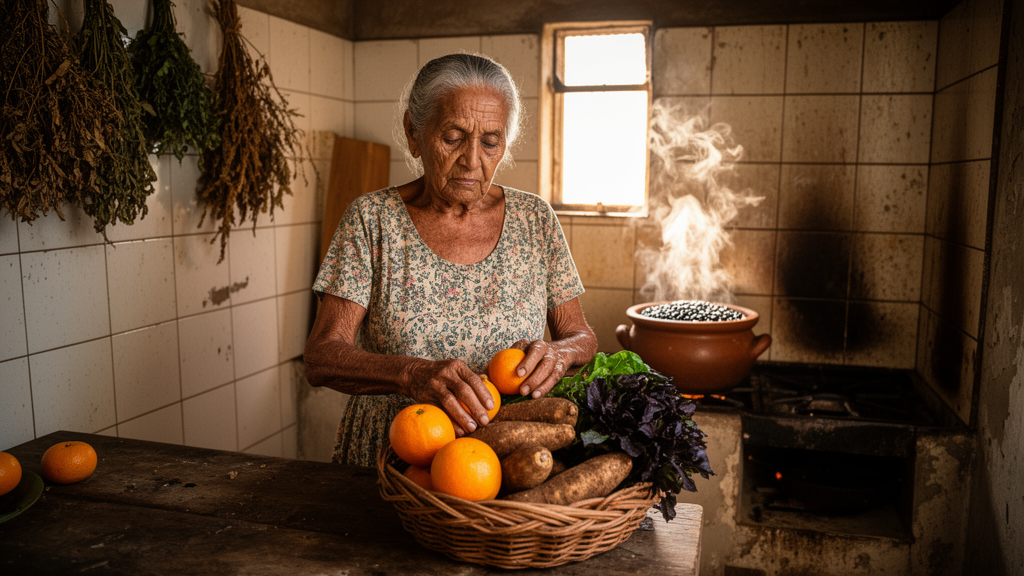
In a small urban community in Northeastern Brazil, where economic precarity shapes daily life and essential services remain out of reach for many residents, a team of Brazilian and Norwegian researchers has uncovered something striking about the way older adults relate to food. Far from being passive recipients of dietary advice, the older people they interviewed treat their traditional food practices as acts of identity, care, and quiet defiance. The study, published in the International Journal for Equity in Health, introduces a new concept the authors call Symbolic Food Resistance, and it challenges the dominant biomedical view that later-life nutrition is simply a matter of following clinical prescriptions.
The research, led by Thiago Medeiros da Costa Daniele of the Postgraduate Program in Public Health at the University of Fortaleza and the University of Stavanger in Norway, together with Maria Emanuela Albuquerque da Silva, Juliana Braga Rodrigues de Castro, and Mirna Albuquerque Frota, set out to explore a dimension of aging that is routinely overlooked. Population aging is transforming health and social care systems across the globe, and nutrition in later life is usually framed through prescriptive lenses: nutrient targets, dietary restrictions, and risk reduction. What remains underexplored, the authors argue, is the affective, cultural, and symbolic weight that food carries, particularly for older adults living in socioeconomically marginalized communities of the Global South.
To capture those meanings, the team conducted a qualitative study in an urban community in Northeastern Brazil marked by structural inequalities, economic precarity, and limited access to essential services. They carried out semi-structured interviews with twenty older adults and complemented the interviews with contextual field observations recorded during home visits. The analytical strategy was deliberately layered, combining thematic analysis, discourse analysis, and grounded theory principles, while the field observations served to situate participants’ narratives within the material realities of their homes and neighborhoods. The study received ethical approval from the Research Ethics Committee of the University of Fortaleza under protocol number 6.704.029, conducted in accordance with Brazilian National Health Council Resolution 466/2012 and the Declaration of Helsinki, with all participants providing written informed consent.
From the analysis, three interlocking dimensions of Symbolic Food Resistance emerged. The first the researchers label food, memory, and affective identity. In this dimension, preparing and sharing traditional dishes operates as a repository of personal and collective history. Recipes handed down through families become anchors of selfhood, and the act of cooking familiar foods allows older adults to maintain continuity with who they have been across their lives. Food here is not fuel; it is biography. When an older person insists on preparing a dish the way their mother did, they are performing an act of remembrance that sustains an affective identity in the face of losses that aging brings.
The second dimension, navigating medicalization and food norms, is where the resistance becomes most explicit. Older adults in the study described encountering medical and nutritional advice that framed their eating habits as problems to be corrected. Rather than simply complying, many participants negotiated with, adapted, or quietly pushed back against these norms. They weighed clinical recommendations against the meanings their foods carried, and often chose to preserve traditional practices even when those practices conflicted with prescriptive dietary guidance. The authors interpret this not as ignorance or noncompliance, but as a reasoned defense of autonomy: the right to decide what one eats is bound up with the right to decide who one is.
The third dimension, precarity, loss, and cultural transmission, reveals the structural backdrop against which these food practices unfold. Living with economic insecurity and limited access to services, participants experienced food not only as pleasure and identity but as a site of anxiety and grief. The study suggests that as older adults face the weakening of cultural transmission, the risk that recipes, techniques, and food knowledge will not be passed to younger generations, they cling to traditional practices as a form of cultural continuity. In this light, cooking traditional food becomes resilience in action, a way of holding a community’s heritage together even as material conditions erode.
Taken together, the findings reframe what might look from a clinical standpoint like stubborn dietary habits. The researchers argue that food practices among these older adults function as forms of cultural continuity, autonomy, and resilience. Symbolic Food Resistance, as they define it, captures how sustaining traditional food practices expresses care for oneself and others, affirms identity, and resists both the medicalization of everyday life and the erosion of cultural transmission. This is resistance in a symbolic register: not protest in the streets, but the daily insistence that a cherished way of eating, and the world of memory and relationship it embodies, still matters.
The study’s implications reach well beyond one community in Northeastern Brazil. By foregrounding the symbolic, affective, and cultural meanings of food, the authors highlight the limitations of exclusively biomedical approaches to aging. Health services that treat older adults’ diets purely as sets of nutrients and risk factors risk alienating the very people they aim to help, because they miss the reasons those diets matter. The researchers argue that their findings offer critical insights for developing culturally grounded health services, community-based care models, and inclusive food and aging policies, particularly in vulnerable contexts where standard prescriptive nutrition programs may collide with deeply held practices and identities.
There is also an equity dimension that the journal’s readership will recognize immediately. The study appears in the International Journal for Equity in Health, and its setting is deliberate: communities of the Global South that bear the brunt of structural inequality are rarely the source of theory about aging and food, more often the object of interventions designed elsewhere. By generating a concept from the narratives of twenty older residents of the Dendê Community, whom the authors thank for sharing their time, experiences, and narratives, the research inverts that usual direction of travel. It suggests that the people most affected by food insecurity and medical paternalism also possess sophisticated frameworks for understanding what food means, frameworks that policy should engage rather than override.
The research received no specific grant from any funding agency in the public, commercial, or not-for-profit sectors, and was supported by the Edson Queiroz Foundation and the University of Fortaleza. The authors note that generative artificial intelligence tools were used solely for language editing and textual organization, not for data collection, coding, analysis, or interpretation, and that they take full responsibility for the manuscript’s accuracy and integrity. Published open access on 15 October 2026 under a Creative Commons Attribution 4.0 license, the study invites clinicians, policymakers, and community workers to ask a different question when they sit down with an older adult and a dietary chart: not only what should this person eat, but what does this food mean, and who would this person become if they gave it up. In the answers to that question, the researchers suggest, lies a more humane and more effective approach to feeding an aging world.
Subject of Research: Symbolic food resistance, identity, and health equity among vulnerable older adults in Northeastern Brazil
Article Title: Symbolic food resistance and aging: food, identity, and inequality in vulnerable older populations
Article References: Symbolic food resistance and aging: food, identity, and inequality in vulnerable older populations. (n.d.). https://doi.org/10.1186/s12939-026-03062-z
Image Credits: AI Generated
DOI: 10.1186/s12939-026-03062-z
Keywords: aging, food culture, symbolic resistance, health equity, cultural identity, social vulnerability, medicalization, qualitative research, Brazil, nutrition, Global South, community-based care
Cite Scienmag News
Beatrice Stafford. (October 15, 2026). Older Adults in Brazil Use Food as Quiet Resistance Against Medicalized Aging. Scienmag. https://scienmag.com/older-adults-in-brazil-use-food-as-quiet-resistance-against-medicalized-aging/
Beatrice Stafford. "Older Adults in Brazil Use Food as Quiet Resistance Against Medicalized Aging." Scienmag, 15 October 2026, https://scienmag.com/older-adults-in-brazil-use-food-as-quiet-resistance-against-medicalized-aging/. Accessed 15 October 2026.
Beatrice Stafford. "Older Adults in Brazil Use Food as Quiet Resistance Against Medicalized Aging." Scienmag. October 15, 2026. https://scienmag.com/older-adults-in-brazil-use-food-as-quiet-resistance-against-medicalized-aging/


