


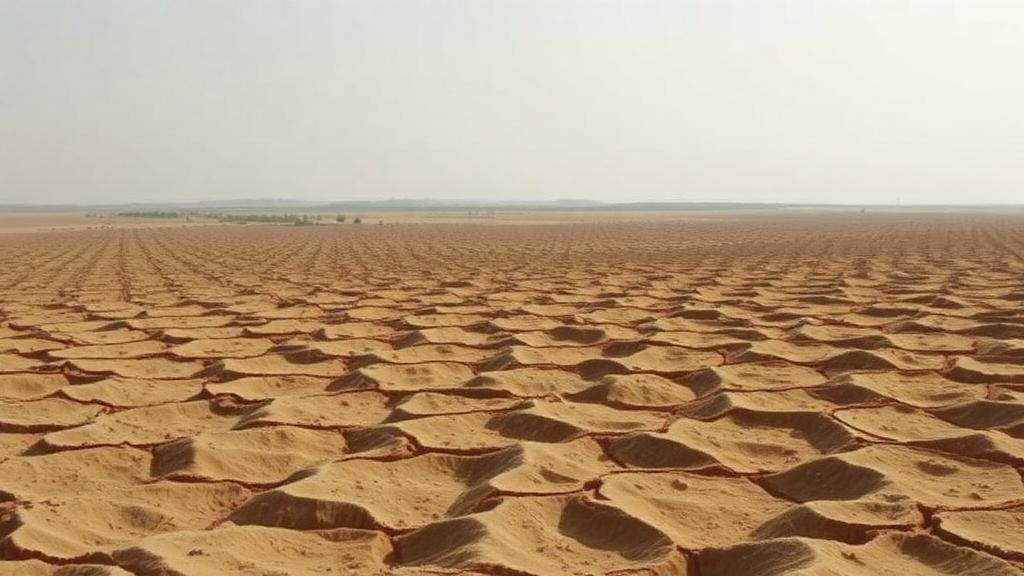
Iran is no stranger to drought, but a sweeping new analysis of more than six decades of climate data suggests the country’s dry spells have become more spatially extensive and more pronounced since the late 1990s, and that some of that variability may be traceable to slow-moving oscillations in the tropical Pacific and the North Atlantic. The study, published in Theoretical and Applied Climatology, reconstructs drought conditions across Iran from 1958 to 2022 and then asks a deceptively simple question: do the great ocean-atmosphere cycles known as teleconnections leave a statistical fingerprint on Iranian drought? The answer, according to researchers Javad Mahdizadeh, Yousef Ghavidel and Manuchehr Farajzadeh of Tarbiat Modares University in Tehran, is a qualified yes, with the strength of the fingerprint depending heavily on where in the country you look and on which timescale you examine.
The technical backbone of the study is the self-calibrating Palmer Drought Severity Index, or scPDSI, a water-balance metric that compares the precipitation a location receives against the atmospheric demand for water, known as potential evapotranspiration, while accounting for the water-holding capacity of the local soil. Rather than relying on sparse station records alone, the team fed the index with TerraClimate precipitation and potential evapotranspiration data, a high-resolution gridded dataset that blends observations with interpolated climate surfaces. Soil water-holding properties were drawn from the FAO Harmonized World Soil Database, allowing the index to reflect the fact that sandy soils in the desert interior and deeper soils in the Zagros Mountains respond very differently to the same rainfall deficit. National meteorological observations were used independently to characterize the long-term evolution of temperature and precipitation, providing a check on the gridded reconstruction.
The headline finding is temporal: drought conditions in Iran became more widespread and more severe during several periods after the late 1990s, though with substantial spatial variability across the country’s remarkably diverse climate zones, from the humid Caspian coast to the arid Lut Desert. Trend detection relied on the Mann-Kendall test, a non-parametric method that identifies monotonic changes without assuming the data follow a normal distribution, paired with Sen’s slope estimator, which provides a robust measure of the magnitude of change. This combination is standard practice in hydroclimatology precisely because drought indices are noisy, autocorrelated and frequently non-Gaussian, conditions under which ordinary least-squares trend fitting can be badly misleading.
With the drought record in hand, the researchers turned to the teleconnection question. They examined six major climate oscillations: the El Niño-Southern Oscillation, represented by the Southern Oscillation Index and the Niño3.4 sea surface temperature index; the Pacific Decadal Oscillation; the Atlantic Multidecadal Oscillation; and the Arctic and North Atlantic Oscillations. At the national scale, Pearson correlations between the monthly scPDSI and these indices revealed significant associations with the Atlantic Multidecadal Oscillation, with a correlation coefficient of minus 0.448 and a p-value below 0.0001, as well as with the Southern Oscillation Index at minus 0.307, the Niño3.4 index at 0.315, and the Pacific Decadal Oscillation at 0.242. Crucially, the p-values were computed using an effective sample size correction based on the lag-1 autocorrelation of the paired monthly series, a step that guards against the inflated significance that arises when slowly varying climate series are treated as independent observations.
Just as revealing were the indices that failed to show a national-scale signal. The Arctic Oscillation and the North Atlantic Oscillation produced correlations of only minus 0.041 and 0.036 respectively, with p-values around 0.4, statistically indistinguishable from zero at the country level. For a country whose winter precipitation is strongly influenced by the position and strength of the mid-latitude storm track, this null result is noteworthy and suggests that whatever influence these northern annular modes exert on Iranian rainfall may be regionally confined, seasonally specific, or mediated by other circulation features in ways that a single national-average correlation cannot capture.
The study’s most sophisticated contribution lies in its treatment of space and frequency. Rather than stopping at national averages, the team produced spatial correlation maps at the grid-cell level, identifying statistically significant cells after applying the Benjamini-Hochberg procedure to control the false discovery rate at q below 0.05. This multiple-testing correction matters enormously in climate science: when thousands of grid cells are tested simultaneously, a naive significance threshold guarantees a flood of false positives, a problem that has led to overstated and overinterpreted maps in the published literature. By controlling the expected proportion of false discoveries, the researchers ensure that the geographic patterns they report, which show considerable heterogeneity in how strongly each oscillation is associated with drought in different regions of Iran, are unlikely to be statistical mirages.
To probe the timing dimension, the authors deployed two wavelet-based tools: the cross-wavelet transform and wavelet coherence. Unlike classical correlation, which collapses an entire time series into a single number and assumes any relationship is stationary, wavelet methods decompose both signals into time-frequency space, revealing when particular periodicities were coherent and when they were not. The cross-wavelet transform highlights regions of high common power between two series, while wavelet coherence measures the local correlation between them across both time and frequency, even where common power is weak. Applied to the scPDSI and the teleconnection indices, these analyses indicated recurrent associations between Iranian drought and the ENSO-related indices at interannual to multi-year timescales, consistent with the well-documented influence of El Niño and La Niña events on precipitation across the Middle East and Southwest Asia.
At longer periods, a different picture emerged. The Pacific Decadal Oscillation and the Atlantic Multidecadal Oscillation showed associations extending toward multi-year to decadal periodicities, hinting that the slow background state of the Pacific and Atlantic oceans may modulate the severity of Iranian drought episodes over decades, potentially by shifting large-scale circulation patterns and sea surface temperature gradients that govern storm tracks and moisture fluxes into the region. This separation of labor, with ENSO dominating the interannual band and the Pacific and Atlantic decadal modes operating at lower frequencies, mirrors findings from other parts of the world, including North America, where multidecadal drought frequency has been linked to the combined state of the two ocean basins.
The authors are careful, and rightly so, about what these results do and do not establish. The identified relationships are statistical associations, not demonstrations of causality, and they do not by themselves translate into predictive skill for drought early warning. A significant correlation between the Atlantic Multidecadal Oscillation and Iranian drought does not reveal the physical pathway, whether through shifts in the subtropical jet, changes in the North Atlantic storm track, or altered moisture transport from the Mediterranean and Arabian seas, that would connect ocean temperature anomalies to rainfall deficits over the Iranian plateau. The researchers explicitly call for further synoptic-dynamic and atmospheric moisture-transport analyses to clarify the mechanisms underlying the teleconnections they detect, and such work would be a prerequisite for any operational forecasting application.
Even with those caveats, the study arrives at a moment when Iran’s water crisis has made drought science a matter of national urgency. Decades of groundwater over-extraction, recurring multi-year dry episodes and rising evaporative demand under a warming climate have strained the country’s water resources to a breaking point, and understanding the natural variability superimposed on that long-term stress is essential for planning. By showing that drought-teleconnection relationships in Iran vary across space, time and frequency, the analysis argues against one-size-fits-all drought monitoring and instead points toward regionally tailored early-warning systems that incorporate large-scale climate indices alongside local observations. Whether the oceans’ slow rhythms can be harnessed to give Iranian farmers and water managers a few seasons of advance notice remains an open question, but this study provides the statistical groundwork on which that answer will have to be built.
Subject of Research: Spatiotemporal variability of drought in Iran and its statistical associations with large-scale climate teleconnection patterns from 1958 to 2022
Article Title: Spatiotemporal drought variability in Iran and the role of teleconnections
Article References: Mahdizadeh, J., Ghavidel, Y., & Farajzadeh, M. (2026). Spatiotemporal drought variability in Iran and the role of teleconnections. Theoretical and Applied Climatology, 157(11), Article 709. https://doi.org/10.1007/s00704-026-06638-5
Image Credits: AI Generated
DOI: 10.1007/s00704-026-06638-5
Keywords: drought, Iran, teleconnections, scPDSI, ENSO, Pacific Decadal Oscillation, Atlantic Multidecadal Oscillation, TerraClimate, wavelet coherence, climate variability, drought monitoring, Theoretical and Applied Climatology
Cite Scienmag News
Violet Maxwell. (October 12, 2026). Droughts in Iran Are Growing Wider and Longer, and Distant Oceans May Be Partly to Blame. Scienmag. https://scienmag.com/droughts-in-iran-are-growing-wider-and-longer-and-distant-oceans-may-be-partly-to-blame/
Violet Maxwell. "Droughts in Iran Are Growing Wider and Longer, and Distant Oceans May Be Partly to Blame." Scienmag, 12 October 2026, https://scienmag.com/droughts-in-iran-are-growing-wider-and-longer-and-distant-oceans-may-be-partly-to-blame/. Accessed 12 October 2026.
Violet Maxwell. "Droughts in Iran Are Growing Wider and Longer, and Distant Oceans May Be Partly to Blame." Scienmag. October 12, 2026. https://scienmag.com/droughts-in-iran-are-growing-wider-and-longer-and-distant-oceans-may-be-partly-to-blame/


