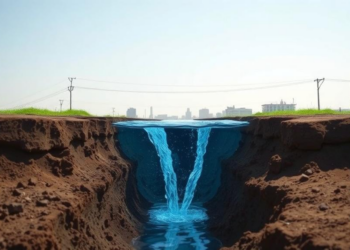
Beneath our feet lies one of the most consequential and least visible resources on the planet: groundwater. The sand, gravel, and fractured rock formations that store and transmit this water are anything but uniform. Some zones carry water like an open pipe, while neighboring layers barely let a drop pass. For decades, hydrogeologists have struggled to map this hidden heterogeneity with enough precision to manage wells, predict contaminant migration, and design remediation systems. A new study published in Hydrogeology Journal by Shao-Yang Huang and Jyun-Lin Chen of National Yunlin University of Science and Technology in Taiwan now offers a strikingly simple insight with far-reaching consequences: the geometry of how water is pushed through an aquifer during a test matters more than how much data you collect.
The research sits within a technique known as hydraulic tomography, a method first developed around the turn of the millennium as a kind of CAT scan for groundwater basins. Just as medical tomography builds a three-dimensional image of the body from X-rays taken at many angles, hydraulic tomography builds a picture of subsurface hydraulic properties from a series of pumping tests in which water is extracted or injected at different wells while pressure responses are recorded elsewhere. Each test casts a different hydraulic shadow through the aquifer, and an inversion algorithm stitches these shadows together into maps of hydraulic conductivity and storage. The promise of the method is enormous, but its effectiveness depends critically on whether the individual tests actually illuminate different parts of the subsurface.
Traditional practice has relied on sequential pumping tests, abbreviated SPT, in which a single well is pumped at a time while observers monitor the drawdown at surrounding wells. Each such test produces a flow field that is approximately radially symmetric, spreading outward from the pumping well like ripples from a stone dropped in a pond. The new study contrasts this with dipole pumping tests, or DPT, in which water is withdrawn from one well and simultaneously injected into another. This paired arrangement forces water to travel along a directed corridor between the two wells, carving a directional flow field through the formation rather than a circular one. The question Huang and Chen posed was deceptively straightforward: which of these two stimulation geometries extracts more usable information about aquifer heterogeneity for the same experimental effort?
To answer it, the researchers combined synthetic numerical experiments with field data. In the synthetic portion of the study, they generated heterogeneous aquifer fields using stochastic methods rooted in the geostatistical literature, including random field generation techniques based on Fourier transforms that allow statistically realistic patterns of hydraulic conductivity and storage to be created with known properties. Because the true subsurface structure is known by construction in these synthetic worlds, the investigators could measure exactly how well each testing strategy recovered it. They then ran both dipole and sequential pumping scenarios through the same tomographic inversion machinery and compared the resulting estimated parameter fields against the ground truth.
The results were unambiguous. Dipole pumping tests, with their directional flow fields, produced hydraulic responses with substantially greater spatial variability than the radially symmetric responses of sequential tests. When those responses were inverted, the dipole-based tomograms showed higher correlation coefficients with the true parameter fields and lower estimation errors. In practical terms, the dipole approach could distinguish high-conductivity channels from low-conductivity barriers more reliably, and it did so with a comparable number of tests and observations. The directional stimulation was effectively squeezing more information out of every measurement, a property the authors describe as improved information efficiency and parameter identifiability.
Perhaps the most consequential finding concerns the temptation that has shaped field campaigns for years: if a little data is good, more must be better. The study tested this assumption directly by increasing the number of datasets collected under sequential pumping conditions. The improvement in model performance was marginal. Piling on additional radially symmetric tests added largely redundant information, echoing earlier work by some of the same research community on redundant and nonredundant information for model calibration. No quantity of circular ripples can substitute for a directional sweep, because the flow paths simply never traverse the aquifer from the angles needed to resolve certain heterogeneity patterns. Geometry, not volume, governs what the data can reveal.
The field component of the study reinforced the synthetic conclusions, demonstrating that the geometric advantage of dipole stimulation carries over from idealized models to real, messy aquifers. This matters because field conditions introduce complications that simulations cannot fully anticipate: partial well penetration, ambient hydraulic gradients, measurement noise, and the sheer logistical difficulty of coordinating simultaneous pumping and injection. The fact that dipole tests retained their information advantage under these conditions suggests the finding is not a numerical artifact but a robust property of how groundwater flow interrogates heterogeneous media.
The implications ripple outward across several practical domains. Groundwater resources in Taiwan and many other regions face mounting stress from over-pumping, land subsidence, and contamination, and accurate aquifer characterization is the foundation of every sound management decision. Remediation design, in particular, depends on knowing where contaminants will travel, which requires resolving the preferential flow paths that heterogeneous aquifers create. Earlier studies have shown that steady-state hydraulic tomography can inform the selection of remediation systems, and multi-year field campaigns have demonstrated that tomographic estimates can be reproducible over time. The new work adds a design principle that could make such campaigns dramatically more efficient: invest in the geometry of stimulation before investing in more sensors, more wells, or more test repetitions.
There is also a conceptual lesson here that extends beyond hydrogeology. The study is a case study in experimental design as an information problem. In tomography of any kind, medical, seismic, or hydraulic, the quality of the reconstructed image depends on the diversity of the illumination angles, not merely on the number of exposures. A radiologist who takes the same X-ray from the same angle a hundred times learns nothing new on the hundred-and-first. Huang and Chen have shown that hydrogeologists have, in effect, been taking the same X-ray repeatedly when they rely on sequential single-well pumping, and that a modest change in test configuration, pairing a pumping well with an injection well, rotates the illumination and unlocks information that no amount of repetition could provide.
The research, supported by the Taiwan National Science and Technology Council, arrives at a moment when subsurface characterization is becoming ever more critical to climate adaptation, as aquifers are tapped to buffer droughts and as managed aquifer recharge schemes require precise knowledge of where injected water will go. By demonstrating that flow-field geometry, rather than data quantity alone, governs information efficiency in hydraulic tomography, the study hands practitioners a practical and inexpensive lever: design the stimulation to sweep the subsurface directionally, and the same field effort will yield sharper, more trustworthy maps of the hidden water-bearing architecture below. For a science that has spent a century inferring the shape of the invisible, that is a genuinely valuable shift in perspective.
Subject of Research: Comparison of dipole and sequential pumping test geometry for information efficiency and parameter identifiability in hydraulic tomography of heterogeneous aquifers
Article Title: Hydraulic stimulation geometry governs information efficiency and parameter identifiability in hydraulic tomography: A comparison of dipole and sequential pumping tests
Article References: Huang, S.-Y., & Chen, J.-L. (2026). Hydraulic stimulation geometry governs information efficiency and parameter identifiability in hydraulic tomography: A comparison of dipole and sequential pumping tests. Hydrogeology Journal. https://doi.org/10.1007/s10040-026-03182-4
Image Credits: AI Generated
DOI: 10.1007/s10040-026-03182-4
Keywords: hydraulic tomography, dipole pumping test, sequential pumping test, aquifer heterogeneity, groundwater, parameter identifiability, hydrogeology, pumping tests, experimental design, hydraulic conductivity, injection wells, information efficiency
Cite Scienmag News
Violet Maxwell. (October 12, 2026). How Water Flows Underground: Pumping Test Geometry Holds the Key to Mapping Hidden Aquifers. Scienmag. https://scienmag.com/how-water-flows-underground-pumping-test-geometry-holds-the-key-to-mapping-hidden-aquifers/
Violet Maxwell. "How Water Flows Underground: Pumping Test Geometry Holds the Key to Mapping Hidden Aquifers." Scienmag, 12 October 2026, https://scienmag.com/how-water-flows-underground-pumping-test-geometry-holds-the-key-to-mapping-hidden-aquifers/. Accessed 12 October 2026.
Violet Maxwell. "How Water Flows Underground: Pumping Test Geometry Holds the Key to Mapping Hidden Aquifers." Scienmag. October 12, 2026. https://scienmag.com/how-water-flows-underground-pumping-test-geometry-holds-the-key-to-mapping-hidden-aquifers/