


Freshwater ecosystems are among the most biologically rich and most imperiled environments on Earth, and a new analysis published in PLOS Water argues that the world is systematically underusing its most powerful legal instrument for protecting them. The study, led by Liz Willetts, examines the outcomes of the fifteenth meeting of the Conference of the Contracting Parties to the Ramsar Convention on Wetlands, held in July 2025, and finds that freshwater biodiversity and human health remain stubbornly siloed in international policy, despite being deeply intertwined in practice. The research comes at a pivotal moment, with a dense calendar of global water governance meetings scheduled for 2026 and 2027, and it makes the case that the Ramsar triennium running from 2025 to 2028 offers a rare, concrete window to fuse biodiversity protection with public health action.
The Ramsar Convention, signed in 1971 in the Iranian city of Ramsar, is the oldest modern intergovernmental treaty devoted to a single ecosystem type. Its contracting parties designate wetlands of international importance and commit to their wise use, making the convention a uniquely authoritative forum for freshwater conservation. Yet the new analysis contends that the convention’s potential contribution to human health and wellbeing has never been fully realized. Wetlands purify water, buffer floods, store carbon, sustain fisheries and support the livelihoods of billions of people, but these health-relevant functions rarely appear in the way national governments report on their wetland commitments or in the proceedings of wetland governance itself.
At the heart of the paper is Sustainable Development Goal 6, which commits the international community to ensuring availability and sustainable management of water and sanitation for all. The author argues that SDG 6, as currently framed, treats water primarily as a resource to be delivered rather than as a living system whose biodiversity underpins human wellbeing. This framing, the analysis suggests, has allowed freshwater ecosystems to decline even as access to water infrastructure slowly improves. The paper proposes a new planetary health vision of SDG 6, one that would carry into the post-2030 development agenda an explicit recognition that human health depends on the health of the freshwater ecosystems from which water is drawn.
Planetary health, as a framework, emphasizes that the degradation of natural systems is now the dominant driver of human health risks at the global scale. Applied to freshwater, the logic is stark: when wetlands are drained, polluted or overexploited, the consequences ripple outward through water quality, food security, disease dynamics and disaster risk. The analysis argues that Ramsar COP15 decisions, taken in 2025, provide an entry point for embedding this socioecological understanding of wetlands into national implementation, but only if governments and the health sector actively translate the resolutions into coordinated action across public health and water, sanitation and hygiene systems.
To assess how far this integration has progressed, the study scrutinized national reports tracking the Changwon Declaration on Human Health and Wellbeing, adopted by Ramsar parties in 2008, alongside reports on implementation during the 2021 to 2024 triennium. The Changwon Declaration was a landmark in its own right, explicitly linking wetland conservation to human health, yet the analysis of nearly two decades of national reporting reveals persistent gaps. Health sector engagement in Ramsar processes remains shallow, and the reporting mechanisms themselves do little to compel health ministries and environment ministries to work together on wetland issues. The result is a governance architecture in which the health benefits of wetlands are acknowledged in principle but routinely ignored in practice.
The technical core of the problem, according to the analysis, is one of framing and coordination rather than knowledge. The scientific literature has long documented the pathways by which freshwater biodiversity supports human health, from the role of intact wetlands in regulating waterborne pathogens to the nutritional and economic contributions of inland fisheries. What is missing is the institutional machinery to carry this evidence into decision-making. National Ramsar reporting rarely involves health authorities, WASH programs rarely consider biodiversity, and biodiversity strategies rarely account for health outcomes. Each sector operates with its own indicators, budgets and timelines, and the interlinkages fall through the cracks between them.
The timing of the analysis is deliberate. The 2025 to 2028 Ramsar triennium coincides with a crowded sequence of global water governance meetings in 2026 and 2027, including processes that will shape how the international community approaches water in the final years of the 2030 Agenda and beyond. The author positions COP15 outcomes as a foundation that must now be carried forward, arguing that decisions taken at the wetlands convention can and should inform the broader water governance agenda. If the interlinkages between freshwater biodiversity and health are not mobilized during this triennium, the paper warns, the opportunity to influence the post-2030 development framework may be lost for another generation.
What makes the paper’s argument particularly compelling is its pragmatism. Rather than calling for new treaties or sweeping institutional reform, it outlines a range of basic coordination actions that governments could take during the current triennium to translate COP15 resolutions across the public health and WASH sectors. These include strengthening the socioecological framing of wetland character assessments, improving coordination with the health sector in national reporting, and ensuring that health perspectives are represented in the proceedings of wetland governance. None of these steps requires new science or new law; they require existing institutions to talk to each other and to treat freshwater biodiversity as a determinant of health rather than as an environmental afterthought.
The stakes could hardly be higher. Freshwater species populations have declined dramatically over recent decades, wetland extent continues to shrink worldwide, and billions of people still lack safely managed water and sanitation. The analysis argues that these crises are not separate problems to be solved by separate ministries but symptoms of a single failure to recognize that water security, biodiversity and health are one system. By reframing SDG 6 through a planetary health lens, the paper suggests, the international community could align the targets of the water goal with the ecological realities that ultimately determine whether water is clean, reliable and safe.
As the 2026 and 2027 water governance calendar unfolds, the analysis offers governments a clear test of seriousness. The resolutions of Ramsar COP15, the legacy of the Changwon Declaration and the evidence of nearly two decades of national reporting together point to the same conclusion: the tools exist, but the coordination does not. Whether the 2025 to 2028 triennium becomes the moment when freshwater biodiversity and human health are finally governed as one, or merely another cycle of acknowledged interlinkages and missed opportunities, will depend on whether environment, health and WASH institutions choose to de-silo now, while the post-2030 agenda is still being written.
Subject of Research: Interlinkages between freshwater biodiversity and human health under SDG 6 and the Ramsar Convention on Wetlands
Article Title: Freshwater biodiversity and health: An analysis of SDG 6 and the Ramsar Convention on Wetlands
Article References: Willetts, L. (2026). Freshwater biodiversity and health: An analysis of SDG 6 and the Ramsar Convention on Wetlands. PLOS Water, 5(8), e0000594. https://doi.org/10.1371/journal.pwat.0000594
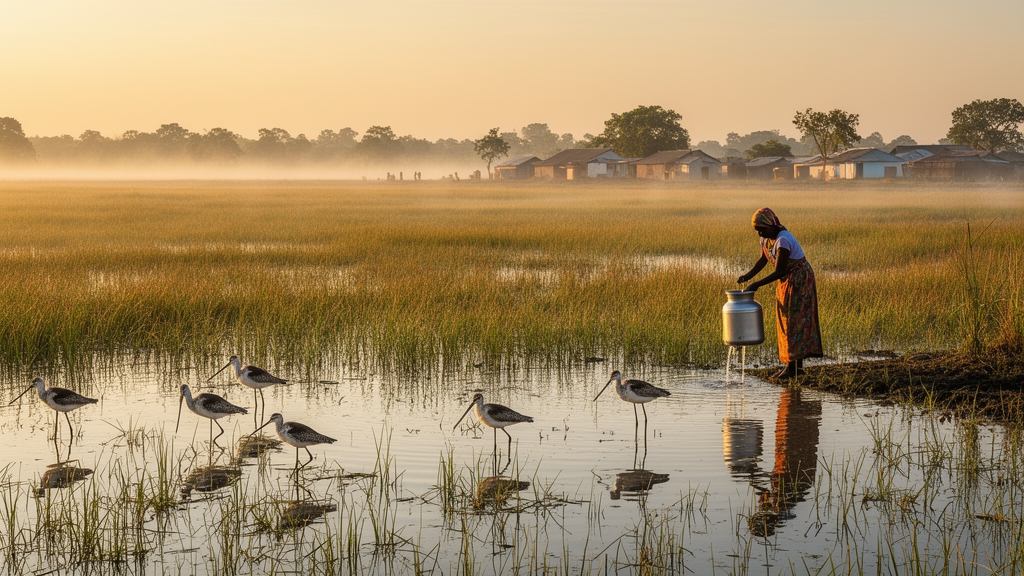
Image Credits: AI Generated
DOI: 10.1371/journal.pwat.0000594
Keywords: freshwater biodiversity, Ramsar Convention, SDG 6, planetary health, wetlands governance, COP15, Changwon Declaration, WASH, water governance, public health, national reporting, post-2030 agenda
Cite Scienmag News
Margaret Porter. (October 9, 2026). Wetlands, Health and Water: Why the Ramsar Convention Holds the Key to SDG 6. Scienmag. https://scienmag.com/wetlands-health-and-water-why-the-ramsar-convention-holds-the-key-to-sdg-6/
Margaret Porter. "Wetlands, Health and Water: Why the Ramsar Convention Holds the Key to SDG 6." Scienmag, 9 October 2026, https://scienmag.com/wetlands-health-and-water-why-the-ramsar-convention-holds-the-key-to-sdg-6/. Accessed 9 October 2026.
Margaret Porter. "Wetlands, Health and Water: Why the Ramsar Convention Holds the Key to SDG 6." Scienmag. October 9, 2026. https://scienmag.com/wetlands-health-and-water-why-the-ramsar-convention-holds-the-key-to-sdg-6/


