


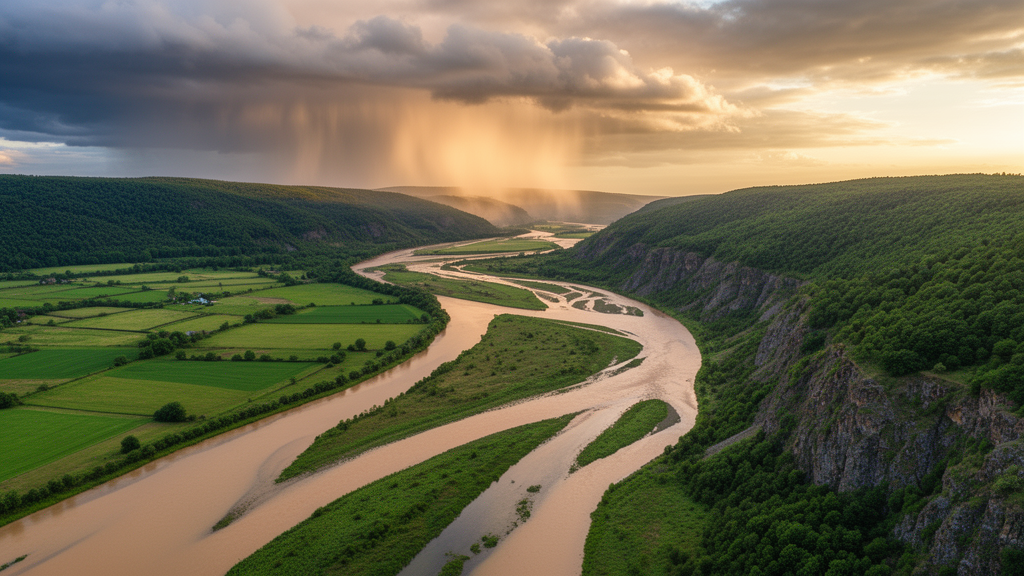
Every time a storm sweeps across a landscape, a river basin performs an act of translation. It takes a volume of water delivered by rain, melting snow, or some combination of the two, and converts it into the streamflow that rises, crests, and eventually recedes downstream. For decades, hydrologists have debated how stable that translation really is. Does a catchment respond to its tenth storm much as it responded to its first, or does its behavior shift from event to event in ways that matter for flood forecasting and water security? A new global analysis published in Communications Earth & Environment offers the most sweeping answer yet: the transformation is almost never fixed. Across nearly five thousand river basins on six continents, the rules governing how water inputs become streamflow change from one event to the next almost everywhere.
The study, led by Ying Yan, Hamed Sharif, and Ali A. Ameli of the University of British Columbia, rests on an extraordinary volume of evidence. The researchers identified and analyzed approximately 1.7 million runoff-producing events across 4,838 catchments spanning six continents. Each event was classified according to two descriptors that together define its hydro-meteorological character: the type of water input, whether rainfall, snowmelt, or rain falling on snow, and the wetness of the soil before the event began, sorted into dry, moderate, or wet antecedent conditions. That ninefold classification scheme allowed the team to ask, in a standardized way, whether a given basin treats a rainstorm on dry soil the same way it treats snowmelt on saturated ground.
The scale of the computation behind this work is itself a story. Identifying individual runoff-producing events in millions of streamflow and precipitation records is a task far beyond what a desktop workstation can handle, so the bulk of the analyses ran on the Compute Canada network of parallel high-performance computing clusters. The effort was supported by grants to Ameli through the Natural Sciences and Engineering Research Council of Canada’s Discovery Grants program. The result is a dataset that turns a question once explored catchment by catchment, in scattered field campaigns and modeling studies, into a globally quantified phenomenon.
The first major finding concerns the diversity of what the authors call dominant hydro-meteorological event types. For each catchment, the team summarized which combination of water-input type and antecedent soil moisture most frequently produced runoff, doing so separately for the dormant season and the growing season. Rather than converging on a handful of universal regimes, the global catchment population displayed a wide diversity of dominant types. Some basins are, in effect, rain-on-dry-soil systems; others are dominated by snowmelt onto wet ground; still others by rain on moderately moist soils. That heterogeneity alone is a caution against one-size-fits-all hydrology, but it is not the paper’s central surprise.
The central surprise is the pervasiveness of time-variance. The researchers quantified, for every catchment, how much the precipitation-to-streamflow transfer function, the mathematical representation of catchment hydrologic function, varied from event to event. The verdict was stark. In the dormant season, 95.6 percent of catchments showed moderate to strong event-to-event variation in their hydrologic function. In the growing season, that figure rose to 99.0 percent. In other words, virtually every river basin on Earth examined in this study behaves differently from one runoff event to the next, at least to a degree that the authors classify as meaningful.
What makes this result more striking is that the variation is not simply a byproduct of events arriving under obviously different weather. Even catchments that experienced highly similar hydro-meteorological conditions across their events, the same input types striking similarly wet or dry soils, remained functionally time-variant. Something beyond the coarse descriptors of input type and antecedent wetness is modulating how these landscapes convert water into runoff. The study points to one candidate mechanism with particular force: within-catchment spatial heterogeneity in hydro-meteorological conditions. A single basin is rarely uniform. One hillslope may be drenched while another stays dry; snow may linger on shaded aspects while sun-facing slopes shed meltwater days earlier. Because different parts of a catchment are activated under different conditions, the integrated streamflow response at the outlet shifts depending on which portions of the landscape are doing the work during any given event.
The implications ripple outward quickly. The precipitation-streamflow transfer function is not an academic abstraction; it is the backbone of how hydrologists translate meteorological forecasts into flood warnings, how engineers size culverts and reservoirs, and how water managers estimate how much of a season’s precipitation will actually arrive in rivers and aquifers. If that transfer function is stable, a model calibrated on past events can be trusted, within limits, to anticipate future ones. If it is time-variant, as this study suggests it almost universally is, then confidence in flood-risk and water-security assessments, the very applications the authors cite as motivation, is directly limited by how well those shifting dynamics are captured. A forecasting system tuned to wet-season events may misjudge a dry-season storm in the same basin, and a model built on rain-dominated events may falter when a rain-on-snow episode arrives.
The study also establishes a link between variability in function and variability in outcome. Greater time-variance in a catchment’s hydrologic function was associated with greater event-to-event variation in the catchment’s runoff response. That connection matters because runoff response is what communities experience: how fast a river rises, how high it crests, how much water is available downstream. Basins whose internal translation rules fluctuate strongly are also basins whose rivers behave less predictably. Identifying such basins, and understanding what drives their internal heterogeneity, could become a priority for flood-risk mapping and infrastructure design in a warming climate, where rain-on-snow events and abrupt shifts between dry and saturated soil conditions are expected to become more frequent in many regions.
Methodologically, the paper demonstrates the power of treating the planet’s river basins as a single statistical population rather than as a collection of idiosyncratic case studies. By imposing a common event classification, rain, snowmelt, or rain-on-snow crossed with dry, moderate, or wet antecedent soil moisture, and by applying it uniformly across 1.7 million events, the researchers could measure time-variance on a comparable scale everywhere. The seasonal split, analyzing dormant and growing seasons separately, adds another layer of nuance, revealing that functional variability is even more widespread when vegetation is active, a hint that evapotranspiration and plant-driven soil dynamics may deepen the nonstationarity of catchment behavior during the growing season.
The broader message is one of humility and opportunity for hydrology. The assumption that a catchment has a single, learnable personality, a fixed transfer function waiting to be calibrated, appears to be wrong for nearly every basin on Earth. That does not mean prediction is hopeless; it means prediction must embrace variability as the norm rather than the exception. Models may need to represent within-catchment heterogeneity explicitly, and forecasting frameworks may need to condition their parameters on event type and antecedent state rather than assuming a single set of values. For a world facing intensifying storms, shrinking snowpacks, and rising demands on freshwater, knowing that the planet’s river basins rarely behave the same way twice is not a discouraging finding. It is, instead, an accurate map of the challenge ahead, drawn from nearly two million events and nearly five thousand landscapes, and it gives hydrologists a far clearer picture of where and why their forecasts are most likely to bend.
Subject of Research: Time-variance in catchment hydrologic function across global river basins
Article Title: Catchment hydrologic function is widely time-variant
Article References: Yan, Y., Sharif, H., & Ameli, A. A. (2026). Catchment hydrologic function is widely time-variant. Communications Earth & Environment. https://doi.org/10.1038/s43247-026-04079-6
Image Credits: AI Generated
DOI: 10.1038/s43247-026-04079-6
Keywords: hydrology, catchments, streamflow, runoff events, soil moisture, snowmelt, rain-on-snow, flood risk, water security, transfer function, global analysis, Communications Earth & Environment
Cite Scienmag News
Violet Maxwell. (October 9, 2026). Global study finds river catchments rarely behave the same way twice. Scienmag. https://scienmag.com/global-study-finds-river-catchments-rarely-behave-the-same-way-twice/
Violet Maxwell. "Global study finds river catchments rarely behave the same way twice." Scienmag, 9 October 2026, https://scienmag.com/global-study-finds-river-catchments-rarely-behave-the-same-way-twice/. Accessed 9 October 2026.
Violet Maxwell. "Global study finds river catchments rarely behave the same way twice." Scienmag. October 9, 2026. https://scienmag.com/global-study-finds-river-catchments-rarely-behave-the-same-way-twice/


