


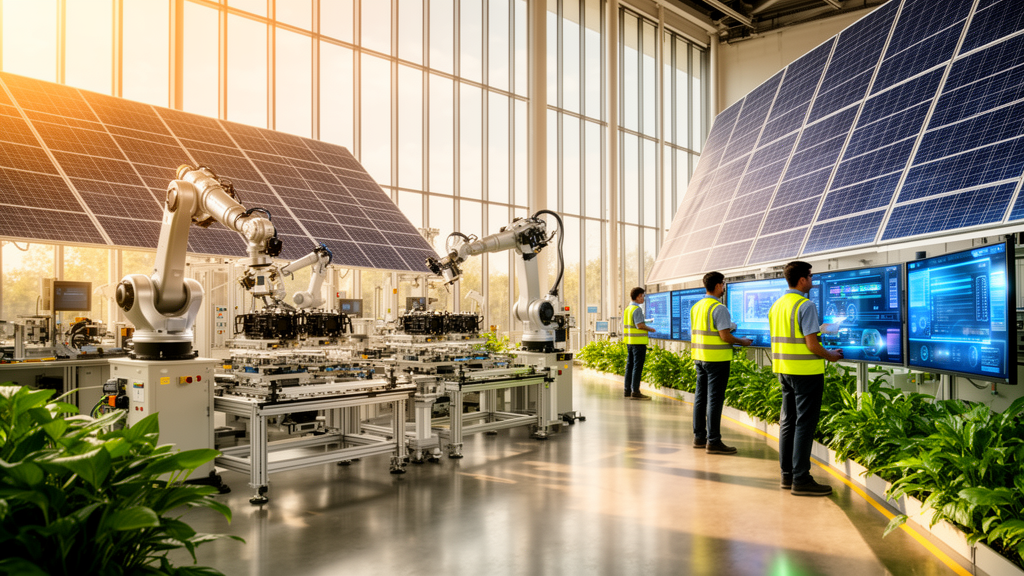
Factories, power grids and supply chains are becoming living networks of connected machines, data platforms and self-adjusting organizations, and a new theoretical study argues that these networks can be engineered to serve sustainability rather than merely profit. In a paper published in the journal Discover Sustainability, Aleksey Tashkinov of Perm National Research Polytechnic University presents a conceptual model of a digital adaptive industrial ecosystem within the context of Industry 4.0, together with a theoretical and methodological framework for evaluating how such ecosystems might contribute to sustainable development. The work arrives at a moment when the convergence of digital manufacturing technologies and environmental goals is transforming industrial ecosystems worldwide, yet the theoretical mechanisms and operational boundaries of that intersection remain, as the author notes, under-researched.
The starting point of the study is a problem that sounds mundane but has real consequences: terminology. In the sprawling literature on digital transformation, terms such as digital platforms, organizational networks, integrated systems and adaptive ecosystems are often used loosely and interchangeably, making it difficult to compare findings or build cumulative theory. Drawing on a thematic literature review, Tashkinov carefully delineates these four concepts, positioning the adaptive ecosystem as the most advanced and least rigid form of industrial digital organization. Where a platform connects actors, a network coordinates them, and an integrated system binds them into a single technical architecture, an adaptive ecosystem, in this framing, is a recursively organized community of firms and technologies that continuously reconfigures itself in response to changing conditions. Resolving this terminological ambiguity matters because each category implies different governance structures, different data flows and, crucially, different potentials for environmental and social impact.
At the heart of the proposed model is a conceptual scheme for integrating the principles of Industry 4.0 through recursive, synergistic processes that support sustainability along three distinct vectors. The first is minimizing energy losses, which digital technologies can achieve through real-time monitoring, predictive control and the fine-grained coordination of production schedules with energy availability. The second is optimizing resource utilization, so that machines, materials and human skills are deployed where they generate the greatest value with the least input. The third is reducing material waste, from scrap on the factory floor to overproduction across entire supply chains. The word synergistic is doing important work here: the model assumes that these vectors do not operate independently but reinforce one another, so that, for example, better resource optimization simultaneously cuts energy demand and waste, while feedback from waste reduction improves the algorithms that manage energy. Recursion, in this context, means that the outputs of each cycle of digital decision-making become inputs to the next, allowing the ecosystem to learn and adapt over time.
What distinguishes this paper from much of the conceptual literature on Industry 4.0 is its attempt to make such claims mathematically operational. Tashkinov anchors his approach in the decomposition and operationalization of parameters within an extended Cobb–Douglas production function, one of the oldest and most widely used tools in economics for relating inputs such as labor and capital to output. The classical function is elegant precisely because of its simplicity, but that simplicity leaves no room for the digital and organizational variables that define modern industry. The study therefore proposes a specification of an extended Cobb–Douglas function that hypothetically incorporates variables for digital integration, denoted D, service autonomy, denoted S, community responsiveness, denoted C, and their interaction term. Digital integration captures how deeply digital technologies are woven into production processes; service autonomy reflects the capacity of systems and organizations to act independently on the basis of data; and community responsiveness measures how quickly the ecosystem reacts to the needs and signals of its participants and stakeholders.
The interaction term is arguably the most intriguing element, because it encodes the hypothesis that the whole exceeds the sum of its parts. In economic terms, the marginal contribution of digital integration to output may depend on the level of service autonomy, and vice versa; an ecosystem that is highly digitized but centrally controlled, or highly autonomous but poorly integrated, may underperform one that combines both. By including such an interaction, the model can in principle capture the synergistic effects that the conceptual scheme describes qualitatively. The purpose of this mathematical apparatus, the paper emphasizes, is not to produce immediate empirical estimates but to translate environmental and social targets into measurable managerial decisions that can be compared directly with economic metrics. In other words, if a firm wants to cut energy losses by a certain percentage, the extended production function provides a common currency in which that goal can be weighed against investment costs, labor requirements and output growth.
It is important to stress, as the author does, that the specification is hypothetical and intended as an operational foundation for future testing rather than a validated result. Conceptual models of this kind serve a vital function in a field where data is abundant but theory is fragmented. By defining variables precisely, proposing functional forms and identifying the mechanisms through which digital technologies should influence sustainability outcomes, the framework generates testable hypotheses. Future researchers can estimate the extended Cobb–Douglas function with real industrial data, check whether the digital, autonomy and responsiveness variables behave as predicted, and refine the model where it fails. This is how empirical economics normally progresses: a plausible functional form is proposed, confronted with data, and iteratively improved.
The study also confronts the practical obstacles that stand between such models and their deployment. Tashkinov systematizes four categories of sector-specific barriers: technological, organizational, economic and regulatory. Technological barriers include gaps in connectivity, interoperability and data infrastructure; organizational barriers involve rigid hierarchies and cultures unaccustomed to adaptive, data-driven decision-making; economic barriers encompass the high upfront costs of digitalization and uncertain returns, particularly for smaller firms; and regulatory barriers range from data governance rules to environmental standards that were not designed with adaptive ecosystems in mind. By classifying these barriers systematically, the framework allows analysts to diagnose which combination of obstacles a given industry faces and to tailor implementation strategies accordingly, rather than assuming that a single blueprint will work everywhere.
Indeed, the deployment potential of the framework is explicitly differentiated across industries with different levels of digital maturity. In high-tech sectors such as automotive manufacturing and energy, where sensor networks, digital twins and automated control systems are already widespread, the author suggests that the model could be applied at full scale, with the extended production function estimated directly and the three sustainability vectors pursued in an integrated way. In industries with lower digital maturity, such as agriculture, mining and pharmaceuticals, the model would require adapted configurations: fewer variables, simpler functional forms, or phased implementation that builds digital capabilities before attempting full ecosystem integration. This differentiation is a refreshing departure from the one-size-fits-all rhetoric that often surrounds Industry 4.0, acknowledging that a mining operation in a remote region and a fully automated car plant inhabit very different technological and institutional worlds.
The broader significance of the paper lies in its attempt to bridge two agendas that have too often run in parallel. The Industry 4.0 literature has tended to celebrate productivity, flexibility and innovation, while the sustainable development literature has focused on environmental limits, social goals and long-term resilience. By building a model in which digital integration, service autonomy and community responsiveness enter the same production function as conventional inputs, and in which the outputs include minimized energy losses, optimized resource use and reduced waste, Tashkinov offers a formal language in which economic and sustainability objectives can be negotiated simultaneously. Whether the model survives contact with empirical data remains to be seen, and the author is candid that validation is future work. But as industries everywhere face mounting pressure to decarbonize while remaining competitive, frameworks that make the sustainability consequences of digital transformation measurable, comparable and manageable are likely to become indispensable tools for researchers, managers and policymakers alike.
For now, the study stands as a carefully constructed conceptual foundation: a clarified vocabulary for digital industrial ecosystems, a three-vector scheme linking Industry 4.0 technologies to sustainable development, an extended production function ready for empirical testing, and a realistic map of the technological, organizational, economic and regulatory barriers that will determine where and how such ecosystems can take root. The next step, as the paper makes clear, belongs to the data.
Subject of Research: A conceptual model of digital adaptive industrial ecosystems in Industry 4.0 and their contribution to sustainable development
Article Title: A conceptual model of a digital adaptive industrial ecosystem within the context of Industry 4.0 and its contribution to sustainable development
Article References: Tashkinov, A. (2026). A conceptual model of a digital adaptive industrial ecosystem within the context of Industry 4.0 and its contribution to sustainable development. Discover Sustainability. https://doi.org/10.1007/s43621-026-04818-x
Image Credits: AI Generated
DOI: 10.1007/s43621-026-04818-x
Keywords: Industry 4.0, digital ecosystem, sustainable development, Cobb–Douglas production function, digital integration, service autonomy, community responsiveness, energy efficiency, resource optimization, sectoral barriers, conceptual model, industrial organization
Cite Scienmag News
Violet Maxwell. (October 9, 2026). New Model Shows How Industry 4.0 Ecosystems Could Drive Sustainable Development. Scienmag. https://scienmag.com/new-model-shows-how-industry-4-0-ecosystems-could-drive-sustainable-development/
Violet Maxwell. "New Model Shows How Industry 4.0 Ecosystems Could Drive Sustainable Development." Scienmag, 9 October 2026, https://scienmag.com/new-model-shows-how-industry-4-0-ecosystems-could-drive-sustainable-development/. Accessed 9 October 2026.
Violet Maxwell. "New Model Shows How Industry 4.0 Ecosystems Could Drive Sustainable Development." Scienmag. October 9, 2026. https://scienmag.com/new-model-shows-how-industry-4-0-ecosystems-could-drive-sustainable-development/


