


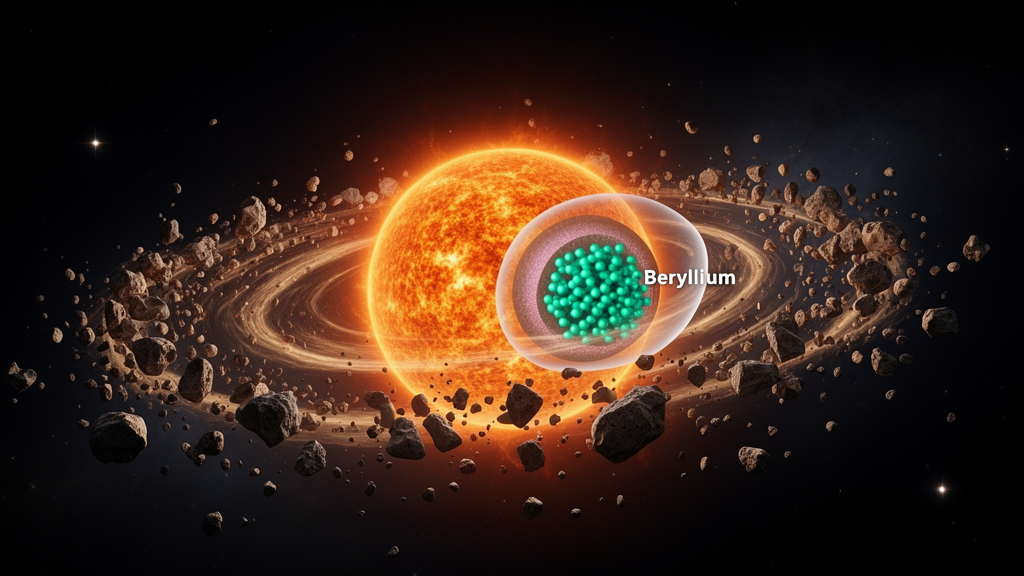
In a discovery that could reshape how astronomers think about the fate of planetary systems, an international team led by researchers at the University of São Paulo has developed a new technique for identifying stars that have swallowed planets orbiting around them. The method hinges on beryllium, a rare and chemically peculiar element that is not manufactured inside stars during their ordinary lives. Because beryllium can only arrive at a star’s surface from outside, its presence in unexpected quantities acts as a forensic signature of planetary cannibalism, preserving a record of violent events that may have unfolded billions of years after the star first ignited. The study, published in the journal Astronomy & Astrophysics, demonstrates for the first time that subtle differences in beryllium abundance between twin stars can reliably flag this destructive process, opening what the researchers describe as a new window onto the evolution of planetary systems and, by extension, onto the prospects for life elsewhere in the galaxy.
The team tested the technique on a binary system containing two remarkably similar stars, HD 129171 and HD 129209, both of which are solar-type stars with physical, chemical, and magnetic activity characteristics resembling those of our own Sun. Binary pairs like this one are natural laboratories for stellar chemistry, because both stars are understood to have formed at virtually the same time from the same molecular cloud, the vast nursery of dust and gas that collapses to give birth to stars. In principle, siblings born from the same cloud should carry nearly identical chemical compositions, reflecting the raw material from which they condensed. Yet when the researchers analyzed the light from these two stars, they found significant and telling differences between them, differences that could not be explained by their shared origins and instead pointed to very different histories after formation.
“The star HD 129171 is enriched in refractory elements – that is, elements that typically condense in the solid state and make up rocky planets. That strongly suggests that it has engulfed planetary material throughout its evolution,” says Anne Rathsam, a doctoral student at the Institute of Astronomy, Geophysics, and Atmospheric Sciences at the University of São Paulo and the first author of the article. Rathsam, a scholarship recipient of the São Paulo Research Foundation, explains that the enrichment pattern is precisely what would be expected if rocky, Earth-like material had fallen into the star and been mixed through its outer layers. Scientists had long suspected that some stars might incorporate planets or planetary fragments into their atmospheres, but this study is unique in demonstrating that beryllium abundance differences between binary stars can serve as a dependable indicator of the phenomenon.
The reason beryllium works so well as a tracer lies in its unusual cosmic origin story. Lithium, beryllium, and boron stand as important exceptions in the chemical history of the universe. “All other chemical elements originate from primordial nucleosynthesis [the formation of the first atomic nuclei in the minutes following the Big Bang] or stellar nucleosynthesis [the nuclear fusion process that occurs inside stars throughout their lifetimes]. But not beryllium and boron. They primarily arise through a process called ‘cosmic spallation,’ in which high-energy particles fragment heavier nuclei, such as carbon, nitrogen, and oxygen, producing lighter elements,” explains Jorge Luis Melendez Moreno, an astronomer and professor at the University of São Paulo who served as the study’s advisor. Because stars cannot forge beryllium in their cores, any excess of the element detected in a star’s light is a warning sign that the star swallowed rocky material, such as planetary remnants, long after it formed.
Lithium had previously been proposed as a possible indicator of planetary engulfment, but it comes with a serious limitation. “Lithium had already been used as a possible indicator of planetary engulfment, but it’s destroyed relatively easily. Beryllium is more resistant, and its chemical signature can last longer,” Rathsam explains. Lithium is fragile under stellar conditions, readily consumed by nuclear reactions that transport material through a star’s interior, so its signature fades over time and can be erased by the very mixing processes astronomers need to understand. Beryllium, by contrast, survives these conditions far better, meaning that a star can carry the chemical memory of a planetary meal for vastly longer stretches of its life. That durability transforms beryllium from a fleeting clue into a durable archive of a star’s violent past, allowing astronomers to detect engulfment events that occurred long before any human could observe them.
The observational work behind the study relied on the UVES spectrograph, a high-resolution instrument installed on the European Southern Observatory’s Very Large Telescope in Chile. The spectrograph breaks starlight down into its constituent wavelengths, allowing researchers to identify extremely subtle chemical signatures encoded in the absorption lines of a stellar spectrum. The observations revealed that HD 129171 has a notably higher concentration of refractory elements, including iron, magnesium, silicon, calcium, and titanium, compared to its companion HD 129209. These are exactly the elements that condense into solids and build rocky worlds. On top of that refractory excess, the star exhibits an overabundance of both lithium and beryllium, a combined pattern that the researchers say is consistent with the ingestion of rocky material equivalent to more than eleven times the mass of Earth.
Whether that material arrived as a single catastrophic meal or as a slow accumulation of smaller bodies remains an open question. “That material may have come from a single large planet or from several smaller bodies. However, in the case of Sun-like stars, internal mixing is so efficient that the final chemical signature doesn’t allow us to distinguish between those scenarios,” Rathsam comments. The main original contribution of the study was the chemical analysis itself, which established beryllium as a marker of planetary engulfment events. The authors also drew on the existing literature to discuss the dynamical mechanisms capable of driving planets into their host stars. These include gravitational interactions between planets in a crowded system, perturbations caused by companion stars, and orbital migration processes. Any of these can push orbits into highly eccentric and unstable configurations, causing planets to be ejected from the system entirely, collide with one another, or spiral inward to be absorbed by the central star.
Perhaps the most consequential implication of the work is that stable planetary systems like our own Solar System may be far rarer than previously assumed. Melendez points out that several independent lines of evidence converge on this conclusion. Computational simulations of planetary formation indicate that configurations resembling the Solar System, with giant planets in nearly circular outer orbits and rocky planets in stable inner orbits, are not common outcomes of the planet-formation process. Furthermore, observational surveys of Sun-like stars have found few Jupiter-like planets occupying orbits comparable to that of our own Jupiter. “When we bring together evidence from dynamical simulations, exoplanet observations, and chemical studies of binary stars, a consistent picture emerges, indicating that systems similar to the Solar System may be less common than we imagined,” the researcher explains. Because binary systems are extremely common in the Milky Way, with current estimates suggesting that roughly half of the galaxy’s stars have a gravitational companion, the technique offers a powerful statistical tool: since binary partners form together from the same cloud, any chemical difference between them is strong evidence that later processes, such as planet ingestion, altered their original composition.
For anyone hoping to find complex life beyond Earth, the findings carry a sobering weight. “In our planetary system, the planets have relatively stable, low-eccentricity orbits. However, if planetary engulfment is common, it suggests that many systems undergo violent dynamic phases,” Rathsam emphasizes. Such turbulence would place an additional hurdle in front of the emergence of sophisticated organisms. “Life wouldn’t just need billions of years to emerge and evolve. The planet would also have to remain in a sufficiently stable orbit to survive significant gravitational perturbations,” she explains. A world repeatedly shaken by close encounters with giant planets, or one that ultimately falls into its star, offers little opportunity for the long, uninterrupted evolutionary timelines that complex life appears to require.
The study also carries implications that reach beyond planetary science into theories of star formation and a technique known as chemical tagging, which uses the chemical compositions of stars to reconstruct the history of the Milky Way. If the chemical differences observed in binary stars were caused by heterogeneities in the primordial clouds from which they formed, rather than by later ingestion of planets, then currently accepted models of star formation would need revision. The team’s results, however, support the planetary ingestion hypothesis, preserving the assumption that twin stars begin life chemically identical. The research brought together scientists from the University of São Paulo, the Polish Academy of Sciences, the Chinese Academy of Sciences, Monash University in Australia, and Italian astronomical observatories, and received support from the São Paulo Research Foundation through a Thematic Project coordinated by Melendez. As spectrographs on ever-larger telescopes continue to sharpen their view of stellar chemistry, beryllium may become a standard tool for reading the hidden histories of stars, revealing which of them quietly nurtured their planets and which, at some point in their long lives, devoured them.
Subject of Research: Detection of planetary engulfment in Sun-like binary stars using beryllium abundance anomalies
Article Title: New technique identifies stars that have swallowed planets
Article References: New technique identifies stars that have swallowed planets. (n.d.). Original publication
Image Credits: AI Generated
DOI: Not provided
Keywords: planetary engulfment, beryllium, binary stars, solar-type stars, exoplanets, stellar chemistry, spectroscopy, Very Large Telescope, planetary system stability, cosmic spallation, chemical tagging, Milky Way
Cite Scienmag News
Grant Pearson. (October 9, 2026). Beryllium fingerprints reveal stars that devoured their own planets. Scienmag. https://scienmag.com/beryllium-fingerprints-reveal-stars-that-devoured-their-own-planets/
Grant Pearson. "Beryllium fingerprints reveal stars that devoured their own planets." Scienmag, 9 October 2026, https://scienmag.com/beryllium-fingerprints-reveal-stars-that-devoured-their-own-planets/. Accessed 9 October 2026.
Grant Pearson. "Beryllium fingerprints reveal stars that devoured their own planets." Scienmag. October 9, 2026. https://scienmag.com/beryllium-fingerprints-reveal-stars-that-devoured-their-own-planets/


