


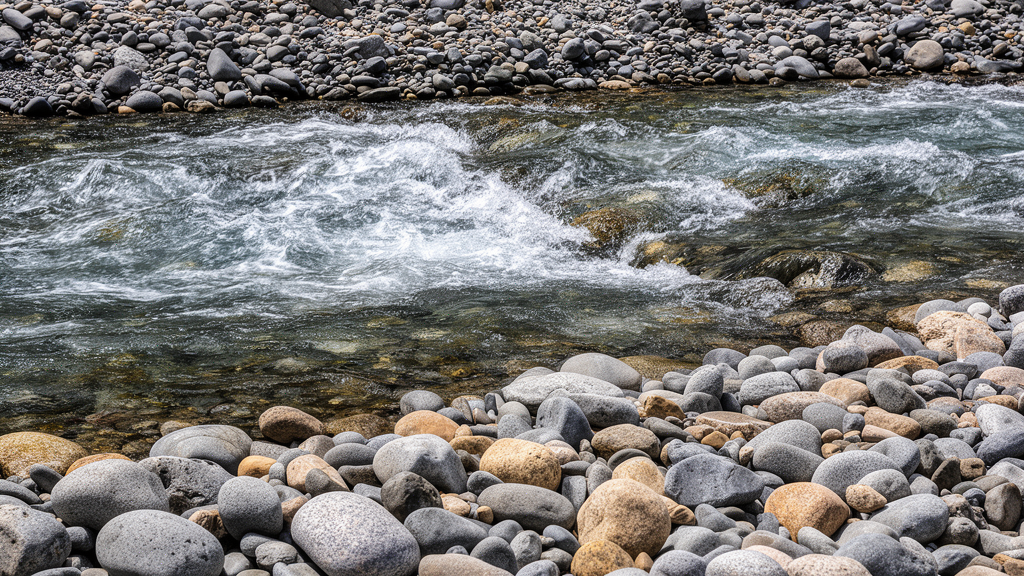
Mountain rivers during flood are among the most violent environments on Earth’s surface, and the way their fast water interacts with bridge piers, boulders, and vegetation stalks determines whether infrastructure survives and how landscapes erode. A new study published in Earth Surface Dynamics by Angel Monsalve of the University of Idaho and Oscar Link of the Universidad de Concepción in Chile has revealed something startling about these flows: the individual grains of gravel on a riverbed, each just a few millimeters to a centimeter across, can completely transform the physics of water moving around an obstacle. What engineers and geomorphologists have long modeled as organized, predictable vortices dissolves, over a rough bed, into a chaotic field of grain-scale turbulence with forces on the riverbed far more extreme and variable than anyone had quantified before.
The research focuses on supercritical flow, the regime that develops when inertial forces overwhelm gravity, expressed technically as a Froude number greater than one. In this state, water slamming into a cylinder behaves in ways that have no counterpart in slower, subcritical rivers. The flow climbs the upstream face as an upward wall jet, periodically collapses backward in a phenomenon called reverse spillage, and generates surface shock waves analogous to sonic booms in aerodynamics. Previous work had identified these structures, including the horseshoe vortex system that wraps around an obstacle’s base and drives scour, but almost all of it assumed a smooth bed. Natural mountain rivers, however, are floored with coarse gravel where the ratio of obstacle size to grain size can be as small as two to ten, meaning individual stones are large enough to matter.
To capture this reality, the team combined laboratory experiments with extraordinarily detailed computer simulations. In a flume at the Universidad de Concepción, they placed a four-centimeter cylinder at the centerline of a mobile bed of agate stones between six and ten millimeters in diameter, tilted the channel to a four percent slope, and ran water at a discharge of 4.92 liters per second. The resulting flow was just under two centimeters deep, moving at 0.70 meters per second, giving a Froude number of 1.68 and a Reynolds number near 49,000. Such shallow, fast, air-entraining flow defeated conventional measurement techniques like particle image velocimetry, so the experiments pinned down bulk quantities while the simulations resolved the full three-dimensional flow field.
The digital side of the study is where the technical ambition becomes remarkable. The researchers photographed the bed with a smartphone camera and used Structure-from-Motion photogrammetry to build digital elevation models with an average resolution of 0.2 millimeters, fine enough to capture every individual grain. These surfaces were converted into computational meshes of roughly 13.5 million cells using OpenFOAM, with refinement down to 0.1 millimeters near the bed. The simulations employed detached eddy simulation, a hybrid turbulence approach that resolves large eddies directly in the main flow while modeling near-wall regions, coupled with a volume-of-fluid method that tracks the churning air-water interface. Time steps averaged around 2.5 microseconds, dictated by the demands of tracking the free surface through violent aeration.
The team examined three morphodynamic states that mirror natural channel evolution: a perfectly smooth bed analogous to bedrock channels, a flat rough bed representing gravel deposited after a flood, and an equilibrium scoured bed produced by running the flow at sediment-moving velocities for eight hours until a symmetric scour hole 3.5 centimeters deep had developed around the cylinder. The model validated well against the experiments, reproducing the wall jet climbing the obstacle, the reverse spillage rolling backward at the base at frequencies between roughly five and seven hertz, the aerated lateral jets, and the measured upstream water depth of 1.76 centimeters.
The headline finding concerns what roughness does to flow organization. Over the smooth bed, the time-averaged flow displayed textbook coherence: a well-defined horseshoe vortex system with a primary necklace vortex located about one obstacle radius upstream, secondary vortices further out, and a nearly symmetric bed shear stress distribution whose mean and median differed by only 1.5 percent. The coefficient of variation of stress, a measure of spatial variability, was 37 percent. Over the flat rough bed, that organized picture collapsed. Individual grains acted as micro-obstacles, each generating its own wake and separation zone, fragmenting the horseshoe vortex until the main necklace vortex was barely recognizable and secondary structures vanished entirely. The stress distribution became skewed, its coefficient of variation jumping to 86 percent.
The scoured bed produced the most complex fields of all, because large-scale topographic modification and grain-scale disruption operated hierarchically, with the scour hole reshaping the approach flow within which individual grains continued to generate their own turbulence. Across the three configurations, the coefficient of variation of bed stress climbed from 37 percent to 86 percent to 115 percent, while the mean stress actually fell, from 0.00183 to 0.00133 to 0.00115 square meters per second squared. The paradox is the point: smoother statistics hide wilder extremes. Localized stress concentrations around individual grain crests exceeded smooth-bed conditions by factors of two to three, and the stress distributions grew progressively right-skewed, from a skewness of 0.41 over the smooth bed to 2.60 over the scoured bed.
These results carry immediate consequences for engineering. Bridge piers and bank protection in steep channels are routinely designed using smooth-bed assumptions inherited from subcritical flow research, yet the study shows that natural rough beds subject structures and sediments to frequent low-stress periods punctuated by intense local peaks, a loading pattern that standard methods do not capture. The findings also reshape understanding of sediment transport, because entrainment of any given grain depends on the force balance on that single particle, not the reach-average stress. Meanwhile, the patchwork of high- and low-stress zones may sustain the microhabitat diversity that benthic organisms depend on, and the pressure gradients generated around individual grains may help drive the exchange of water between the river and its subsurface.
The authors are careful about the limits of their approach. The bed was fixed and impermeable, so the extreme stress heterogeneity they observe represents an instantaneous upper bound that grain mobility would erode over time as mobile stones respond to the flow. Validation relied on bulk parameters and visual comparison rather than spatially resolved velocity measurements, and grain-scale stress values at individual particle crests should be read as indicative patterns rather than precise predictions. Even so, the demonstration that supercritical flow over rough beds abandons the organized physics of subcritical flows, and instead becomes grain-dominated chaos, marks a turning point. Predicting how mountain rivers carve their channels, and how the structures we build within them will fare, may now require models that resolve, or at least honestly parameterize, every last stone on the bed.
Subject of Research: Grain-scale bed roughness effects on velocity and bed stress fields around obstacles in supercritical mountain river flow
Article Title: Grain roughness controls on velocity and bed stress fields around a fully protruding obstacle in supercritical flow
Article References: Monsalve, A., & Link, O. (2026). Grain roughness controls on velocity and bed stress fields around a fully protruding obstacle in supercritical flow. Earth Surface Dynamics, 14(3), 469-491. https://doi.org/10.5194/esurf-14-469-2026
Image Credits: AI Generated
DOI: 10.5194/esurf-14-469-2026
Keywords: supercritical flow, grain roughness, horseshoe vortex, bed shear stress, scour, mountain rivers, detached eddy simulation, Structure-from-Motion, sediment transport, bridge piers, turbulence, geomorphology
Cite Scienmag News
Violet Maxwell. (October 9, 2026). Single Grains of Gravel Turn Mountain River Chaos Into a Predictable Science. Scienmag. https://scienmag.com/single-grains-of-gravel-turn-mountain-river-chaos-into-a-predictable-science/
Violet Maxwell. "Single Grains of Gravel Turn Mountain River Chaos Into a Predictable Science." Scienmag, 9 October 2026, https://scienmag.com/single-grains-of-gravel-turn-mountain-river-chaos-into-a-predictable-science/. Accessed 9 October 2026.
Violet Maxwell. "Single Grains of Gravel Turn Mountain River Chaos Into a Predictable Science." Scienmag. October 9, 2026. https://scienmag.com/single-grains-of-gravel-turn-mountain-river-chaos-into-a-predictable-science/


