


For decades, one of the simplest ways to find someone in central Budapest was to tell them to wait by the clock at Blaha Lujza Square. A long-time resident recalls that everyone met there, and that now it is gone, leaving everything feeling unfamiliar. That small, personal disorientation is the starting point for a new study arguing that the square’s much-celebrated 2022 renewal did not simply modernise a public space; it quietly reorganised the social rhythms that once made it a genuine gathering place. The research, published in Geographica Helvetica by James Clifford Viloria of Eötvös Loránd University, suggests that public life at Blaha has not vanished but has thinned into faster, more temporary and digitally mediated encounters, governed by circulation rather than lingering.
Blaha Lujza Square, named after the nineteenth-century actress known as the nightingale of the nation, has been remade repeatedly. During the socialist period from the 1960s to the late 1980s, it functioned as a dense transport and cultural hub where trams and buses converged, kiosks and vendors occupied corners, and the nearby Corvin department store structured routines of buying, queuing and casual conversation. The National Theatre and the EMKE Café anchored the square as cultural nodes for artists, workers and intellectuals. After the political transition of 1989, the square fragmented into surface parking and heavy traffic, yet everyday sociability persisted through informal interactions and waiting practices embedded in that broken environment. The 2022 reopening, framed as a comprehensive renewal for mobility, accessibility and visual order, marked the latest and perhaps most consequential transformation.
The study’s central claim is that urban loss should be understood not as disappearance but as a process that reorganises material space, social rhythms and everyday relations. Viloria combines archival photographs from Hungary’s open-access Fortepan archive, which returned 718 images of the square dating from the early 1900s to 1990, with contemporary fieldwork photographs taken between 2023 and 2025, ten semi-structured oral history interviews with long-term residents, and analysis of online discussions about the renewal on Facebook groups, news portals and forums between 2022 and 2024. Interviews used photo-elicitation, in which archival and contemporary images prompted reflection and sensory recollection. This multimodal design treats loss as something enacted through movements, gestures and mediated discourse rather than a fixed event in the past.
The material evidence is striking when two aerial photographs are compared. A 1973 image shows a square textured with trees, benches and the traces of daily movement, with people hovering near tram stops, gathering under vegetation and occupying benches oriented toward one another. The 2023 view reveals a simplified geometry of wide granite paving, restrained greenery and carefully aligned furniture. The redesign introduced open paving, reduced shade and automated infrastructures, producing what urban scholars describe as aesthetic and moral ordering, or rule by aesthetics: governance through visual order. Where density once fostered contact, clarity now produces exposure. The reduction in shaded areas and the increased spacing of seating limit opportunities for prolonged co-presence, making sustained interaction less likely. In prioritising how the square looks over how it is lived, the design substitutes representational order for relational density.
The temporal dimension of this loss may be even more significant than the spatial one. Socialist-era photographs capture the square as an infrastructure of time: people sitting on benches, feeding pigeons, waiting for trams or meeting under the clock, with bodies oriented toward one another rather than toward movement. Oral histories echo these scenes. Interviewees recalled meeting at the clock, coming to the square to meet people and say hello, and going on casual dates there. One participant described it as a place where you always ended up talking to someone while waiting, highlighting how waiting functioned not as idle time but as a socially productive interval that enabled spontaneous encounters and familiar recognition. Waiting, in this account, was a shared rhythm of urban life that affirmed belonging through co-presence.
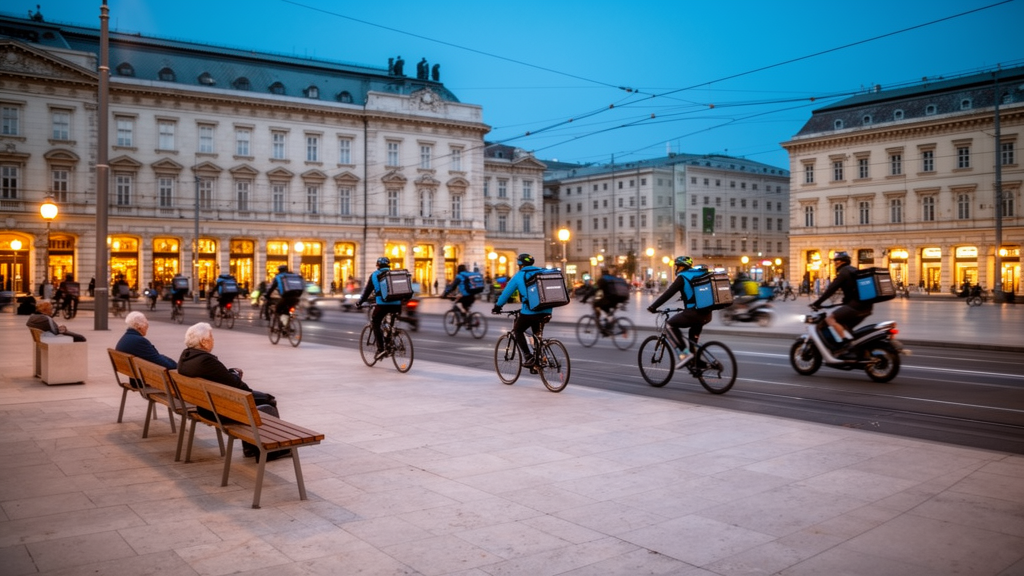
In the renewed square, those practices have become difficult to sustain. The benches are narrow, shade is limited and the surfaces uninviting, so people pause briefly, often while checking their phones or waiting for a ride, before moving on. Researchers describe a new form of absent togetherness, in which attention circulates across physical and digital realms through short, frequent but thin mobile micro-interactions. Crucially, the study argues that digital technology does not erode sociability on its own; rather, it fills the void left by a square that no longer supports lingering or collective tempo. Even groups who arrive together often sit facing outward or turn to their phones, because the environment offers few cues for shared presence. Online commenters describe the square as too clean or soulless, a place one simply passes through rather than stays.
The most vivid embodiment of the new order is the delivery rider. Gig workers coordinated through platforms such as Wolt and Foodpanda now wait at the corner of Rákóczi Road, their movements dictated by algorithmic notifications rather than human tempo. Their sociability is what researchers call networked proximity: co-presence organised by data and labour rather than spontaneity. The square’s MOL Bubi bike dock and tram stop coexist with riders’ phones, forming a hybrid landscape of automation and mobility. A 62-year-old woman who has lived near Blaha since childhood recalled that her mother once bought from street vendors there, but now everything can be ordered on a phone and delivered by Wolt workers. Everyday practices once structured by embodied interaction, including waiting, choosing and casual conversation, have been compressed into platform-mediated transactions that reduce both the duration and social depth of encounter.
The transformation also extends into questions of who is welcome. The new infrastructures of the square, including automated toilets, surveillance cameras and benches designed to prevent lying down, perform control not through prohibition but through calibration. The timed, fee-based public toilet functions as a subtle tool of deterrence, making the square less inviting for people already stigmatised as undesirable, particularly homeless residents. This filtering of presence reflects broader revanchist urban policies in Hungary that frame control of public space as the protection of order. Meanwhile, the proliferation of Airbnb apartments in adjacent neighbourhoods has contributed to rising rents and the displacement of long-term residents. A 53-year-old resident who has lived in the area since the late 1990s described seeing different tenants in her building every week as owners rent to visitors, eroding the everyday recognition and familiarity that once structured neighbourhood life.
The study situates these changes within the wider trajectory of post-socialist urbanism, in which cities across central and eastern Europe experienced a compressed modernisation that condensed decades of capitalist restructuring into a few decades of rapid change. Renewal projects framed as Europeanisation or revitalisation often recode modernity as a visual and moral order in which cleanliness, safety and visibility stand for progress, producing socially selective spaces that privilege consumption over interaction. Yet the author is careful to note that the dynamics at Blaha increasingly reflect global digital capitalism rather than the post-socialist condition alone. Platform-based labour, data infrastructures and algorithmic coordination reorganise everyday rhythms everywhere, entangling sociability with optimisation, visibility and real-time responsiveness.
The conclusion is neither nostalgic nor simply pessimistic. Sociability at Blaha persists, but as fleeting encounters regulated by circulation, and fleeting encounters can still produce empathy, recognition and curiosity. What has disappeared is not public life itself but the depth, duration and mutual recognition that once sustained it: a condition the study describes as rhythm without resonance, social density without social depth. The square no longer breathes collectively; it scrolls. The real challenge, the author argues, is not to recover a lost past but to recognise how publicness is being redefined in the present through design, visibility and algorithmic governance, and to consider what forms of sociability might still emerge within, against or beyond the logics of efficiency and control that now shape the contemporary city.
Subject of Research: Urban renewal, platform labour and the transformation of public sociability in a post-socialist Budapest square
Article Title: Fleeting encounters: digital labour mobility and the loss of public sociality in Blaha Lujza Square, Budapest
Article References: Viloria, J. C. (2026). Fleeting encounters: digital labour mobility and the loss of public sociality in Blaha Lujza Square, Budapest. Geographica Helvetica, 81(3), 375-391. https://doi.org/10.5194/gh-81-375-2026
Image Credits: AI Generated
Keywords: urban renewal, public space, sociability, platform labour, Budapest, post-socialist cities, algorithmic governance, digital mediation, urban loss, gig economy, urban rhythms, geography
Cite Scienmag News
Courtney Benton. (October 9, 2026). How a Budapest Square Lost Its Pause: Renewal, Delivery Apps and the Thinning of Public Life. Scienmag. https://scienmag.com/how-a-budapest-square-lost-its-pause-renewal-delivery-apps-and-the-thinning-of-public-life/
Courtney Benton. "How a Budapest Square Lost Its Pause: Renewal, Delivery Apps and the Thinning of Public Life." Scienmag, 9 October 2026, https://scienmag.com/how-a-budapest-square-lost-its-pause-renewal-delivery-apps-and-the-thinning-of-public-life/. Accessed 9 October 2026.
Courtney Benton. "How a Budapest Square Lost Its Pause: Renewal, Delivery Apps and the Thinning of Public Life." Scienmag. October 9, 2026. https://scienmag.com/how-a-budapest-square-lost-its-pause-renewal-delivery-apps-and-the-thinning-of-public-life/


