


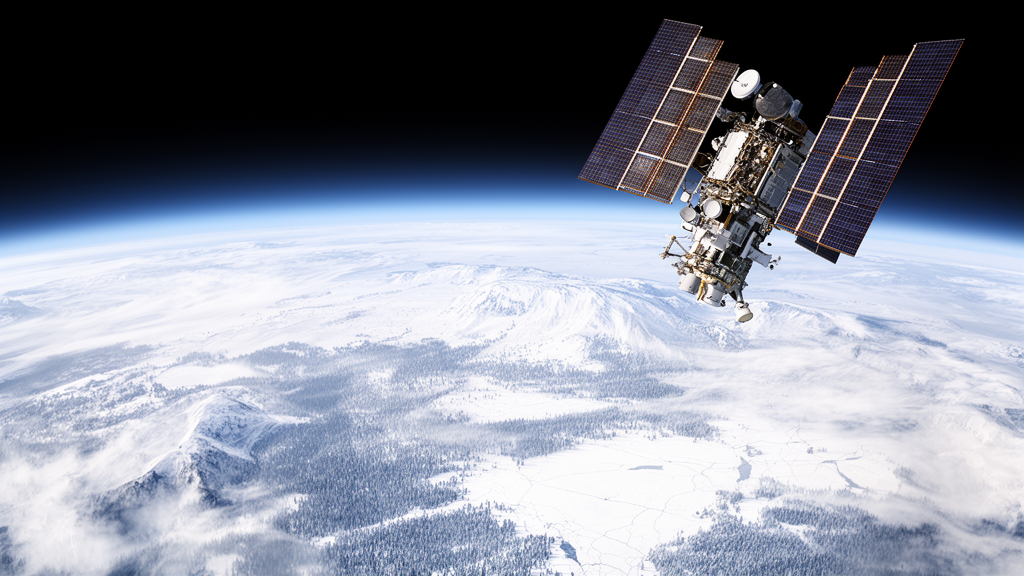
Every winter, an enormous reservoir of freshwater quietly accumulates across the Northern Hemisphere. Seasonal snow is one of the largest and most dynamic freshwater stores on Earth, feeding rivers that sustain billions of people, powering agriculture and hydropower, and shaping the climate system through its bright, reflective surface. Yet for all its importance, scientists have struggled to answer a deceptively simple question: how much water is actually locked up in the global snowpack at any given moment? A new dataset developed by Hussein Mohasseb and Shuang Yi of the University of Chinese Academy of Sciences, described in a preprint under review for the journal Earth System Science Data, offers one of the most comprehensive answers yet, and it does so by weighing the snow from orbit.
The product, called GMM-SWE v1.0, covers the Northern Hemisphere between 35° and 85° north latitude for every month from 2003 to 2022. Rather than relying on a single measurement technique, the framework fuses two very different streams of information: satellite measurements of tiny changes in Earth’s gravity field from the GRACE and GRACE-FO missions, and high-resolution meteorological data from the ERA5-Land reanalysis. The two are combined within a physics-constrained data assimilation scheme built around an adaptive Kalman filter, a mathematical engine that continuously reconciles model predictions with observations by weighting each according to its uncertainty. The result is a spatially continuous, physically consistent record of three fundamental snow properties: snow water equivalent, snow depth, and snow density.
The gravitational component is the conceptual heart of the approach. The GRACE satellites, flying in tandem, detect minuscule variations in the distance between one another as they pass over regions of changing mass on the surface below. When snow accumulates, the ground beneath it becomes fractionally heavier, and the satellites register the shift. The signal, however, is not clean. Changes in total terrestrial water storage also include groundwater fluctuations, soil moisture, surface water, and other hydrological components. To isolate the snow contribution, the researchers explicitly subtracted these non-snow terms, derived from an ensemble of land surface and hydrological models. This mass-balance approach means the snow estimates are anchored to actual physical mass rather than to statistical relationships that may break down outside the conditions in which they were calibrated.
Gravity alone, however, cannot tell the whole story. The GRACE measurements are coarse in space and time, and they say nothing directly about how deep the snowpack is or how dense it has become. GMM-SWE therefore incorporates high-resolution meteorological forcing and global topographic information to capture elevation-dependent melt dynamics and temperature thresholds, a refinement that matters enormously in complex mountain terrain where snow behavior can change dramatically over a few hundred meters of altitude. Once the assimilated snow mass has been estimated, it is further refined with a Rauch–Tung–Striebel smoother, a technique that reduces temporal noise and ensures that the seasonal evolution of the snowpack remains physically coherent rather than jittering from month to month.
Perhaps the most innovative element of the dataset is its dynamic decoupling of snow mass and snow volume. Traditional large-scale products often assume a static relationship between depth and density, an assumption that ignores the fact that a snowpack is a living, evolving material. Fresh powder may sit at densities below 100 kilograms per cubic meter, while a spring snowpack that has survived repeated melt–freeze cycles can exceed 500. GMM-SWE retrieves snow depth and density by coupling the smoothed snow water equivalent estimates with a physics-based SNOW-17 compaction scheme resolved at sub-daily time steps. This allows the dataset to explicitly represent densification and metamorphic processes within the snowpack, capturing how grains round, settle, and transform under their own weight and through temperature fluctuations, without leaning on fixed density assumptions that vary wildly across climates and seasons.
The validation effort behind the dataset is substantial. The researchers compared their estimates against an extensive network of 13,135 in-situ ground stations spanning a wide range of climatic and topographic regimes, as well as against established products including ERA5-Land, GLDAS, WGHM, and GlobSnow. The results show consistently strong performance, with particular skill in the high-latitude continental interiors of Siberia and North America, where seasonal snow dominates the annual water cycle. Crucially, the framework substantially improves the representation of snow water equivalent in complex mountain regions, such as high mountain Asia, where passive microwave satellite retrievals, the backbone of many conventional snow products, are severely limited by deep snowpacks, wet snow conditions, and rugged topography that scramble the microwave signal.
Sensitivity analyses add an important layer of credibility. The researchers found that the large-scale patterns of snow water equivalent and their year-to-year variability are governed primarily by the physical mass-balance constraints at the core of the method, rather than by finely tuned parameter choices. In other words, the dataset’s performance does not hinge on arbitrary calibration decisions that might not generalize; it emerges from the underlying physics of mass conservation. This robustness is exactly what is needed for a product intended to serve hydrological applications and climate-scale assessments of cryospheric change, where users must be able to trust that the numbers reflect reality rather than modeler preference.
The practical implications reach far beyond the scientific community. Snow water equivalent is the single most important variable for seasonal water forecasting in snow-dominated basins: it determines how much meltwater will arrive in rivers and reservoirs months later. Water managers across the western United States, Central Asia, and the Himalayan headwaters make decisions worth billions of dollars based on snow estimates, and errors in those estimates propagate directly into flood risk, drought planning, and hydropower generation. A unified, physically informed dataset that spans two decades and the entire hemisphere gives these communities a consistent baseline, and gives climate scientists the long, homogeneous record they need to detect trends in seasonal snow storage and to evaluate how well climate models capture them.
The dataset also arrives at a moment of rapid change. Warming temperatures are altering the timing of snowfall, shortening the snow season, and shifting precipitation from snow to rain in many mid-latitude regions, with pronounced regional differences in how seasonal snow storage is evolving. Disentangling those regional trajectories requires observations that are consistent across borders and biomes, something no network of ground stations alone can provide. By combining the global reach of satellite gravimetry with the local realism of meteorological forcing and snow physics, GMM-SWE offers a template for how the next generation of cryospheric monitoring products might be built, and the authors have released both the dataset and the MATLAB production code openly, inviting scrutiny, reuse, and improvement by the wider community.
As with any ambitious synthesis, the work is a preprint currently under peer review, and its assumptions, particularly the model-based subtraction of non-snow water storage components, will face scrutiny from specialists. But the underlying idea is undeniably elegant: the same planet-watching satellites originally designed to track melting ice sheets and draining aquifers can, with the right physics bolted on, be repurposed to weigh the winter snowpack of an entire hemisphere. In doing so, they transform one of hydrology’s most stubborn uncertainties into a monthly, measurable quantity, one that may prove indispensable as the world’s snowlines climb and the freshwater stored in snow becomes an ever more precious and contested resource.
Subject of Research: A GRACE and meteorology data assimilation dataset of Northern Hemisphere snow water equivalent, snow depth, and snow density for 2003–2022
Article Title: GMM-SWE v1.0: A GRACE–Meteorology-Constrained Dataset of Snow Water Equivalent, Snow Depth, and Snow Density over the Northern Hemisphere, 2003–2022
Article References: Mohasseb, H., & Yi, S. (2026). GMM-SWE v1.0: A GRACE–Meteorology-Constrained Dataset of Snow Water Equivalent, Snow Depth, and Snow Density over the Northern Hemisphere, 2003–2022. https://doi.org/10.5194/essd-2026-675
Image Credits: AI Generated
Keywords: snow water equivalent, GRACE, GRACE-FO, data assimilation, snow density, snow depth, ERA5-Land, Northern Hemisphere, cryosphere, hydrology, satellite gravimetry, climate change
Cite Scienmag News
Violet Maxwell. (October 9, 2026). Weighing the World’s Snow: Satellites Track Northern Hemisphere Snowpack From Space. Scienmag. https://scienmag.com/weighing-the-worlds-snow-satellites-track-northern-hemisphere-snowpack-from-space/
Violet Maxwell. "Weighing the World’s Snow: Satellites Track Northern Hemisphere Snowpack From Space." Scienmag, 9 October 2026, https://scienmag.com/weighing-the-worlds-snow-satellites-track-northern-hemisphere-snowpack-from-space/. Accessed 9 October 2026.
Violet Maxwell. "Weighing the World’s Snow: Satellites Track Northern Hemisphere Snowpack From Space." Scienmag. October 9, 2026. https://scienmag.com/weighing-the-worlds-snow-satellites-track-northern-hemisphere-snowpack-from-space/


