


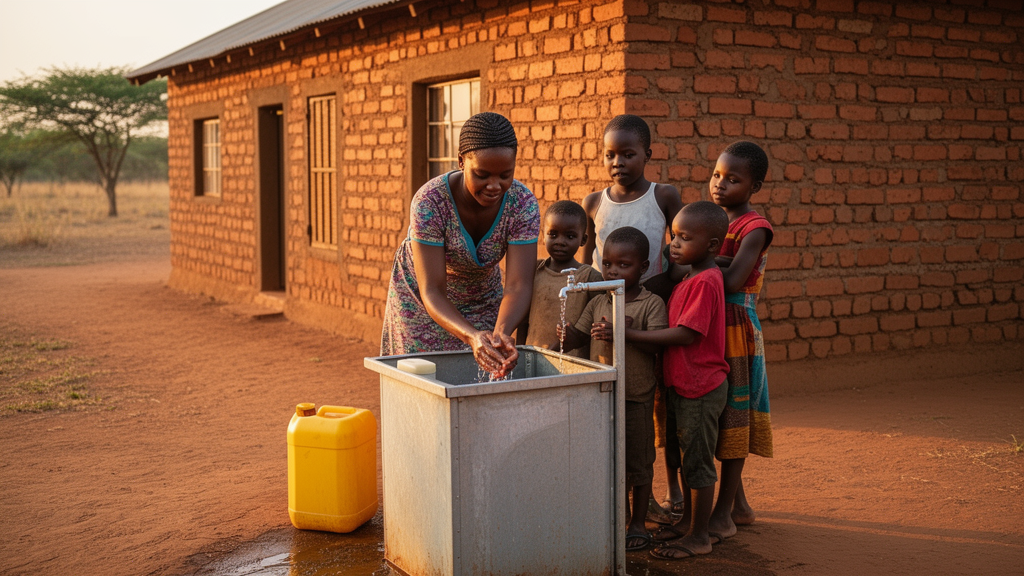
Handwashing with soap is one of the most cost-effective ways to prevent the spread of respiratory and diarrheal disease, yet billions of people around the world still lack a dedicated place at home to wash their hands. A new study from peri-urban Lusaka, Zambia, offers a rare and rigorous answer to a question that has long puzzled the water, sanitation and hygiene sector: when the price is right, will low-income households actually open their wallets and buy a handwashing facility? The findings, published in PLOS Water by an international team of researchers, suggest that the answer is a qualified yes, but only if the product is one they genuinely like and the price is brought within reach through substantial subsidies or financing.
The research team, led by Katherine Davies of the London School of Hygiene & Tropical Medicine together with colleagues including Katayi Mwila-Kazimbaya, Ian Ross, Elisabeth Tadiri, Jenala Chipungu and Robert Dreibelbis, designed a two-phase voucher-based randomised pricing experiment. The approach was deliberately crafted to move beyond the limitations of traditional surveys, in which people are simply asked how much they would be willing to pay for a good they have never used. Stated preference methods of that kind are notorious for producing inflated or unreliable estimates, because respondents have no real money at stake and no experience of the product in their daily lives. By contrast, this study let households live with the technology before asking them to buy it, and then confronted them with real purchase decisions at randomly assigned prices.
In the first phase, the researchers tested three different handwashing facilities with sixty households. Each household received two of the three designs to use for two weeks, with twenty households assigned to each possible combination. The three products spanned a wide range of cost and provenance. The most expensive was a pre-manufactured handwashing station retailing at 1,000 Zambian kwacha, roughly 38 US dollars. The cheapest was a low-cost pre-manufactured option at 100 kwacha, about 4 dollars. The third was a locally manufactured design known as the Kalingalinga bucket, a bucket fitted with a tap and mounted on a metal stand, priced at 250 kwacha or approximately 10 dollars.
When the trial period ended, the preferences were strikingly clear. Households overwhelmingly favoured the Kalingalinga bucket over both of the pre-manufactured alternatives, despite its mid-range price. The finding carries an important lesson for product designers and programme implementers: affordability alone does not determine whether a hygiene technology will be adopted. The locally made bucket evidently offered a combination of usability, durability, aesthetics and local familiarity that the imported designs could not match, even when those designs were either four times cheaper or four times more expensive. Local manufacture may also have played a role, since products made within the community can be easier to repair, replace and trust than mass-produced items from distant suppliers.
The second phase of the experiment focused entirely on the preferred design. A new sample of 160 households received a Kalingalinga bucket and used it for two weeks, giving them the same hands-on experience as the first cohort. At the end of the trial, each household was given a gift of 50 kwacha, worth about 2 dollars, and a randomly assigned discount voucher. The vouchers came in four levels: 20, 40, 60 or 80 percent off the retail price, with forty households in each group. This randomisation is the methodological heart of the study. Because the discounts were assigned by chance, any differences in purchasing behaviour across groups can be attributed to price rather than to pre-existing differences in wealth, motivation or enthusiasm for handwashing.
The results revealed a steep price sensitivity. Among the forty households offered an 80 percent discount, which reduced the effective price to zero, 98 percent chose to buy the facility, with 39 of 40 households making the purchase. At the other end of the spectrum, only 30 percent of households offered a 20 percent discount, corresponding to an effective price of 150 kwacha, decided to buy. In between, the purchase rates fell along a demand curve that the researchers used to build a predictive model. That model estimated that half of households would purchase the handwashing facility at an effective price of 103 kwacha, which corresponds to roughly 40 percent of the retail price. In other words, even for a product households had come to like through two weeks of use, the price needed to fall well below the market rate before a majority would commit.
Perhaps the most intriguing finding came from the households that declined to buy. Despite turning down the purchase offer, every non-purchasing household reported a positive stated willingness to pay when asked directly. The researchers interpret this as evidence of latent demand: households value handwashing facilities and would like to own one, but their ability to pay is constrained by the realities of household budgets in peri-urban Lusaka. The gap between what people say they would pay in the abstract and what they actually hand over in cash reflects not indifference but genuine financial hardship. This distinction matters enormously for policy, because it suggests that the barrier is affordability rather than a lack of perceived benefit.
The implications reach well beyond Zambia. Global efforts to achieve universal hand hygiene, embedded in the Sustainable Development Goals, have long recognised that access to a dedicated handwashing facility increases handwashing with soap, which in turn protects against respiratory infections and diarrheal disease, two of the leading causes of illness and death in young children worldwide. Yet programmes have often focused on supplying facilities through giveaways or on promoting behaviour change, while paying little attention to whether and how much end-users are able and willing to invest in the hardware themselves. This study is among the first to quantify that willingness with a randomised pricing design, and its message is sobering: market-based approaches that expect households to pay full retail price are unlikely to achieve anywhere near universal coverage.
At the same time, the study offers grounds for optimism. The strong preference for the locally manufactured Kalingalinga bucket suggests that well-designed, affordable products made close to the communities that use them can command real demand. The demand curve generated by the experiment provides concrete numbers that policymakers and programme designers can use to calibrate subsidies, voucher schemes, microfinance products or results-based financing. If half of households will buy at around 40 percent of the retail price, then a targeted subsidy of roughly 60 percent, or a financing mechanism that spreads payments over time, could dramatically expand coverage without the full cost of universal free distribution. The 50 kwacha gift given to all participants also demonstrated that modest cash transfers can lower the effective barrier to purchase.
The researchers are careful to note the boundaries of their evidence. The experiment took place in one peri-urban setting in Lusaka, and preferences and price sensitivity may differ in rural areas, in other countries, or for other product designs. The two-week trial period, while far more informative than a hypothetical survey, still cannot capture long-term durability, maintenance costs or sustained use over months and years. Nevertheless, the methodological template, combining free trials, randomised discounts and real purchase decisions, offers the hygiene sector a powerful new tool for testing not just whether people like a technology, but what they will actually sacrifice to own it. As governments and donors grapple with the enormous financing gap for hygiene, studies like this one make clear that closing it will require financial interventions that make desirable handwashing facilities genuinely affordable to the households that stand to benefit most.
Subject of Research: Household willingness to pay for handwashing facilities in peri-urban Lusaka, Zambia, measured through a randomised voucher-based pricing experiment
Article Title: How much are households willing to invest in hand hygiene enabling technologies? A randomised pricing experiment in Lusaka, Zambia
Article References: Davies, K., Mwila-Kazimbaya, K., Ross, I., Tadiri, E., Chipungu, J., & Dreibelbis, R. (2026). How much are households willing to invest in hand hygiene enabling technologies? A randomised pricing experiment in Lusaka, Zambia. PLOS Water, 5(8), e0000583. https://doi.org/10.1371/journal.pwat.0000583
Image Credits: AI Generated
DOI: 10.1371/journal.pwat.0000583
Keywords: hand hygiene, handwashing facilities, willingness to pay, randomised pricing experiment, Zambia, Lusaka, water sanitation and hygiene, vouchers, household investment, diarrheal disease prevention, respiratory disease prevention, PLOS Water
Cite Scienmag News
Violet Maxwell. (October 9, 2026). Households in Zambia Reveal How Much They Would Pay for Handwashing Stations. Scienmag. https://scienmag.com/households-in-zambia-reveal-how-much-they-would-pay-for-handwashing-stations/
Violet Maxwell. "Households in Zambia Reveal How Much They Would Pay for Handwashing Stations." Scienmag, 9 October 2026, https://scienmag.com/households-in-zambia-reveal-how-much-they-would-pay-for-handwashing-stations/. Accessed 9 October 2026.
Violet Maxwell. "Households in Zambia Reveal How Much They Would Pay for Handwashing Stations." Scienmag. October 9, 2026. https://scienmag.com/households-in-zambia-reveal-how-much-they-would-pay-for-handwashing-stations/


