


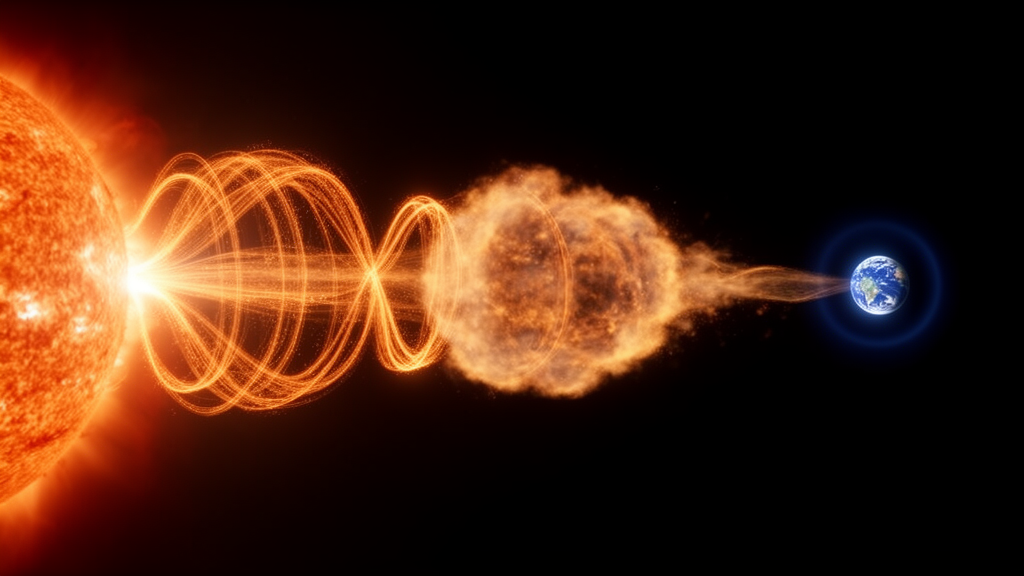
In June 2015, the Sun fired two coronal mass ejections (CMEs) toward Earth within four days of each other. Both were fast, massive eruptions of plasma and magnetic field, and both arrived on schedule. Yet one triggered a severe geomagnetic storm that rattled the planet’s magnetic shield, while the other barely registered a ripple. A new study published in Annales Geophysicae by Somaiyeh Sabri of the University of Tehran and Stefaan Poedts of KU Leuven has now traced, end to end, exactly why these two seemingly similar solar storms produced such wildly different outcomes on Earth, and in doing so has validated a complete forecasting chain that could one day give power grid operators hours of actionable warning.
The team coupled two sophisticated numerical models into a single pipeline. At the front end sits EUHFORIA, the European Heliospheric Forecasting Information Asset, a three-dimensional magnetohydrodynamic model that simulates the inner heliosphere from 0.1 to 2 astronomical units. EUHFORIA injects CMEs at its inner boundary as flux-rope structures defined by launch time, position, angular width and initial speed, then propagates them through the ambient solar wind, capturing shock formation, CME-CME interactions and the evolution of the embedded magnetic field en route to Earth. At the Lagrange L1 point, 1.5 million kilometres sunward of our planet, the model outputs time series of proton density, bulk velocity, thermal pressure and the three components of the interplanetary magnetic field, which then serve as the upstream boundary conditions for the second model.
That second model, Gorgon-Space, is a global magnetohydrodynamic code originally developed for high-energy-density plasma physics, including Z-pinches and laser-plasma experiments, and later adapted to planetary magnetospheres. Its defining numerical feature is that it evolves the magnetic vector potential rather than the magnetic field itself, which guarantees that the divergence-free condition on the magnetic field is preserved to machine precision. That property matters enormously during CME impacts, when the magnetosphere is compressed so violently that standard solvers can accumulate spurious magnetic monopoles and degrade the solution. Gorgon-Space runs on a fixed Cartesian grid spanning 90 by 80 by 80 Earth radii with a uniform resolution of half an Earth radius, resolving the bow shock, the magnetopause and a substantial portion of the magnetotail, while a thin-shell ionosphere at roughly 110 kilometres altitude closes the coupled system.
The two test cases were ideally matched. CME1, launched on 21 June 2015 at 05:01 UT with an initial speed of 1250 kilometres per second, arrived at Earth on 23 June at 00:03 UT and ignited a major G4-class geomagnetic storm, with the planetary Kp index peaking at 8 and the SYM-H index plunging to roughly minus 200 nanotesla. CME2, launched on 25 June at 10:51 UT, was actually faster, leaving the Sun at 1450 kilometres per second, and reached Earth on 28 June at 12:52 UT. Yet it produced only a minor disturbance, with Kp hovering near 2 and SYM-H dipping to just about minus 20 nanotesla. The difference, the simulations show, lay entirely in the orientation of the embedded interplanetary magnetic field.
CME1 carried a sustained southward magnetic field component, with Bz below minus 15 nanotelsa for more than six hours. Southward fields are the golden ticket for geomagnetic trouble: they reconnect antiparallel with Earth’s northward-pointing dayside field, tearing open previously closed field lines and allowing solar wind energy and momentum to pour into the magnetosphere. The reconnection electric field, a standard proxy for the rate of energy transfer, exceeded 15 millivolts per metre during CME1, well above the 1 to 2 millivolts per metre threshold for strong driving. CME2, by contrast, kept Bz above minus 5 nanotesla for over 90 percent of its passage, yielding a feeble reconnection field below 3 millivolts per metre and almost no energy transfer, despite its higher speed.
The simulated magnetospheric response to CME1 was dramatic. The dayside magnetopause and bow shock were pushed inward to roughly 10 Earth radii from the planet’s centre, compared with about 20 Earth radii during the weaker event, reflecting the far greater dynamic pressure of the incoming solar wind. Thermal pressure surged throughout the equatorial plane, and the magnetotail stretched and distorted in ways consistent with the onset of nightside reconnection, with the formation of X-lines and the ejection of plasmoids converting magnetic energy into kinetic and thermal energy. Flow velocity visualisations showed energetic, irregular plasma motion around the magnetosphere as solar wind energy was transferred through dayside reconnection, while the closed-field regions on the nightside shrank as open magnetic flux accumulated.
The ionospheric consequences were equally striking. Field-aligned currents, the conduits through which magnetospheric stress is transmitted to the high-latitude ionosphere, surged past 23 million amperes during CME1, compared with less than 8 million amperes of weak, disorganised current during CME2. The simulations reproduced the classic two-phase response to a shock arrival: a preliminary impulse driven by compression of the dayside magnetosphere, followed by a main impulse marking the full engagement of the global Region-1 current system. Crucially, the modelled current patterns matched observations from the AMPERE satellite constellation closely in morphology, timing and integrated magnitude, validating the dynamic conductance treatment that links auroral precipitation to ionospheric conductivity.
The cross-polar cap potential, a key measure of global ionospheric convection, climbed to approximately 160 kilovolts during CME1, a signature of the powerful convection electric field that drives plasma transport across the polar cap and feeds the ring current that defines storm intensity. During CME2 the potential barely moved, physically consistent with the low plasma velocities observed in the magnetosphere for that event. This convection also matters for practical technology: the same current systems that light up auroras can induce geomagnetically induced currents in long conductors such as power lines and pipelines, and ionospheric disturbances can degrade high-frequency radio communications and introduce positioning errors in satellite navigation.
The broader lesson is one that space weather forecasters have long suspected but rarely demonstrated with such quantitative clarity: CME speed alone is a poor predictor of storm intensity. A fast CME with an unfavourable magnetic geometry can pass by almost unnoticed, while a slightly slower one carrying hours of southward field can cripple infrastructure. By resolving the complete causal chain from CME launch at the Sun, through heliospheric propagation, to magnetospheric compression, current intensification and ionospheric electrodynamic response, the EUHFORIA-Gorgon-Space chain offers a physics-based way to reject false alarms from fast but magnetically benign eruptions. The authors note that their framework, with its numerically robust divergence-free formulation, is well suited to operational forecasting of geomagnetically induced current risk, and future work will extend validation to auroral electrojet indices derived from ground magnetometer networks.
Subject of Research: Magnetosphere–ionosphere response to two coronal mass ejections simulated with a coupled EUHFORIA–Gorgon-Space modelling chain
Article Title: Magnetosphere–ionosphere response to the 21 and 25 June 2015 coronal mass ejections
Article References: Sabri, S., & Poedts, S. (2026). Magnetosphere–ionosphere response to the 21 and 25 June 2015 coronal mass ejections. Annales Geophysicae, 44(2), 743-763. https://doi.org/10.5194/angeo-44-743-2026
Image Credits: AI Generated
DOI: 10.5194/angeo-44-743-2026
Keywords: coronal mass ejection, space weather, geomagnetic storm, magnetosphere, ionosphere, EUHFORIA, Gorgon-Space, magnetic reconnection, field-aligned currents, cross-polar cap potential, interplanetary magnetic field, MHD simulation
Cite Scienmag News
Violet Maxwell. (October 9, 2026). Two solar storms, one surprise: why speed is not what makes a CME dangerous. Scienmag. https://scienmag.com/two-solar-storms-one-surprise-why-speed-is-not-what-makes-a-cme-dangerous/
Violet Maxwell. "Two solar storms, one surprise: why speed is not what makes a CME dangerous." Scienmag, 9 October 2026, https://scienmag.com/two-solar-storms-one-surprise-why-speed-is-not-what-makes-a-cme-dangerous/. Accessed 9 October 2026.
Violet Maxwell. "Two solar storms, one surprise: why speed is not what makes a CME dangerous." Scienmag. October 9, 2026. https://scienmag.com/two-solar-storms-one-surprise-why-speed-is-not-what-makes-a-cme-dangerous/


