


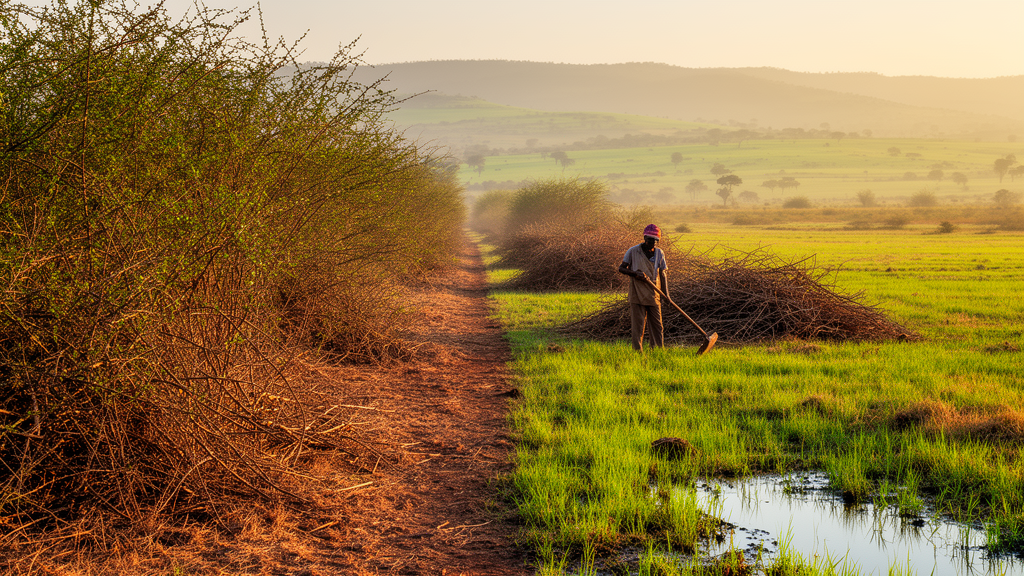
In the semi-arid rangelands of southern Ethiopia, dense thickets of woody shrubs have been quietly transforming the landscape for decades, and a new study suggests that this silent invasion is making droughts worse. Research published in Theoretical and Applied Climatology offers some of the most detailed quantitative evidence yet that managing bush encroachment can measurably reduce drought severity, both today and under the intensifying climate conditions projected for the coming decades. The work, led by Mohammed Abdulahi of Haramaya University together with collaborators in Norway, Uganda and Ethiopia, focused on the Ganale Dawa River Basin, a vast and drought-prone watershed where pastoralist communities depend directly on soil moisture and streamflow for their livelihoods.
The research team set out to answer a question that has long frustrated land managers and climate scientists alike: does clearing encroaching woody vegetation actually help, and if so, how much? Nature-based solutions, which harness ecosystem processes rather than engineered infrastructure, are increasingly promoted as sustainable responses to drought. Yet rigorous evaluations of their effectiveness, particularly under future climate pathways, have remained scarce. Most previous studies have examined woody encroachment at the scale of individual plots or small catchments, leaving open the question of whether the benefits scale up to an entire river basin and whether they persist as temperatures rise and rainfall patterns shift.
To tackle this, the researchers assembled an unusually rich data foundation spanning nearly 120 years, from 1982 to 2100. They combined satellite-derived remote sensing products with bias-corrected climate projections from the CMIP6 archive, the latest generation of global climate models used in international assessments. Historical and future climate forcing came from well-established datasets, including CHIRPS satellite-based rainfall estimates, CHIRTS temperature records, ERA5 reanalysis data and NASA’s FLDAS land data assimilation outputs, all processed through the Google Earth Engine platform. Land cover information, including the extent of woody encroachment, was drawn from the Dynamic World near-real-time land use dataset, allowing the team to map where shrubs and trees had displaced grassland across the basin.
At the heart of the analysis sat a Random Forest machine learning framework, an ensemble method that builds hundreds of decision trees and averages their predictions to capture complex, nonlinear relationships between environmental variables. The team trained the model to simulate two critical hydrological variables: soil moisture, which governs agricultural drought, and runoff, which determines hydrological drought and the water available in rivers and streams. The model was validated against observed records, and the appendix of the published paper shows close agreement between predicted and observed values for both soil moisture and runoff, giving confidence that the simulations captured real basin behaviour rather than statistical artefacts.
With this modelling engine in place, the researchers constructed three contrasting land management scenarios and compared them against a baseline. The first scenario, severe bush encroachment, assumed that woody vegetation continued to spread unchecked. The second, moderate bush clearing, simulated partial removal of encroaching shrubs. The third, intensive bush clearing, represented aggressive restoration of grassland dominance across the basin. Each scenario was run under two future climate pathways drawn from the CMIP6 framework: SSP2-4.5, a moderate emissions scenario, and SSP5-8.5, a high-emissions trajectory in which warming continues largely unabated through the end of the century. Drought severity was then quantified using standardized indices for soil moisture and runoff, the same family of metrics widely used by drought monitoring agencies worldwide.
The results were striking in both directions. Where bush encroachment was left unmanaged, drought conditions deteriorated significantly: agricultural drought severity increased by up to 21 percent and hydrological drought severity by up to 7 percent under future climate conditions. In other words, allowing woody plants to continue their spread would actively deepen the water stress that climate change alone is expected to bring. The mechanism is well understood from ecohydrological research: dense woody vegetation intercepts rainfall before it reaches the soil, draws water from deeper layers through extensive root systems, and increases evapotranspiration, effectively competing with grasses and reducing the water that percolates into soils and streams.
Conversely, intensive bush clearing produced the largest drought-mitigation benefits of any intervention tested. Under the far-future high-emissions scenario, clearing reduced agricultural drought severity by up to 26 percent and hydrological drought severity by up to 8 percent. Moderate clearing also delivered consistent reductions, though smaller in magnitude, confirming a clear dose-response relationship: the more thoroughly woody vegetation is managed, the greater the relief for soil moisture and streamflow. Notably, the benefits were most pronounced under the most severe climate pathway, suggesting that active vegetation management becomes even more valuable, not less, as warming intensifies through the century.
One of the study’s most important findings concerns the asymmetry between drought types. Agricultural drought, expressed through soil moisture deficits, responded far more strongly to vegetation management than hydrological drought, expressed through runoff. This indicates that woody plants exert their strongest influence on the near-surface water balance, regulating how much moisture remains available in the root zone where crops and grasses grow. The runoff response, while real and consistent, was more modest, reflecting the complexity of basin-scale water routing and the fact that streamflow integrates processes across the entire catchment. For pastoralists and agro-pastoralists in the region, however, the soil moisture signal is precisely the one that matters most, since it governs pasture growth and rain-fed agriculture.
The findings carry significant implications well beyond the Ganale Dawa Basin. Woody encroachment is a global phenomenon, affecting savannas and grasslands across Africa, North America, Australia and South America, driven by a combination of overgrazing, fire suppression, rising atmospheric carbon dioxide that favours woody growth, and changing rainfall regimes. Previous research has documented how encroaching species can desiccate deeper soil layers, alter subsurface hydrology and reduce streamflow even in grasslands that receive adequate rainfall. By quantifying these effects at basin scale and projecting them decades into the future, the new study transforms bush clearing from a locally debated land management practice into a quantifiable climate adaptation strategy with numbers attached.
The study also adds a critical piece of evidence to the broader debate over nature-based solutions. Critics have sometimes questioned whether ecosystem-based interventions can deliver measurable benefits under the harsh conditions of a rapidly warming world, or whether their advantages evaporate precisely when they are needed most. This research demonstrates the opposite for semi-arid rangeland basins: vegetation management remained effective across all climate periods examined, from the historical record through the far future, and delivered its greatest relative benefits under the most extreme scenario tested. The authors emphasize that bush encroachment control is an effective nature-based approach for reducing drought severity and improving climate resilience in semi-arid rangelands. With all datasets and analysis code made publicly available, including through a Zenodo repository, the work provides a replicable template for evaluating vegetation-based drought mitigation in other dryland basins facing the twin pressures of land degradation and climate change.
Subject of Research: Effectiveness of bush encroachment control as a nature-based solution for mitigating agricultural and hydrological drought under current and future climate scenarios in a semi-arid Ethiopian river basin
Article Title: Evaluation of bush encroachment control effectiveness in reducing drought under different climate change scenarios
Article References: Abdulahi, M., Egli, P. E., Belayneh, A., Bamutaze, Y., Nakakaawa, C. A., & Dejene, S. W. (2026). Evaluation of bush encroachment control effectiveness in reducing drought under different climate change scenarios. Theoretical and Applied Climatology, 157(9), Article 596. https://doi.org/10.1007/s00704-026-06522-2
Image Credits: AI Generated
DOI: 10.1007/s00704-026-06522-2
Keywords: bush encroachment, drought mitigation, nature-based solutions, CMIP6 climate projections, Random Forest modelling, soil moisture, runoff, Ganale Dawa River Basin, Ethiopia, semi-arid rangelands, remote sensing, climate change adaptation
Cite Scienmag News
Violet Maxwell. (October 9, 2026). Clearing Invasive Bush Could Soften Droughts in a Warming Ethiopia, Study Finds. Scienmag. https://scienmag.com/clearing-invasive-bush-could-soften-droughts-in-a-warming-ethiopia-study-finds/
Violet Maxwell. "Clearing Invasive Bush Could Soften Droughts in a Warming Ethiopia, Study Finds." Scienmag, 9 October 2026, https://scienmag.com/clearing-invasive-bush-could-soften-droughts-in-a-warming-ethiopia-study-finds/. Accessed 9 October 2026.
Violet Maxwell. "Clearing Invasive Bush Could Soften Droughts in a Warming Ethiopia, Study Finds." Scienmag. October 9, 2026. https://scienmag.com/clearing-invasive-bush-could-soften-droughts-in-a-warming-ethiopia-study-finds/


