


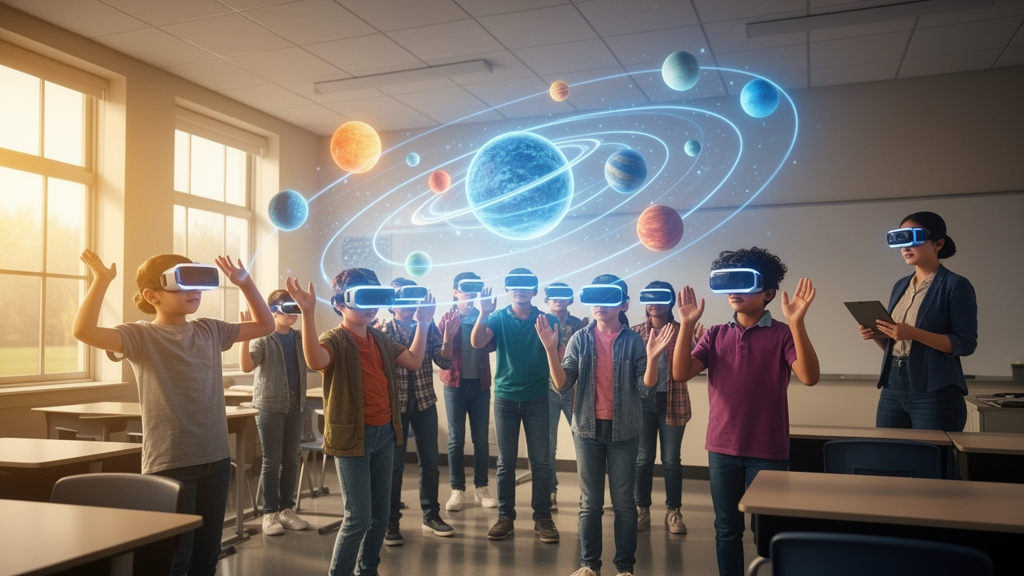
Virtual reality headsets have promised to transform science classrooms for years, letting students walk through cells, orbit planets, and manipulate forces that no textbook diagram can capture. But a new study from Indonesia asks a quieter, more intriguing question: what happens to students’ sense of their own digital abilities after they strap on a headset and navigate a three-dimensional solar system? The answer, published in Discover Education, is a nuanced portrait of teenage digital confidence — strong in some areas, surprisingly fragile in others, and far more complicated than a single headline number suggests.
The research team, led by Melani Putria Dewi Sari and Hartono Bancong of Universitas Muhammadiyah Makassar, worked with 144 junior secondary school students drawn equally from four different schools, with 36 participants from each. Over four instructional sessions of roughly 90 minutes each, conducted between late March and mid-May 2025, the students did not simply watch a virtual show. They prepared Android devices, opened and synchronized applications, activated Bluetooth, connected remote controllers and VR equipment, and then moved through a layered learning environment that combined video, text, in-application evaluation, and an immersive solar system simulation in which they selected planetary objects and linked spatial representations to pop-up explanations. Three weeks after the final session, the students completed a 25-item self-report questionnaire called the Assessment of Digital Competence for Students, or ADI-S, which took about 40 minutes to finish.
The headline result looks impressive at first glance. The overall mean score was 3.390 on a four-point scale, with a standard deviation of just 0.187, and the domain averages clustered toward the top of the response range. Digital Content Creation and Evaluation posted the highest domain mean at 3.467, followed by Digital Communication and Publication at 3.410, Information Literacy and Digital Learning at 3.353, and Operational Digital Technology at 3.331. Across the 3,600 individual item responses, 58.5 percent received the maximum score of four, and eight of the 25 items had maximum-score proportions of 70 percent or higher. On the surface, these teenagers appeared to view themselves as highly capable digital operators after their VR-supported physics experience.
But the researchers themselves sound a loud note of caution, and it is here that the study becomes genuinely instructive. Internal consistency of the questionnaire in this sample was extraordinarily low. Cronbach’s alpha for the overall 25-item score was just 0.170, and the coefficients for the four domains ranged from 0.044 to 0.165 — including a negative value of −0.003 for Information Literacy and Digital Learning. A negative alpha of that magnitude signals that some items within the domain correlated weakly or even negatively with one another, meaning that summing them into a single score cannot defensibly measure one underlying trait. The authors attribute this partly to the instrument’s heterogeneous, scenario-based construction, in which items represent qualitatively different digital practices and are scored by the quality of the behavioral response rather than through a uniform Likert ordering. Whatever the cause, the consequence is clear: the total and domain scores can only be read as descriptive summaries of observed responses, not as psychometrically reliable indicators of an underlying competence level.
Because the composite scores are statistically shaky, the real analytical weight falls on the item-level patterns, and those patterns are striking. Students rated themselves highest on adaptive, action-oriented practices: opening the virtual observatory application (mean 3.681), overcoming challenges when using technology (3.639), optimizing technology for communication efficiency (3.611), evaluating the success of a designed document (3.597), and responding to developments in animation software (3.590). By contrast, the lowest scores went to understanding software functions (2.701, with a large standard deviation of 1.218), organizing information from multiple sources (2.986), evaluating the reliability and authenticity of internet information (3.181), planning content before social media publication (3.188), and knowing the steps for updating software (3.188). In other words, the same students who felt confident launching a VR application and troubleshooting their equipment felt markedly less sure of themselves when it came to the conceptual, evaluative, and strategic sides of digital life.
This split maps neatly onto what the learning sequence actually demanded of them. Navigation, device connection, controller coordination, and basic troubleshooting were explicit components of the VR lesson; updating software, producing digital presentations, judging external sources of information, and planning social media posts were not. The authors are careful to frame this correspondence as contextual alignment only. Because the study included no baseline measure, no control condition, no behavioral trace data, and no performance-based assessment, nothing in the design can show that the VR activity produced or strengthened any of the reported competencies. The scores describe a snapshot taken three weeks after participation, and the observed profile may equally reflect prior digital experience, response styles, confidence, familiarity, or social desirability. The researchers explicitly state that the findings are not evidence of change, improvement, or an effect attributable to virtual reality.
The theoretical framing adds another layer of interest. The authors draw on cognitive-load theory and the Cognitive Affective Model of Immersive Learning, both of which hold that the educational value of VR depends not on immersion alone but on how technological affordances, instructional methods, presence, agency, and cognitive processing interact. In this study, students had to divide attention across interface controls, three-dimensional planetary representations, textual information, and instructional goals — a demanding coordination task that the study did not directly measure. Embodied-cognition perspectives suggest that interactions become meaningful when sensorimotor actions align with the representations being explored, and the solar system simulation offered exactly that kind of alignment. But the authors are careful to present these frameworks as interpretive lenses for understanding the task’s demands, not as empirically tested mechanisms, since cognitive load, attention, and embodiment were never directly assessed.
The between-school comparisons, though exploratory, add a modest twist. A one-way analysis of variance found statistically significant differences for Information Literacy and Digital Learning (F = 4.364, p = .006, η² = 0.086) and for the overall observed score (F = 2.688, p = .049, η² = 0.054), with school membership accounting for roughly 8.6 percent and 5.4 percent of the variance respectively. Post-hoc Tukey tests localized the differences: School A scored lower than School B and School C in the information-related domain, and lower than School B on the overall score. The remaining three domains showed no significant differences. The authors stress that these results must not be read as population-level school effects. Students were clustered within only four schools, the analysis did not model that clustering, measurement invariance was never established, and contextual variables such as teacher scaffolding, device access, infrastructure, and school digital culture were not measured. The data can describe where profiles differed, but not why.
What makes this study worth attention is precisely its honesty about the gap between perception and proof. Junior secondary students may genuinely believe they can perform a digital task even when direct assessment would reveal shakier performance, and a four-point scale crowded at the top end has limited power to distinguish among confident responders. The authors deliberately removed proficiency-category labels such as Advanced from their analysis, arguing that classification would imply psychometric precision the reliability coefficients cannot support. Instead, they offer a differentiated, task-contextualized description: a group of students who, after an immersive physics unit, reported stronger self-perceptions in functional and responsive digital participation than in information synthesis, source evaluation, software conceptual understanding, and strategic content planning.
For educators and designers of immersive learning, the practical implication is clear. Virtual reality can place students inside demanding digital environments that exercise navigation, troubleshooting, and multimodal interpretation, but those experiences do not automatically cultivate the critical and strategic competencies that contemporary digital-literacy frameworks place at their core. The authors suggest that future VR-supported instruction should deliberately pair immersive interaction with explicit opportunities to evaluate information critically, synthesize it from multiple sources, and plan digital products strategically. They also outline what a stronger study would look like: psychometrically robust instruments, pretest–posttest or comparison designs, direct behavioral and trace-level measures, and larger multisite samples that permit proper modeling of clustering and measurement invariance. Until then, the study stands as a careful, self-aware data point in a field often dominated by enthusiasm — a reminder that what students feel about their digital skills after a virtual journey through the planets is a rich and complicated story, one that deserves measurement as rigorous as the technology itself.
Subject of Research: Students' self-reported digital competence after virtual reality-supported solar system physics learning in junior secondary schools
Article Title: Perceived digital competence following virtual reality-supported physics learning in junior secondary schools
Article References: Sari, M. P. D., Bancong, H., Nurazmi, N., Said, M. A., & Ardiana, A. (2026). Perceived digital competence following virtual reality-supported physics learning in junior secondary schools. Discover Education, 5(1), Article 1010. https://doi.org/10.1007/s44217-026-02215-0
Image Credits: AI Generated
DOI: 10.1007/s44217-026-02215-0
Keywords: virtual reality, physics education, digital competence, solar system, junior secondary school, self-report questionnaire, ADI-S, digital literacy, immersive learning, psychometrics, educational technology, Indonesia
Cite Scienmag News
Grant Pearson. (October 9, 2026). After a Virtual Trip Through the Solar System, Students Rate Their Digital Skills. Scienmag. https://scienmag.com/after-a-virtual-trip-through-the-solar-system-students-rate-their-digital-skills/
Grant Pearson. "After a Virtual Trip Through the Solar System, Students Rate Their Digital Skills." Scienmag, 9 October 2026, https://scienmag.com/after-a-virtual-trip-through-the-solar-system-students-rate-their-digital-skills/. Accessed 9 October 2026.
Grant Pearson. "After a Virtual Trip Through the Solar System, Students Rate Their Digital Skills." Scienmag. October 9, 2026. https://scienmag.com/after-a-virtual-trip-through-the-solar-system-students-rate-their-digital-skills/


