


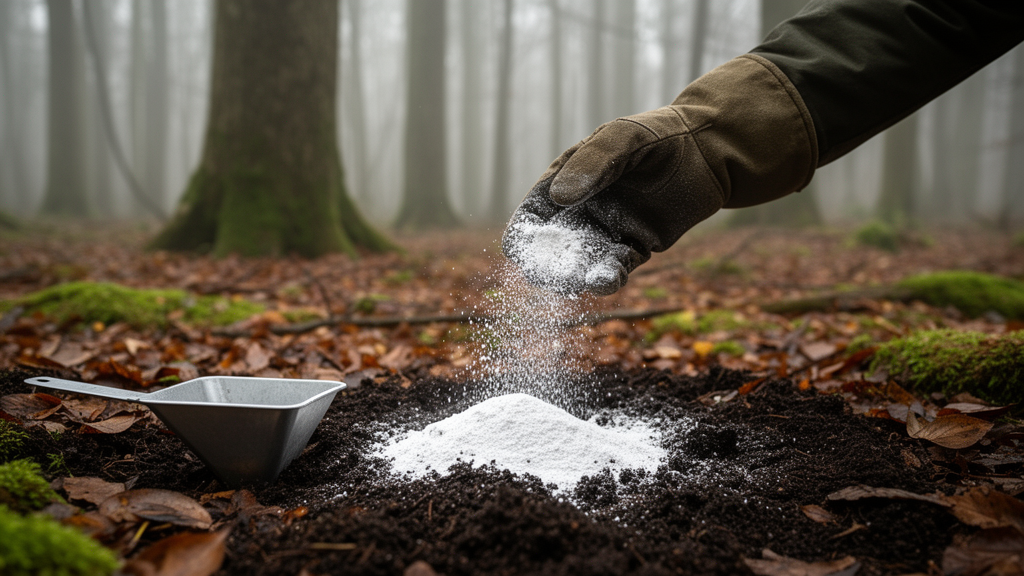
Across subtropical China, vast plantations of Chinese fir (Cunninghamia lanceolata) grow on soils so acidic that life underground is squeezed to its limits. A new study published in the journal Plant and Soil suggests that a single, carefully chosen dose of quicklime—an old agricultural remedy made of calcium oxide—may be enough to unlock microbial activity in these forest soils, dramatically accelerating the decomposition of organic carbon. But the study also carries a warning: too much lime does the opposite, and the difference between a boost and a brake is narrower than many forest managers might assume.
The research, led by a team at Jiangxi Normal University in Nanchang with colleagues at the Jiangxi Provincial Forestry Science and Technology Promotion and Publicity Education Center, set out to understand how different rates of quicklime amendment reshape the biogeochemistry of strongly acidic plantation soils. Soils collected from Chinese fir plantations that had received six different quicklime application rates, ranging from no amendment at all up to 3,000 kilograms per hectare, were incubated for 49 days in a controlled carbon mineralization experiment. The researchers then layered together an unusually rich set of analytical tools: high-throughput DNA sequencing to identify the microbial community, PICRUSt2 functional prediction to estimate what metabolic genes those microbes carry, Mantel tests to link environmental variables to biological patterns, and partial least squares structural equation modeling, known as PLS-SEM, to trace causal pathways among soil chemistry, microbes, and carbon release.
The headline finding is a nonlinear, dose-dependent response. At 2,250 kilograms per hectare—a level the researchers labeled T4—quicklime acted as the sweet spot. At that dose, soil pH rose from a forbidding 4.71 to a much friendlier 5.25, a shift that released the microbial community from the chronic stress of acidity. Microbial biomass carbon, a measure of the total living microbial pool in the soil, surged by 113.96 percent, while microbial biomass phosphorus, a proxy for the nutrient content of that pool, climbed by 192.75 percent. In plain terms, the soil suddenly held far more living microbial matter, and that matter was better fed.
That biomass explosion translated directly into faster carbon cycling. Activities of two key cellulose-degrading extracellular enzymes, β-glucosidase and cellobiohydrolase, rose significantly, and cumulative carbon mineralization—the amount of organic carbon respired by the soil community as carbon dioxide over the incubation—increased by 88.5 percent compared with untreated soil. These enzymes are the molecular scissors that soil microbes use to cut complex plant litter and soil organic matter into sugars small enough to absorb, so their heightened activity marks a genuine acceleration in the breakdown of organic carbon reserves.
One of the study’s most intriguing technical observations, however, complicates the simple story of more microbes, more enzymes, more carbon loss. At the optimal lime dose, the researchers found a decoupling between high enzymatic capacity and lower abundance of the genes predicted to encode those enzyme functions. In other words, the soil community achieved greater enzymatic throughput without simply possessing more copies of the relevant genes. The authors interpret this as evidence of a high-efficiency metabolic strategy: rather than investing heavily in replicating gene machinery, the microbial community appears to operate its existing enzymatic repertoire more intensively once acidity stress is lifted. This distinction matters because many soil studies infer function from gene abundance alone, and this result is a reminder that what microbes do is not always proportional to what their genomes suggest.
The structural equation modeling untangled the sequence of cause and effect. Quicklime first improves the soil’s physicochemical conditions—raising pH, easing acidity stress, and shifting nutrient availability. Those improved conditions then promote the accumulation of microbial biomass, a step captured by a strong path coefficient of 0.860. The larger, healthier microbial biomass subsequently enhances extracellular enzyme activity, with an even stronger path coefficient of 0.899. The overall model fit was robust, with a goodness-of-fit statistic of 0.519. Critically, the model revealed that the magnitude of the microbial biomass, not the composition of the community, was the primary regulator of enzymatic capacity. Community composition registered a path coefficient of just 0.074, essentially negligible, while biomass magnitude carried the 0.899 weight. Nitrate nitrogen emerged as a key factor linking environmental conditions to microbial functional profiles, threading nitrogen availability through the chain from chemistry to function.
Why would biomass quantity matter more than which species are present? Acidic soils such as those under Chinese fir are dominated by acid-tolerant specialists, including members of the bacterial phylum Acidobacteria, which have evolved lean, minimalist genomes adapted to scarcity. When lime relieves acidity, the existing community may not need to restructure dramatically; instead, the entire community can simply grow larger and more active. The study’s conclusion—that microbial biomass magnitude, rather than community structure, is the primary driver of enzymatic capacity—challenges a common assumption in microbial ecology that changing the players changes the game. Here, changing the stadium changed the game instead.
The dose ceiling is just as consequential as the optimum. At the highest application rate, 3,000 kilograms per hectare, quicklime produced significant inhibitory effects on carbon cycling, with the results statistically significant at P < 0.05. Over-liming likely pushes pH beyond what the acid-adapted community tolerates comfortably and can alter nutrient solubility in ways that hamper microbes, echoing a broader literature in which liming sometimes accelerates and sometimes suppresses organic carbon turnover depending on rate, soil type, and duration. For forest managers, the message is that the relationship between lime and carbon is not linear and that the difference between the optimal dose and the excessive dose in this system was just 750 kilograms per hectare.
The broader stakes are considerable. Chinese fir is one of the most widely planted timber species in China, and repeated rotations of these plantations are known to degrade soil fertility and deepen acidification. Soil organic carbon in plantation soils represents both a potential sink and a potential source of atmospheric carbon dioxide, and interventions that alter microbial decomposition rates directly influence that balance. The finding that an optimal lime dose stimulates mineralization while an excessive dose suppresses it means that liming prescriptions cannot simply be extrapolated; they need the kind of threshold analysis this study performed. The researchers argue that their results provide a scientific basis for optimizing carbon cycling management in acidic forest soils, and the mechanistic pathway they documented—chemistry to biomass to enzymes—offers a template other researchers can test in different forests and landscapes.
There are, of course, limits to what a 49-day incubation can reveal. Carbon mineralization measured in the laboratory may not track field-scale carbon stocks over years, and calcium itself can stabilize organic matter through organo-mineral associations, a process the short incubation could not fully capture. The functional gene predictions from PICRUSt2, while powerful, remain estimates inferred from marker-gene data. Still, the study’s central result stands out for its clarity: in strongly acidic Chinese fir plantation soils, a modest, precise application of quicklime can nearly double cumulative carbon mineralization by simply letting microbes breathe easier, and the primary lever is how much life the soil contains, not which species live there. As forests worldwide contend with acidification from both natural processes and decades of acid deposition, that insight—quantity over identity, dose over dogma—may prove one of the more practical lessons soil science has delivered in some time.
Subject of Research: Effects of quicklime application rates on soil carbon mineralization and microbial activity in strongly acidic Chinese fir plantation soils
Article Title: Effects of quicklime application rate on carbon mineralization in strongly acidic soil of Chinese fir (Cunninghamia lanceolata) plantations
Article References: Jiayi, Z., Jiacheng, T., Fang, F., Yanting, Z., Songzhe, L., Dandan, M., Shunbao, L., & Yanjie, Z. (2026). Effects of quicklime application rate on carbon mineralization in strongly acidic soil of Chinese fir (Cunninghamia lanceolata) plantations. Plant and Soil. https://doi.org/10.1007/s11104-026-09067-5
Image Credits: AI Generated
DOI: 10.1007/s11104-026-09067-5
Keywords: quicklime, soil acidification, carbon mineralization, Chinese fir, microbial biomass, extracellular enzymes, PLS-SEM, soil pH, plantation forestry, soil microbiology, PICRUSt2, threshold effect
Cite Scienmag News
Morgan Morrow. (October 9, 2026). A Precise Lime Dose Could Reshape Carbon Cycling in Acidic Forest Soils. Scienmag. https://scienmag.com/a-precise-lime-dose-could-reshape-carbon-cycling-in-acidic-forest-soils/
Morgan Morrow. "A Precise Lime Dose Could Reshape Carbon Cycling in Acidic Forest Soils." Scienmag, 9 October 2026, https://scienmag.com/a-precise-lime-dose-could-reshape-carbon-cycling-in-acidic-forest-soils/. Accessed 9 October 2026.
Morgan Morrow. "A Precise Lime Dose Could Reshape Carbon Cycling in Acidic Forest Soils." Scienmag. October 9, 2026. https://scienmag.com/a-precise-lime-dose-could-reshape-carbon-cycling-in-acidic-forest-soils/


