


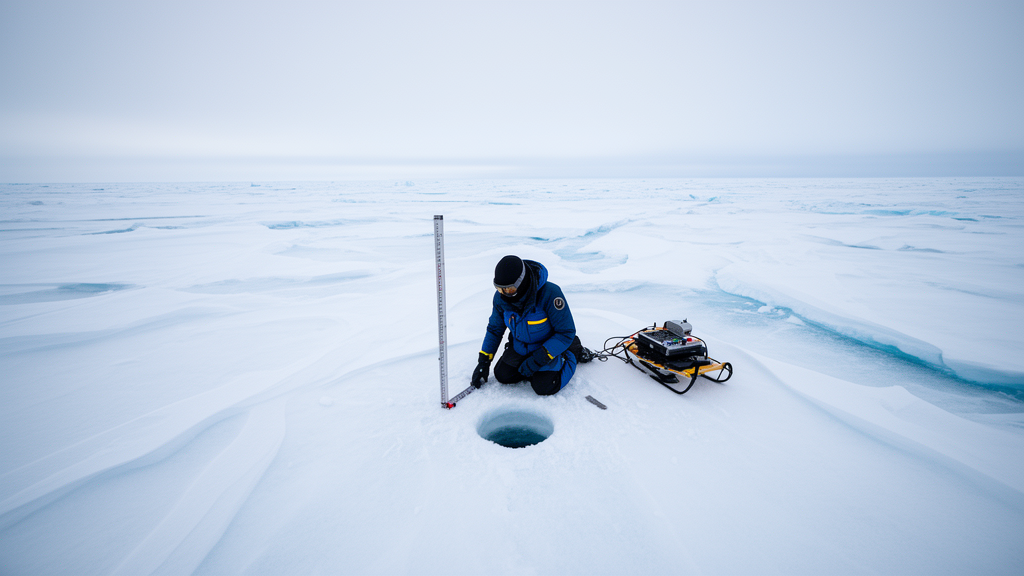
Snow blanketing Antarctic sea ice has long been treated by climate models and satellites as a relatively uniform white layer, a simplification that new research shows may be hiding some of the most important physics in the polar system. A team of German polar scientists has now delivered the most spatially extensive, layer-by-layer portrait of late-summer snow on Antarctic sea ice ever assembled, combining more than 900 high-resolution penetration profiles with hand-dug snow pits and a machine-learning classifier adapted specifically to Antarctic conditions. Their central finding is striking: the snowpack’s most consequential differences between ice types lie not in the intrinsic properties of the snow itself, but in how its layers are stacked, and those layers can change dramatically over distances of just a few meters.
The study, led by Daria Paul of the Alfred Wegener Institute in Bremerhaven together with colleagues at the Helmholtz-Zentrum Hereon, the German Climate Computing Center, and the University of Hamburg, draws on field campaigns aboard the research icebreaker RV Polarstern during three austral summers between 2018 and 2021. Across 28 ice stations in the Weddell Sea, the team sampled 19 first-year ice floes and 9 multi-year ice floes, excavating 50 snow pits and collecting 921 profiles with a SnowMicroPen, a motorized penetrometer that drives a sensor tip into the snow at a constant speed of 20 millimeters per second. The instrument records penetration resistance at roughly 4-micrometer vertical resolution, capturing about 250 force measurements per millimeter of snow, a level of detail no manual snow pit can match.
Raw penetration force signals, however, do not directly reveal snow types. To convert thousands of force curves into stratigraphic information, the researchers trained a one-dimensional convolutional neural network on 155 manually classified profiles, teaching it to recognize the characteristic signatures of four major snow classes: wind slab, rounded and faceted grains, depth hoar, and melt-freeze forms. The network, built from four convolutional layers with a kernel size of five, processed the profiles in 1-millimeter depth bins, generating more than 7.7 million training data points from the labeled subset. Validation showed that wind slab and rounded-faceted snow were classified correctly more than 80 percent of the time, while depth hoar and melt-freeze forms reached around 70 percent, with most errors confined to transitions between structurally similar classes. The trained model then classified the remaining 766 unlabeled profiles.
With the full dataset classified, a clear pattern emerged. The intrinsic properties of each snow type, including density and specific surface area, the measure of ice crystal surface area per unit mass that governs how snow interacts with light and microwaves, were broadly similar on first-year and multi-year ice. Wind slabs and melt-freeze layers were dense, averaging around 355 to 360 kilograms per cubic meter, while rounded-faceted snow and depth hoar were looser, at roughly 252 to 290 kilograms per cubic meter. What separated the two ice regimes was composition. On first-year ice, rounded and faceted crystals dominated, making up 57 percent of the snowpack, while melt-freeze forms accounted for only 13 percent. On multi-year ice, the proportions nearly inverted: melt-freeze forms rose to 35 percent and rounded-faceted snow fell to 30 percent.
This compositional shift has a physical explanation rooted in the contrasting histories of the two ice types. First-year ice is thin, allowing strong conductive heat fluxes from the relatively warm ocean below to sustain steep temperature gradients within the snow, which drive dry metamorphism and the growth of faceted grains and depth hoar. Multi-year ice, by contrast, is thicker and its snow survives multiple summers, experiencing repeated episodes of surface melt. Meltwater percolates into the snowpack and refreezes, producing hard, dense melt-freeze layers near the base that are often interleaved with depth hoar. The multi-year snowpacks averaged six distinct layers compared with five on first-year ice, and their bulk density was significantly higher, at 321.7 versus 301.7 kilograms per cubic meter, not because individual layers were denser but because dense melt-freeze layers were roughly three times more prevalent and twice as thick.
Perhaps the most consequential result concerns spatial scales. Using Moran’s I spatial autocorrelation analysis along transects up to 64 meters long, the team quantified how far snow properties remain correlated horizontally. On first-year ice, correlations collapsed rapidly, falling from values of 0.4 to 0.6 at short separations to below 0.2 within about 15 meters. On multi-year ice, snowpack composition stayed far more coherent, with autocorrelation values of 0.6 to 0.8 for most snow types and sustained values around 0.4 out to roughly 20 meters. The contrast reflects the greater surface stability of multi-year floes, whose long-lived snow covers smooth out small-scale roughness, whereas first-year ice surfaces are continually reshaped by deformation, wind redistribution, and episodic flooding.
The implications for measurement strategy are sobering. When the researchers compared the variance of bulk density within individual floes against the variance across all floes of the same ice class, they found that a single floe captures only about half, roughly 50 percent for first-year ice and 49 percent for multi-year ice, of the density variability characteristic of its regime. In other words, even a well-sampled floe is only partially representative of its ice type, and point measurements on first-year ice become statistically meaningless within meters. Robust characterization of Antarctic snow demands sampling across multiple floes, a requirement that clashes with the logistical realities of polar fieldwork.
The study also revealed a hierarchy of variability that matters for how models and satellites represent snow. Relative variability, expressed as the ratio of standard deviation to mean, was highest for snow-type fractions and layer thicknesses, nearly double that of specific surface area and snow depth. Bulk density, by contrast, was the most spatially homogeneous property, meaning snow load estimates can be upscaled more reliably than stratigraphic detail. But the authors caution that this does not make bulk representations sufficient. Microwave emission and scattering, the physical basis of satellite retrievals of sea ice concentration and thickness, are sensitive to the vertical distribution of density, grain size, and refrozen melt layers. Radar altimeters such as those on CryoSat-2, operating in the Ku-band, frequently scatter within the snowpack rather than at the true snow-ice interface, introducing substantial uncertainty into derived ice thicknesses.
There is also a hemispheric twist. Arctic studies have reported the opposite spatial pattern, with higher correlations on first-year ice than on multi-year ice, linked to the heterogeneous summer surfaces of Arctic multi-year floes, pockmarked by melt ponds and bare ice. The Antarctic result, obtained in late summer when depth hoar is comparatively minor and dense basal melt-freeze layers dominate multi-year snowpacks, underscores that snow stratigraphy assumptions cannot simply be transferred between hemispheres or seasons. The consistency of specific surface area within snow types across ice regimes, however, offers something valuable: snow-type-specific parameters that may be transferable for microwave emission and radiative-transfer modeling, even as whole-snowpack properties diverge.
The team acknowledges limitations, including the penetrometer’s inability to penetrate the hardest basal ice layers, which likely means multi-year ice stratigraphic complexity and bulk density are underestimated, and the coupling of ice type to sampling region in the Weddell Sea. Yet the core conclusion stands robust: Antarctic snow on sea ice is a stratigraphically structured, ice-regime-dependent medium whose heterogeneity is governed by layer composition and geometry rather than bulk properties. As the authors note, capturing this variability is essential for improving sea ice and climate models and the satellite products that validate them. In a warming Antarctic where the extent and character of sea ice are shifting, knowing exactly how snow is stacked, and how quickly that stacking changes over a few steps across the ice, may prove fundamental to reading the polar climate record correctly.
Subject of Research: Spatial variability of snow stratigraphy and properties on Antarctic late-summer sea ice
Article Title: Variability of internal snow properties over Antarctic late summer sea ice on different spatial scales
Article References: Paul, D., Caus, D., Keil, P., Kadow, C., & Arndt, S. (2026). Variability of internal snow properties over Antarctic late summer sea ice on different spatial scales. The Cryosphere, 20(9), 5491-5508. https://doi.org/10.5194/tc-20-5491-2026
Image Credits: AI Generated
Keywords: Antarctic sea ice, snow stratigraphy, SnowMicroPen, machine learning, convolutional neural network, Weddell Sea, first-year ice, multi-year ice, snow density, specific surface area, remote sensing, climate models
Cite Scienmag News
Blake Davidson. (October 9, 2026). Antarctic Sea Ice Snow Varies Over Meters, Not Kilometers, Machine-Learning Study Finds. Scienmag. https://scienmag.com/antarctic-sea-ice-snow-varies-over-meters-not-kilometers-machine-learning-study-finds/
Blake Davidson. "Antarctic Sea Ice Snow Varies Over Meters, Not Kilometers, Machine-Learning Study Finds." Scienmag, 9 October 2026, https://scienmag.com/antarctic-sea-ice-snow-varies-over-meters-not-kilometers-machine-learning-study-finds/. Accessed 9 October 2026.
Blake Davidson. "Antarctic Sea Ice Snow Varies Over Meters, Not Kilometers, Machine-Learning Study Finds." Scienmag. October 9, 2026. https://scienmag.com/antarctic-sea-ice-snow-varies-over-meters-not-kilometers-machine-learning-study-finds/


