


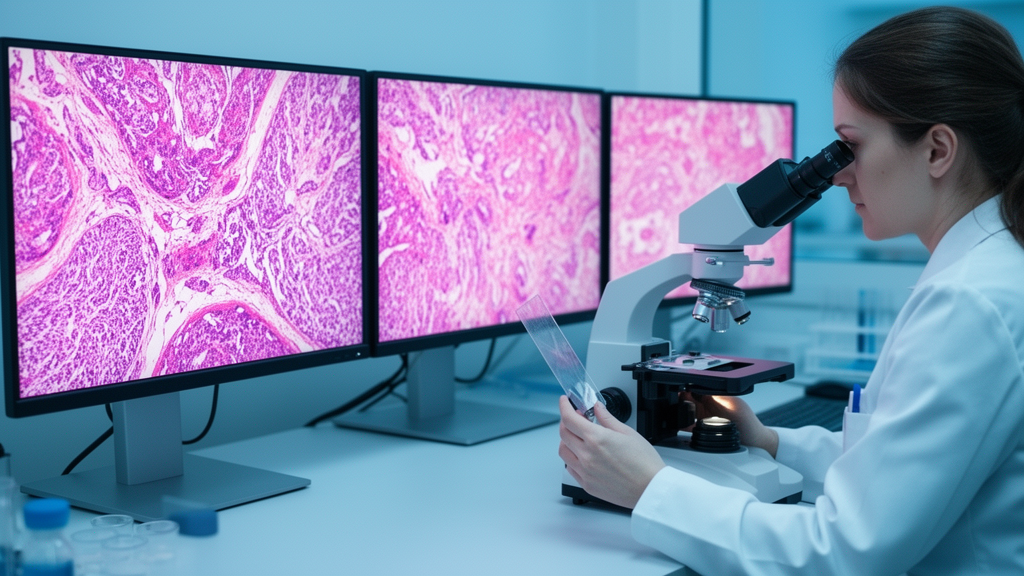
Pathology laboratories around the world face a quiet bottleneck. Every breast cancer diagnosis rests on a pathologist peering through a microscope at thin slices of stained tissue, searching for the subtle architectural fingerprints that separate benign lesions from malignant tumors. The work is meticulous, subjective, and increasingly strained by rising caseloads. Now, a team of researchers from the University of Mohamed Khider in Biskra, Algeria, together with collaborators at Al Ain University in the United Arab Emirates, has built an artificial intelligence system that reads breast tissue images with remarkable precision, and their design choices offer an instructive lesson about when complexity helps and when it hurts. Writing in the journal Cluster Computing, Mohamed Lakhdar Tiar, Nadjiba Terki, Zineddine Sarhani Kahhoul, Belkacem Athamena, and Zina Houhamdi describe a soft-voting ensemble of three convolutional neural networks that classifies breast cancer histopathology images with an accuracy of 97.12 percent, plus or minus 0.54 percent, and a macro F1-score of 96.67 percent across repeated trials.
The team’s starting point was a systematic bake-off rather than a single architectural bet. They trained ten different convolutional neural network backbones, all pre-trained on the enormous ImageNet dataset, and evaluated them under identical conditions on the clinically verified BreaKHis dataset, a widely used benchmark of breast tumor microscopy images. Transfer learning of this kind is standard practice in medical imaging because models that have already learned to detect edges, textures, and shapes in natural photographs can be fine-tuned far more efficiently on smaller medical datasets than networks trained from scratch. After this exhaustive first examination, three architectures emerged as the strongest feature extractors: DenseNet169, ResNet101, and ResNet152. Each represents a distinct design philosophy. Residual networks such as ResNet101 and ResNet152 use shortcut connections that let information skip layers, easing the training of very deep stacks, while DenseNet169 connects each layer to every subsequent one, encouraging feature reuse and parameter efficiency.
With three strong base classifiers in hand, the researchers turned to ensemble learning, the idea that a committee of diverse models can outperform any individual member. Their method of choice was average soft voting, in which each network outputs a probability that an image shows malignant tissue, and the final decision reflects the averaged confidence of all three. Soft voting is gentler than hard voting, which simply counts majority votes, because it preserves the nuance of each model’s uncertainty. A case where two networks are barely convinced of malignancy while a third strongly disagrees is treated differently from a unanimous, high-confidence verdict. The researchers stress-tested this ensemble across five different random seeds, 22, 32, 42, 52, and 62, to ensure that the reported performance was not a fluke of one lucky training run. The consistency of the results, with accuracy holding near 97 percent and standard deviations below one percentage point, suggests the ensemble genuinely generalizes rather than memorizing quirks of a particular data split.
Perhaps the most scientifically interesting part of the study is what the authors left out. Attention mechanisms have become one of the most fashionable tools in deep learning, popularized by transformer models and adapted to convolutional networks through modules such as the Convolutional Block Attention Module, or CBAM. CBAM refines feature maps by applying two forms of attention in sequence: channel attention, which learns which feature channels matter most, and spatial attention, which highlights the image regions carrying the most diagnostic signal. Intuitively, this should help a network ignore irrelevant background and focus on cancerous cells, much as a pathologist’s eye is drawn to abnormal nuclei. The team added CBAM to all three of their winning backbones in a targeted ablation study, expecting the attention-enhanced variants to shine.
The opposite happened. In their experiments, the CBAM-equipped models consistently performed worse than their non-attention counterparts on the same stratified image-level splits. Rather than burying this inconvenient result, the researchers treated it as evidence and stripped CBAM from the final architecture, keeping a simpler and, empirically, more resilient design. The finding is a useful corrective to a field often swept by enthusiasm for adding attention everywhere. In domains with limited training data, such as histopathology benchmarks, extra modules can introduce additional parameters that overfit or disrupt features that transfer learning has already tuned well. The authors’ conclusion is refreshingly pragmatic: for computer-aided breast cancer diagnosis, a validated ensemble of robust convolutional networks can achieve effective classification without excessive attention complexity.
Transparency was the other pillar of the work. Deep networks are often criticized as black boxes, and in a clinical setting a bare accuracy number is not enough; doctors need to know what the model was looking at. To provide that evidence, the team employed Grad-CAM++, an extension of the gradient-based class activation mapping technique that produces heatmaps showing which regions of an image most influenced the network’s decision. When the ensemble flags a tissue sample as malignant, Grad-CAM++ can highlight the discriminative areas, such as dense clusters of irregular cells, that drove the prediction. This visual interpretation serves two purposes: it lets pathologists verify that the model is attending to biologically plausible structures rather than artifacts like staining variations or scanner noise, and it builds the trust required before such tools can support real diagnostic workflows.
The evaluation protocol itself deserves attention. The BreaKHis dataset was divided into 70 percent for training, 15 percent for validation, and 15 percent for testing, using an image-level stratified methodology that keeps class proportions consistent across splits. Stratification matters in medical data because malignant and benign samples are rarely balanced, and an unstratified split could accidentally skew the test set. The macro F1-score, which averages the harmonic mean of precision and recall across classes, guards against a common failure mode in imbalanced classification: a model that achieves high accuracy simply by predicting the majority class. The ensemble’s macro F1 of 96.67 percent indicates strong performance on both benign and malignant categories, not just the dominant one.
Breast cancer remains the most commonly diagnosed cancer in women worldwide, with GLOBOCAN 2020 estimates attributing roughly 2.3 million new cases and about 685,000 deaths to the disease in a single year. Early and accurate detection dramatically improves outcomes, which is why the diagnostic pathway, from screening mammography to biopsy and histopathological confirmation, is such an active target for computational assistance. Histopathology is the diagnostic gold standard, but it is labor-intensive and subject to inter-observer variability, with studies showing that even expert pathologists can disagree on ambiguous cases. Tools like the one developed in Biskra would not replace pathologists; rather, they would act as a second reader, flagging suspicious slides, prioritizing urgent cases, and providing a consistent baseline against which human judgment can be checked.
The study, published in Cluster Computing as volume 29, article 757, was partially supported by Algeria’s Directorate General for Scientific Research and Technological Development, and the authors report no conflicts of interest. Its broader message resonates beyond breast cancer. In the race to apply deep learning to medicine, bigger and more elaborate models are not automatically better. A disciplined pipeline, comparing many architectures, testing fashionable additions with rigorous ablation, validating across multiple random seeds, and demanding visual explainability, produced a system that is simultaneously simpler and more trustworthy than its attention-laden rivals. As hospitals weigh which AI tools to adopt, that combination of empirical restraint and transparency may prove more valuable than any single accuracy figure, and it sets a template other research groups would do well to follow.
Subject of Research: Ensemble deep learning for automated binary classification of breast cancer from histopathology images
Article Title: An ensemble deep learning model for automated classification of breast cancer from histopathology images
Article References: Tiar, M. L., Terki, N., Kahhoul, Z. S., Athamena, B., & Houhamdi, Z. (2026). An ensemble deep learning model for automated classification of breast cancer from histopathology images. Cluster Computing, 29(13), Article 757. https://doi.org/10.1007/s10586-026-06615-7
Image Credits: AI Generated
DOI: 10.1007/s10586-026-06615-7
Keywords: deep learning, convolutional neural networks, breast cancer, histopathology, BreaKHis, soft voting ensemble, CBAM ablation, Grad-CAM, explainable AI, transfer learning, computer-aided diagnosis, DenseNet
Cite Scienmag News
Nathaniel Bowman. (October 9, 2026). Ensemble of Three CNNs Reads Breast Cancer Slides With 97% Accuracy. Scienmag. https://scienmag.com/ensemble-of-three-cnns-reads-breast-cancer-slides-with-97-accuracy/
Nathaniel Bowman. "Ensemble of Three CNNs Reads Breast Cancer Slides With 97% Accuracy." Scienmag, 9 October 2026, https://scienmag.com/ensemble-of-three-cnns-reads-breast-cancer-slides-with-97-accuracy/. Accessed 9 October 2026.
Nathaniel Bowman. "Ensemble of Three CNNs Reads Breast Cancer Slides With 97% Accuracy." Scienmag. October 9, 2026. https://scienmag.com/ensemble-of-three-cnns-reads-breast-cancer-slides-with-97-accuracy/


