


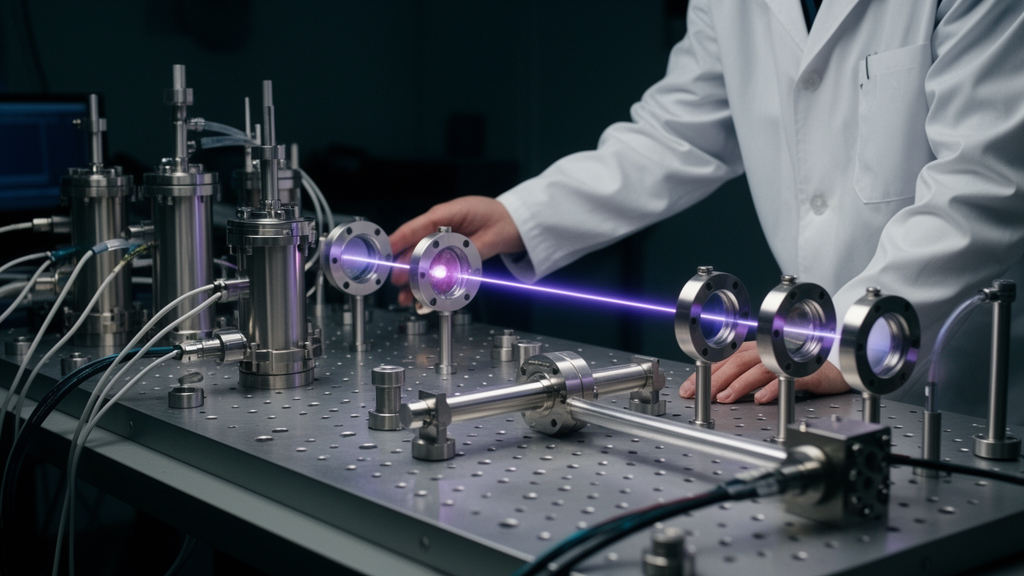
For decades, chemists and physicists have used a trick of quantum mechanics to steer chemical and atomic reactions: by splitting a transition into two indistinguishable quantum pathways and controlling the relative phase between them, they can either amplify or erase the probability of reaching a chosen final state. This technique, known as coherent control, has been a workhorse of optical laser science since the 1980s. Now, a research team led by Ulli Eichmann of the Max Born Institute in Berlin has extended it deep into the extreme ultraviolet, a spectral region where such phase-sensitive manipulation had long been considered out of reach. Writing in Nature Photonics, the collaboration reports the first demonstration of phase-controlled stimulated Raman excitation in the XUV regime, using helium atoms and two carefully synchronized pulses from a seeded free-electron laser.
The appeal of pushing coherent control to short wavelengths is easy to understand. XUV and X-ray photons interact with electrons in ways that optical light cannot, probing inner-shell and site-selective excitations on femtosecond and even attosecond timescales. If researchers could control quantum interference at these energies, they would gain a handle on ultrafast electronic dynamics in atoms and molecules with unprecedented precision. The obstacle has been equally clear: at short wavelengths, intense light tends to rip electrons away entirely through photoionization, and any intermediate state created along the way decays rapidly. Producing two intense short-wavelength pulses with a stable, adjustable relative phase has also been a formidable technical challenge.
The team attacked both problems at the FERMI free-electron laser facility in Trieste, Italy. FERMI is a seeded free-electron laser, meaning its XUV pulses inherit the coherence of an external seed laser rather than emerging from the noisy spontaneous amplification that characterizes most such machines. In its two-colour mode, the seed laser imprints a coherent energy modulation on a high-energy electron beam, and two separate sets of undulators then amplify two different harmonics of the seed frequency. The result is a pair of XUV pulses whose photon energies are exact integer multiples of the seed energy and whose relative phase can be shifted at will using a phase shifter placed between the undulator sets.
The target was helium, chosen for its simplicity and for one particularly useful property. The researchers aimed to drive the atom from its ground state to the long-lived metastable state He(1s2s ¹S), which sits 20.615 electronvolts above the ground state but cannot be reached by a single dipole-allowed photon. Instead, the team used a two-photon stimulated Raman transition: a pump photon lifts the atom into the ionization continuum, and a Stokes photon of slightly lower energy brings it back down into the metastable state. Because the Raman resonance depends only on the difference between the two photon energies, the scheme works even though both photons individually carry far more energy than the excitation itself. By selecting harmonics whose orders differ by four, and tuning the seed laser to 5.154 electronvolts, the team satisfied the resonance condition exactly.
Detecting the outcome posed its own challenge. The two-photon Raman cross-section is tiny compared with the single-photon ionization cross-section, so the signal of interest is buried under a flood of photoelectrons and photoions. The researchers exploited a clever separation scheme: metastable helium atoms, carrying roughly 20 electronvolts of internal energy, liberate electrons when they strike a detector and are therefore registered by a position-sensitive multichannel plate, while ground-state atoms pass unnoticed. A small static electric field across the interaction region sweeps charged particles away from the atomic beam, so only neutral metastable atoms travel the roughly 500 microseconds to the detector. The measurement is thus essentially immune to the overwhelming ionization background.
The first results confirmed that a genuine stimulated Raman process was at work. Using the seventh and eleventh harmonics, circularly polarized with the same handedness as required by the dipole selection rules for a two-photon transition, the team measured a strong metastable yield on resonance. Flipping the helicity of one pulse, which renders the two-photon transition dipole-forbidden, collapsed the yield to a few percent of its former value, with the residue attributable to imperfect circular polarization. Sweeping the seed laser photon energy across the resonance for four different harmonic pairs produced clean, Gaussian-shaped Raman lines centred precisely at the predicted metastable excitation energy, with no measurable shift even at the highest pulse intensities.
Theoretical calculations underpinned the interpretation. The team solved the time-dependent Schrödinger equation for a single active electron in a model helium potential, capturing all nonlinearities associated with the strong fields. The calculations reproduced the measured lineshapes and revealed that the Stark shift of the resonance remains negligible up to an intensity product of about 10⁵ terawatts squared per square centimetre. They also uncovered a striking feature: at high intensities, where the ground state is almost completely depleted by ionization, the metastable population saturates just below one percent yet survives, because it is produced early in the pulse while ground-state atoms are still abundant and is far less susceptible to subsequent ionization than the ground state itself.
The centrepiece of the study, however, was the demonstration of interference between two Raman pathways. In a single two-colour Raman transition, all the phases of the fields and dipole moments cancel in the cross-section and are unobservable. But when two coherent pathways connect the same initial and final states through different continuum states, the pathways become indistinguishable and their relative phase enters the cross-section as a cosine modulation. The team created such a pair by exploiting a weak, unamplified harmonic that accompanies the two strong ones: the intense Stokes photon of the main pathway doubles as the pump photon of a second pathway, completed by the weak lower harmonic as its Stokes photon. Although the weak harmonic carries only about 0.1 percent of the pulse energy, the much larger Raman cross-section at lower photon energies compensates, making the second pathway competitive.
Scanning the phase of the upper harmonic with the FERMI phase shifter, the researchers watched the metastable yield oscillate periodically, a direct signature of quantum interference deep in the XUV. For the harmonic pair involving the fundamental seed laser as the weak Stokes photon, the fringe visibility reached about 50 percent, and time-dependent Schrödinger equation calculations using the experimental field strengths matched the measured modulation closely. The decisive control experiment followed: inserting an aluminium filter to block the fundamental radiation removed the second pathway entirely, and with it the modulation vanished. The interference, and the phase control it enables, was unambiguously real.
The achievement opens a route to phase-sensitive coherent control of atomic and molecular processes at short wavelengths, including site-selective core excitations and ultrafast electronic dynamics that optical control schemes cannot address. The authors point to particularly intriguing prospects near autoionizing resonances, where theory predicts dramatic Stark shifts and strong lineshape alterations that their experimental approach is ideally suited to explore. As free-electron laser technology matures toward two independently tunable, fully coherent pulses, the dream of writing and rewriting quantum pathways with XUV and X-ray light moves from theoretical proposal to laboratory routine.
Subject of Research: Phase-coherent control of stimulated Raman transitions in helium using interfering XUV pathways
Article Title: Phase control of interfering stimulated Raman pathways in the XUV regime
Article References: Eichmann, U., Carlström, S., Patchkovskii, S., Eisebitt, S., Rubensson, J.-E., Söderström, J., Mikosch, J., Allaria, E., Brynes, A., Callegari, C., Di Fraia, M., Manfredda, M., Pal, N., Perosa, G., Plekan, O., Simoncig, A., & Génévriez, M. (2026). Phase control of interfering stimulated Raman pathways in the XUV regime. Nature Photonics. https://doi.org/10.1038/s41566-026-02024-9
Image Credits: AI Generated
DOI: 10.1038/s41566-026-02024-9
Keywords: coherent control, stimulated Raman scattering, extreme ultraviolet, free-electron laser, helium, quantum interference, phase control, nonlinear optics, atomic physics, metastable states, FERMI, Raman excitation
Cite Scienmag News
Katie Riggs. (October 9, 2026). Physicists Steer Quantum Pathways in the Extreme Ultraviolet for the First Time. Scienmag. https://scienmag.com/physicists-steer-quantum-pathways-in-the-extreme-ultraviolet-for-the-first-time/
Katie Riggs. "Physicists Steer Quantum Pathways in the Extreme Ultraviolet for the First Time." Scienmag, 9 October 2026, https://scienmag.com/physicists-steer-quantum-pathways-in-the-extreme-ultraviolet-for-the-first-time/. Accessed 9 October 2026.
Katie Riggs. "Physicists Steer Quantum Pathways in the Extreme Ultraviolet for the First Time." Scienmag. October 9, 2026. https://scienmag.com/physicists-steer-quantum-pathways-in-the-extreme-ultraviolet-for-the-first-time/


