


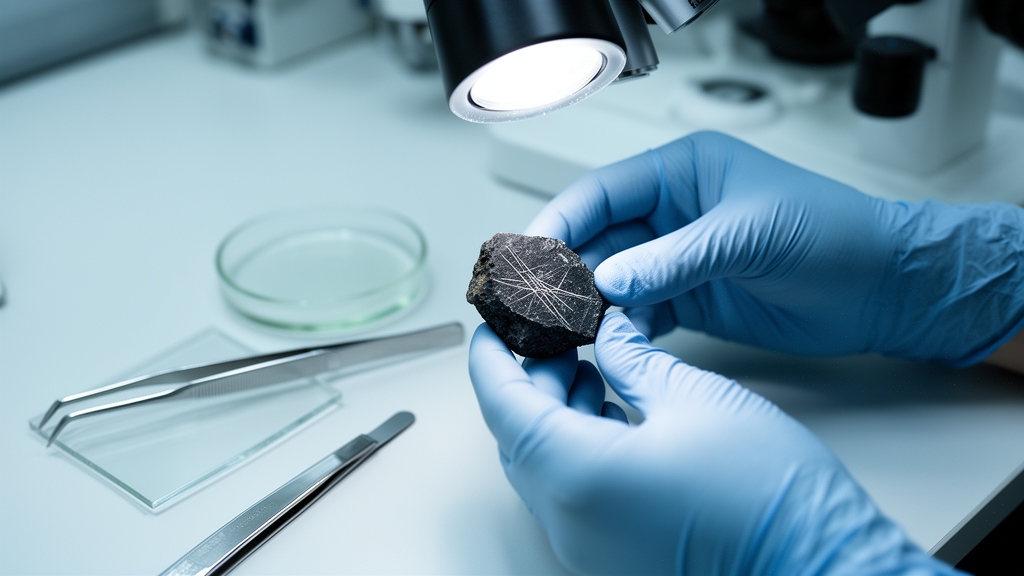
Deep inside a grain of apatite, a common phosphate mineral found in mountains and sandstones around the world, uranium atoms have been quietly keeping time for hundreds of millions of years. When a uranium-238 nucleus undergoes spontaneous fission, the two fragments tear through the crystal lattice and leave behind a nanometre-wide scar, a so-called fission track. Over geological time these scars accumulate, and because uranium decays at a precisely known rate, geologists have long counted them to work out when a rock last cooled below a critical temperature. A new study published in the journal Geochronology by Peter K. Jensen of the Technical University of Denmark now shows that a single apatite grain can yield not just one age, but a whole sequence of ages, each tied to a different chapter of the rock’s burial and uplift history.
The traditional method is elegantly simple. Researchers count the density of tracks crossing a polished mineral surface, measure the uranium concentration, and combine these with the decay constant in a standard age equation. For minerals that cooled quickly, such as ash or volcanic extrusions, this produces a precise crystallisation age. But the equation is also routinely applied to apatite that cooled slowly through the so-called partial annealing window, the temperature range between roughly 120 and 60 degrees Celsius in which tracks form but are gradually shortened and erased. In that regime the resulting single apparent age is at best a rough average of a complicated thermal story, and Jensen argues it deserves far more scrutiny.
The key insight behind the new work is that track length carries information that the conventional equation ignores. Fission tracks are born at a standard initial length of about 16 micrometres and then shorten over time as heat allows the crystal to heal itself, a process called annealing. Crucially, the oldest tracks in a grain have generally experienced the most annealing and are therefore the shortest, while the youngest tracks remain the longest. In principle, then, a track of a given length can be dated simply by counting how many shorter tracks exist below it, adding one, and dividing by the rate at which tracks are generated per unit volume of crystal. That deceptively clean relationship was established theoretically decades ago, but turning it into a practical dating tool has proved difficult.
The difficulty lies in blurring. Tracks of the same true age do not all have the same length. The fission fragments carry a spread of kinetic energies, the crystal lattice shortens tracks at different rates depending on their orientation relative to the crystallographic c-axis, and the etching and measurement procedures used to make tracks visible under the microscope introduce further biases. The result is that each column of a measured track-length histogram mixes tracks from several different time intervals, and the tidy one-to-one link between length and age is smeared out. Without correcting for this smearing, any attempt to assign ages to individual length classes would be meaningless.
Jensen’s solution borrows a mathematical technique from signal processing: deconvolution, the same family of methods used to strip noise from telecommunications signals. The idea is that the measured histogram can be treated as a weighted sum of reference histograms, each representing tracks generated in a short time interval and then annealed to a particular degree. Those reference distributions, called kernels, come from laboratory experiments in which apatite samples are irradiated with neutrons in a reactor and then heated at controlled temperatures and durations, producing known track-length spreads. If the measured histogram can be decomposed into the right weighted combination of these kernels, the weights reveal how many tracks were produced in each time interval, restoring the link between histogram columns and time.
The new study advances this approach in two important ways. First, it applies the deconvolution to c-axis projected tracks, a standardised measurement protocol in which track lengths are corrected along the crystal’s principal axis. Because tracks of the same age tend to cluster along an elliptical curve in the length-versus-angle diagram, projecting them onto the c-axis already gathers contemporaneous tracks together, acting as a partial deconvolution in itself. Second, the inversion is formulated in a fully probabilistic framework based on the work of geophysicist Albert Tarantola, using an extended least-squares method that incorporates both the uncertainties of the measurements and prior information about the expected answer. Because the total number of counted tracks is fixed, the histogram columns are strongly covariant, and the method handles this explicitly through variance-covariance matrices rather than treating each bin as independent.
One stubborn mathematical problem is that least-squares inversion can return negative numbers of tracks, which is physically impossible. Jensen tames this by choosing positive prior values with variances large enough that the priors guide the solution without dominating the data, ensuring that the deconvolved histogram columns remain mainly positive. The variances are also chosen generously enough that, in principle, all tracks could end up in a single bin, so the prior does not impose an artificially rigid shape on the result. The full calculation, implemented in the open-source Octave platform and released with the paper, converts the deblurred length histogram into a histogram of time intervals and then cumulates those intervals from the youngest tracks backwards to assign an age to the oldest track in each column.
To test the method, Jensen applied it to twenty apatite samples from Ellesmere Island and Northwest Greenland, part of a large dataset assembled to reconstruct the Phanerozoic tectonic history of the Arctic. The results are striking. In a Late Devonian sandstone sample, the deconvolution extracted three statistically distinct age nodes at roughly 134, 274 and 443 million years, with non-overlapping uncertainties. The oldest of these predates the deposition of the sandstone itself, revealing that the apatite grains carried inherited tracks from earlier mountain-building episodes before they were eroded and redeposited. By comparing track ages with the known depositional age, the method could even separate post-depositional tracks from inherited ones, showing in this case that about 70 percent of the tracks formed after burial.
The deconvolution also sharpens features that are nearly invisible in raw data. For several samples, histograms that appeared broad and unimodal in the original measurements revealed clear bimodality after deblurring, a signature of distinct thermal episodes. One sample told a three-act story: a long stretch between about 193 and 90 million years ago when maximum temperatures reached the upper part of the partial annealing window, a shorter cooling phase through the lower part of the window, and then a prolonged period of moderate temperatures below 60 degrees Celsius lasting to the present. The method even proved useful as a quality check, flagging samples whose histograms showed unrealistically sharp peaks caused by too few measured tracks, since the forward calculation from the deconvolved histogram could not reproduce such features.
The broader payoff is a new layer of information for reconstructing how mountains rose, basins filled and plates shifted. Across the sample suite, the oldest track ages typically came out about 20 percent older than the conventional central ages, and they broadly align with the timing of the last thermal peaks above 100 degrees Celsius inferred from independent thermal history modelling, albeit with large uncertainties. Most samples yielded between two and five reliable age nodes, averaging three, from a single histogram. Jensen suggests these multiple age estimates could guide the choice of age-temperature constraints in thermal history simulation models, potentially tightening reconstructions of past temperatures and tectonic events. For a technique that has spent half a century squeezing a single number out of each mineral grain, the prospect of reading an entire chronological sequence from one crystal marks a quiet but potentially transformative shift in how geologists read Earth’s thermal diary.
Subject of Research: Extraction of multiple thermal history ages from c-axis projected apatite fission tracks using probabilistic deconvolution
Article Title: Extraction of multiple ages from c-axis projected fission tracks
Article References: Jensen, P. K. (2026). Extraction of multiple ages from c -axis projected fission tracks. Geochronology, 8(2), 373-386. https://doi.org/10.5194/gchron-8-373-2026
Image Credits: AI Generated
DOI: 10.5194/gchron-8-373-2026
Keywords: fission track dating, apatite, thermochronology, deconvolution, uranium-238 fission, partial annealing zone, c-axis projection, geochronology, tectonic history, inverse theory, track length distribution, Ellesmere Island
Cite Scienmag News
Violet Maxwell. (October 9, 2026). Hidden Clocks in Crystal Tracks: New Method Pulls Multiple Ages From a Single Mineral. Scienmag. https://scienmag.com/hidden-clocks-in-crystal-tracks-new-method-pulls-multiple-ages-from-a-single-mineral/
Violet Maxwell. "Hidden Clocks in Crystal Tracks: New Method Pulls Multiple Ages From a Single Mineral." Scienmag, 9 October 2026, https://scienmag.com/hidden-clocks-in-crystal-tracks-new-method-pulls-multiple-ages-from-a-single-mineral/. Accessed 9 October 2026.
Violet Maxwell. "Hidden Clocks in Crystal Tracks: New Method Pulls Multiple Ages From a Single Mineral." Scienmag. October 9, 2026. https://scienmag.com/hidden-clocks-in-crystal-tracks-new-method-pulls-multiple-ages-from-a-single-mineral/


