


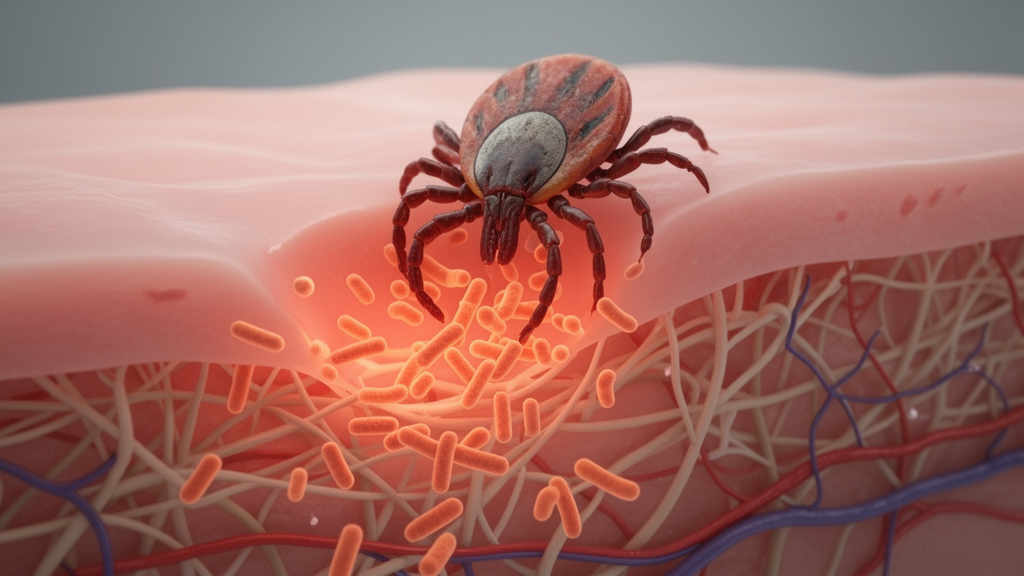
A single tick bite can deliver a dangerous dose of bacteria faster than most people would ever suspect. New research published in PLOS Pathogens shows that Rickettsia parkeri, an emerging tick-borne pathogen responsible for spotted fever rickettsiosis in the southeastern United States and beyond, is transmitted from an infected Gulf Coast tick to the skin of its host within just one hour of attachment. The finding, reported by Chanakan Suwanbongkot and colleagues at Louisiana State University, challenges assumptions about how quickly these bacteria establish themselves and offers the most detailed picture yet of what happens at the bite site during the earliest moments of infection.
Rickettsia parkeri is carried by Amblyomma maculatum, the Gulf Coast tick, a hard-bodied arachnid that feeds slowly on mammals and birds over many hours or days. Like other spotted fever group rickettsiae, the bacterium invades the cells lining blood vessels and can cause fever, headache, muscle pain, and an eschar, a dark scab that forms at the site of the bite. Although the disease is generally less severe than Rocky Mountain spotted fever, cases have been rising, and the early events of transmission have remained poorly understood because most laboratory studies of rickettsial disease rely on needle inoculation rather than genuine tick feeding.
That methodological shortcut matters more than researchers once appreciated. When bacteria are injected with a syringe, the experiment bypasses everything the tick itself contributes: the salivary compounds that the arthropod pumps into the skin to suppress clotting, dull pain, and dampen local immunity. These pharmacologically active molecules fundamentally alter the environment into which the pathogen arrives. As a result, the true dynamics of transmission and the genuine cutaneous immune response at the infection site have been, in the words of the study team, undefined biological variables in the standard murine models used for decades.
To close that gap, Suwanbongkot, Ingeborg Langohr, Killian Brewer, Robert Barrington, and Kevin Macaluso developed a single tick feeding model that allowed them to track infection from the very first hour of tick attachment through to 144 hours, six full days into the blood meal. Infected and uninfected ticks were allowed to feed on laboratory mice, and skin biopsies, draining lymph nodes, and internal tissues were collected at defined time points. The team then combined quantitative measurements of bacterial load with immunophenotyping of infiltrating cells, profiling of cytokines and chemokines, and histopathological examination of the tissue, testing the hypothesis that the skin would mount a distinct immune response depending on whether the feeding tick carried the bacterium.
The kinetics that emerged were striking. Transmission of R. parkeri from the infected tick to the host occurred within one hour of attachment, an interval far shorter than the many hours often cited for other tick-borne pathogens such as the Lyme disease spirochete, which typically requires prolonged feeding to migrate from the tick midgut to the salivary glands and then into the skin. From that foothold in the dermis, the rickettsiae disseminated rapidly, reaching draining lymph nodes and internal tissues within the early window of the experiment. Speed, in other words, is built into this pathogen’s transmission strategy.
The quantifiable bacterial loads delivered by the feeding tick were also remarkably precise. At three hours after attachment, the researchers counted approximately 9,500 rickettsiae in the mouse skin. That number climbed to about 15,000 bacteria at 48 hours and roughly 22,000 by 144 hours, indicating that the initial inoculum is substantial and continues to expand as the tick feeds and the pathogen replicates locally. Such numbers provide a benchmark that needle-based models have never been able to establish, because a syringe delivers an arbitrary dose without the accompanying saliva, feeding wound, or host-tick interface.
Perhaps the most unexpected result concerned the immune response rather than the bacteria themselves. Independent of whether the feeding tick was infected, the degree of time-dependent inflammation in the skin was similar at three and 48 hours after attachment. The bite itself, and the tick’s salivary manipulation of the host, drove a baseline inflammatory program that looked much the same whether or not R. parkeri was present. Only at the late stage, 144 hours after attachment, did the infected skin diverge decisively from the uninfected control sites.
By that sixth day, macrophages had become the dominant cell type infiltrating R. parkeri-infected skin, and the tissue showed enhanced levels of the pro-inflammatory signaling molecules interferon-gamma and tumor necrosis factor-alpha. At the same time, production of interleukin-10, an anti-inflammatory cytokine that normally restrains immune activation, was reduced. Taken together, the pattern suggests a delayed pro-inflammatory activation in response to rickettsial infection when the bacteria are delivered by ticks, a tempo that may reflect the combined immunosuppressive pressure of tick saliva during the long early phase of feeding. Whether that delay benefits the pathogen, the tick, or both remains an open question, but it implies that the critical window for immune intervention may be later than needle-based models would predict.
The histopathological findings reinforce this picture of a slowly escalating battle in the skin. Early bite sites showed the expected wound-healing and saliva-driven changes, while late infected lesions displayed the cellular architecture of an active intracellular bacterial infection, with macrophages recruited in force to a dermis where rickettsiae had been multiplying for days. Because rickettsiae are obligate intracellular pathogens that spread cell to cell, the dominance of macrophages, the very cells that engulf and kill intracellular microbes, fits the known requirement for cell-mediated immunity, coordinated by interferon-gamma and tumor necrosis factor-alpha, to control spotted fever group infections.
The practical implications reach beyond basic biology. Understanding that transmission can occur within a single hour of attachment sharpens public health messaging about prompt tick removal, since even brief encounters with infected Gulf Coast ticks may suffice to seed infection. More broadly, the single feeding model gives vaccine and drug developers a realistic platform for testing preventive strategies against tick-borne rickettsial disease, one that captures the true inoculum size, the role of saliva, and the genuine timing of the host response. As Suwanbongkot and colleagues note, these insights into the earliest events of transmission and cutaneous immunity provide the foundation for interventions that could stop R. parkeri before it ever leaves the skin.
Subject of Research: Transmission kinetics of Rickettsia parkeri and the cutaneous immune response during single tick feeding events
Article Title: Spotted fever group Rickettsia infection kinetics and cutaneous host response during single tick feeding events
Article References: Suwanbongkot, C., Langohr, I. M., Brewer, K. Z., Barrington, R. A., & Macaluso, K. R. (2026). Spotted fever group Rickettsia infection kinetics and cutaneous host response during single tick feeding events. PLOS Pathogens, 22(9), e1014626. https://doi.org/10.1371/journal.ppat.1014626
Image Credits: AI Generated
DOI: 10.1371/journal.ppat.1014626
Keywords: Rickettsia parkeri, tick-borne disease, Amblyomma maculatum, spotted fever group rickettsiosis, tick saliva, cutaneous immunity, macrophages, interferon-gamma, TNF-alpha, transmission kinetics, murine model, PLOS Pathogens
Cite Scienmag News
Kristina Jarvis. (October 9, 2026). Tick-Borne Rickettsia Reaches Host Skin Within an Hour of a Bite. Scienmag. https://scienmag.com/tick-borne-rickettsia-reaches-host-skin-within-an-hour-of-a-bite/
Kristina Jarvis. "Tick-Borne Rickettsia Reaches Host Skin Within an Hour of a Bite." Scienmag, 9 October 2026, https://scienmag.com/tick-borne-rickettsia-reaches-host-skin-within-an-hour-of-a-bite/. Accessed 9 October 2026.
Kristina Jarvis. "Tick-Borne Rickettsia Reaches Host Skin Within an Hour of a Bite." Scienmag. October 9, 2026. https://scienmag.com/tick-borne-rickettsia-reaches-host-skin-within-an-hour-of-a-bite/


