


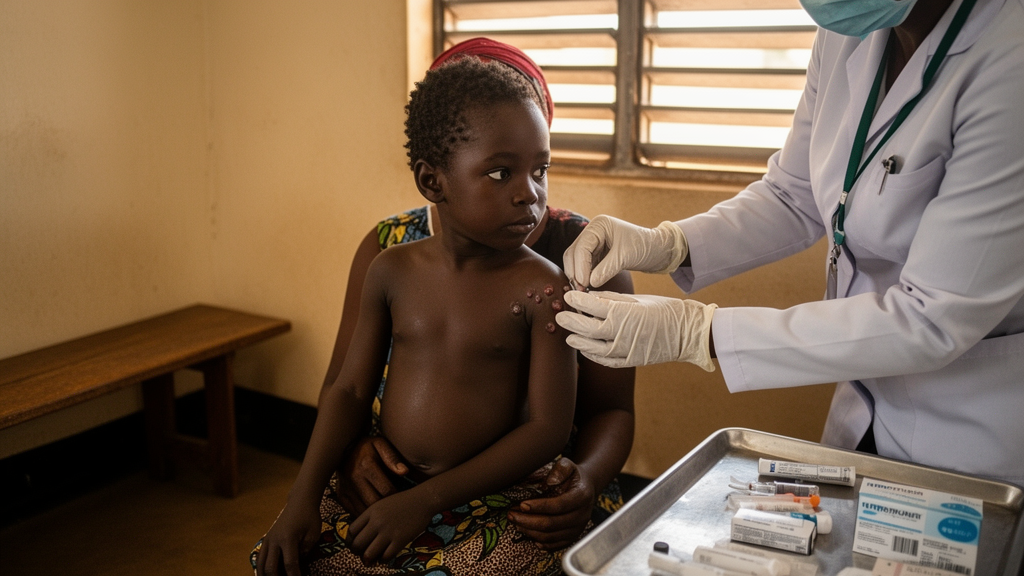
When mpox swept through Sierra Leone in 2024 and 2025, the global assumption that the clade IIb virus circulating there was primarily an adult problem was quietly overturned. A retrospective national study published in PLOS Neglected Tropical Diseases has now documented 415 children younger than 15 years among 5,466 cases with recorded age, meaning children accounted for 7.6 percent of the outbreak’s known burden. The finding matters because the 2022 multicountry global outbreak, which was driven largely by sexual networks among adults, reported children and adolescents as only about 1.3 percent of cases. Sierra Leone’s experience shows that during a sustained African clade IIb epidemic, household transmission can pull young children into the epidemiological picture at rates several times higher than the world saw in 2022, and that surveillance systems built around adult-centered assumptions risk underestimating and under-serving this vulnerable group.
The research team, led by investigators at Sierra Leone’s National Public Health Agency, assembled their cohort from the national District Health Information Software 2 database, the country’s integrated disease surveillance backbone, and then enriched it with patient charts and the original outbreak-investigation forms completed by district response teams. The analysis covered a database extract frozen on 1 July 2026, after the Ministry of Health declared the outbreak over in December 2025. Of the 415 paediatric cases, 411 were laboratory-confirmed, four were classified as probable, and none were clinician-diagnosed only. The age distribution was strikingly young: 188 children, or 45.3 percent, were aged 0 to 4 years, 121 were aged 5 to 9, and 106 were aged 10 to 14. The median paediatric age was just 5 years, and 230 of the 415 children, or 55.4 percent, were male.
The temporal signal was equally telling. National surveillance summaries recorded only three sporadic paediatric cases of mpox-like illness between 2017 and 2024, a period when the disease was largely absent from the country. Notifications then rose sharply from April 2025 and peaked at 37 laboratory-confirmed paediatric cases in the epidemiological week ending 18 May 2025, before declining through June with a smaller resurgence in September and early October. Genomic analyses cited by the authors indicated that the clade IIb G.1 virus had been transmitting locally before public detection, which helps explain how an epidemic that appeared suddenly in adults had already seeded the household settings where young children are most exposed. The paediatric epidemic curve, in other words, was not an independent phenomenon but a mirror of the national outbreak, amplified through domestic contact networks.
Geographically, the burden concentrated in Western Area Urban, the densely populated district containing the capital Freetown, which recorded 195 of the 413 paediatric cases with known district, or 47.2 percent. Yet crude notified paediatric rates told a more nuanced story: Western Area Urban led at 80.2 notified cases per 100,000 estimated children, followed by the northern districts of Koinadugu at 60.5 and Falaba at 30.0. Together, Koinadugu, Falaba, and Karene accounted for 20.1 percent of paediatric cases but only 1.6 percent of cases among people aged 15 and older, a disproportionate paediatric share that the authors flag as a priority for field investigation. They caution, however, that these rates applied a single national age projection to every district, so if northern populations are younger than assumed, their paediatric denominators were underestimated and the rates overestimated. District-specific age denominators and testing data are needed before geographic differences can be read as true incidence.
Clinically, the picture was dominated by fever and rash, each documented in 346 of 415 children, or 83.4 percent, with arm and leg lesions the most commonly reported sites. Secondary bacterial skin infection was documented in 36 children, or 8.7 percent, and one child developed acute respiratory distress syndrome. Care location was recorded for 285 children, of whom 216, or 75.8 percent, received hospital care for isolation, clinical management, or both, while 69 were managed at home. The authors emphasize that hospital admission in this outbreak did not necessarily signal severe disease, because admission frequently served isolation and infection-control purposes in crowded households where home isolation was impractical. Among 162 retrieved patient charts for hospitalized children, the median length of stay was 6 days, with an interquartile range of 4 to 9 days, and admission indication was available in 119 charts: isolation alone in 48, clinical management plus isolation in 62, and clinical management alone in 9.
Outcomes were recorded for 261 children, and three died, a case fatality proportion of 1.1 percent with an exact 95 percent confidence interval of 0.2 to 3.3. The fatal cases shared a concerning pattern of delayed presentation, with onset-to-care intervals of 6, 15, and 27 days, and records described poor feeding or dehydration in two children, secondary bacterial skin infection in one, and moderate acute malnutrition in one. HIV status was unavailable for all three children who died, a gap that carries weight given a companion national analysis from the same team reporting fourfold or higher mpox mortality among people living with HIV during the outbreak. The authors argue that national records should distinguish admission purpose and standardize documentation of severity, treatment, complications, and recovery, because the emergency-era data could not fully separate the clinical course of mpox from the circumstances of delayed or inadequate care.
The exposure analysis, drawn from 246 classifiable outbreak-investigation forms retrieved for 331 of the 415 children, pointed firmly toward the household. Household or caregiving contact, defined to include a household case, direct care, shared sleeping space, shared bedding or clothing, bathing, or feeding, was documented in 141 of 246 forms, or 57.3 percent. Another 48 children, or 19.5 percent, had several plausible exposures with no single predominant source, 39, or 15.9 percent, reported school, peer, or community contact, 12, or 4.9 percent, reported animal, wildlife, or bushmeat exposure, and 6, or 2.4 percent, reported health-care contact. Notably, eight of the twelve animal-related records came from Koinadugu or Falaba, hinting at rural exposure patterns that differ from the urban household transmission dominating Western Area Urban. The authors are careful to stress that these categories describe documented exposure histories, not proven routes of infection, and that the forms rarely captured linked-case identifiers, timing, or contact testing consistently enough to establish who infected whom.
Vaccination data proved interpretable only for a narrow slice of the cohort. Sierra Leone’s response used the modified vaccinia Ankara-Bavarian Nordic vaccine, or MVA-BN, in a targeted single-dose campaign for selected groups aged 12 years and older, consistent with the World Health Organization’s prequalification of the vaccine for adolescents aged 12 to 17. Among the 54 paediatric cases aged 12 to 14, vaccination status was recorded for only 27, of whom six were vaccinated. Dates, doses, indications, eligibility, and timing relative to exposure or symptom onset were inconsistently documented, so the study could not estimate coverage, access, or effectiveness. The authors note that WHO’s 2024 position paper supports off-label MVA-BN vaccination of children during outbreaks when expected benefits exceed potential risks, and that by September 2026 European authorization for the vaccine, marketed as Imvanex, had extended to children aged 2 years and older on the strength of paediatric immunogenicity data. With 188 children younger than 5 in this cohort alone, they argue that Sierra Leone’s future guidance should define eligibility for exposed younger children under applicable national authorization, with prospective safety and effectiveness monitoring.
The study also surfaced a sensitive clinical and child-protection dimension. After deduplicating surveillance fields, 55 of the 415 children had documented genital or perianal lesions, and the DHIS2 field labelled vaginal lesions was marked for 43 of 185 girls, most often among those aged 10 to 14. The authors are explicit that genital or perianal lesions do not identify the route of infection: plausible explanations include disseminated disease, transfer from another body site, close caregiving contact, contaminated materials, sexual contact, sexual abuse, or simple recording error, and the retrieved records could not distinguish among them. Encouragingly, of 43 records retrieved for these children, 26, or 60.5 percent, documented a child-protection assessment or referral decision, 9 involved referral to social-work or child-protection services, and 3 involved forensic or medico-legal assessment. The authors recommend that clinicians take an age-appropriate exposure history and seek child-protection or medico-legal assessment whenever the history or examination raises concern for abuse.
The broader lesson is one of surveillance architecture. Sex was recorded for all 415 children and district for 99.5 percent, but care location was recorded for only 68.7 percent, final outcome for 62.9 percent, and HIV status for a mere 18.3 percent, while the national database lacked complete fields for lesion count, mucosal involvement, nutritional status, treatment, exposure route, household links, and recovery time. The authors call for DHIS2 to capture epidemiologic links, clinical outcomes, vaccine eligibility and status, and potential exposure settings through standardized fields, supported by detailed investigation forms, and for prospective household and community contact studies to define paediatric transmission pathways. Passive case finding likely missed mild infections and children who never reached care, and the emergency context limited record retrieval, so the true paediatric burden may be higher than reported. What the study establishes beyond doubt is that children were not spared in Sierra Leone’s clade IIb epidemic, and that mpox response plans, from case finding and contact follow-up to clinical care and vaccination assessment, must be designed with children explicitly in view rather than as an afterthought to adult-focused strategies.
Subject of Research: Paediatric mpox epidemiology during Sierra Leone's 2024 to 2025 clade IIb outbreak
Article Title: Paediatric mpox during Sierra Leone’s 2024 to 2025 clade IIb outbreak: A national surveillance and outbreak-investigation study of 415 children
Article References: Ikoona, E. N., Namulemo, L., Sinnah, M. M., Vandi, M. A., & Sahr, F. (2026). Paediatric mpox during Sierra Leone’s 2024 to 2025 clade IIb outbreak: A national surveillance and outbreak-investigation study of 415 children. PLOS Neglected Tropical Diseases, 20(10), e0014785. https://doi.org/10.1371/journal.pntd.0014785
Image Credits: AI Generated
DOI: 10.1371/journal.pntd.0014785
Keywords: mpox, Sierra Leone, clade IIb, paediatric, children, outbreak investigation, DHIS2, surveillance, MVA-BN vaccine, household transmission, public health, PLOS Neglected Tropical Diseases
Cite Scienmag News
Harold Sullivan. (October 9, 2026). Children Bore a Hidden Share of Sierra Leone’s Clade IIb Mpox Outbreak. Scienmag. https://scienmag.com/children-bore-a-hidden-share-of-sierra-leones-clade-iib-mpox-outbreak/
Harold Sullivan. "Children Bore a Hidden Share of Sierra Leone’s Clade IIb Mpox Outbreak." Scienmag, 9 October 2026, https://scienmag.com/children-bore-a-hidden-share-of-sierra-leones-clade-iib-mpox-outbreak/. Accessed 9 October 2026.
Harold Sullivan. "Children Bore a Hidden Share of Sierra Leone’s Clade IIb Mpox Outbreak." Scienmag. October 9, 2026. https://scienmag.com/children-bore-a-hidden-share-of-sierra-leones-clade-iib-mpox-outbreak/


