


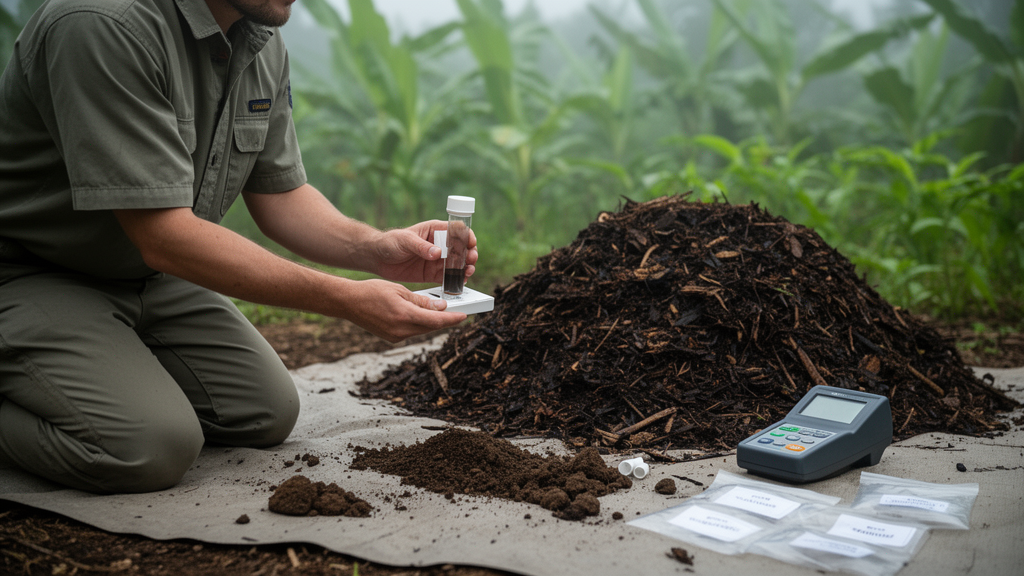
Compost has long been celebrated as a climate-friendly cornerstone of sustainable agriculture, a way to recycle organic waste, feed crops, and lock carbon into the ground. But a new study from Malaysia delivers a sobering twist: what happens after compost hits tropical soil may determine whether that climate benefit survives at all. Researchers at Universiti Malaya found that carbon dioxide emissions from compost-amended tropical soil depend less on how much compost is added and more on how the amendment reshapes two fundamental soil properties, pH and available phosphorus. Their work, published in the journal SOIL, offers one of the clearest empirical demonstrations yet that compost is not inherently carbon neutral.
The research team, led by Xingxing Cheng and corresponding author Chiu Chuen Onn, set out to answer a deceptively simple question: when different composts are mixed into the same tropical soil, why do some trigger far more carbon loss than others? To find out, they collected a highly weathered, acidic ultisol from the 10 to 20 centimeter subsurface layer at the university’s Agricultural Research Center in Kuala Lumpur. This clayey, kaolinite-dominated soil, typical of the humid tropics, is naturally low in fertility and phosphorus, conditions that make it an ideal testing ground for understanding how organic amendments behave in some of the world’s most important agricultural regions.
The experimenters obtained four well-stabilized composts produced at the university’s own composting facility, each from a distinct feedstock: a food waste compost, a goat manure and leaf compost, a chicken dung compost bulked with sawdust and rice bran, and a sludge compost derived from dewatered food and beverage wastewater. Each compost was mixed into the soil at two application rates, 2.5 percent by weight, which corresponds to a typical field rate of roughly 50 tonnes per hectare, and 10 percent, chosen to amplify treatment effects under controlled conditions. Together with an unamended control, the nine treatments were replicated three times and incubated for 90 days at a constant 28 degrees Celsius, matching ambient tropical temperatures.
Carbon dioxide escaping from each incubation unit was trapped in sodium hydroxide solution and quantified by titration on twelve occasions across the three-month experiment. The results revealed a striking hierarchy. Chicken dung compost produced the highest cumulative emissions, followed by sludge compost, then the goat manure-leaf blend, with food waste compost yielding the least. Emission dynamics also differed by feedstock: food waste and goat manure-leaf treatments built up gradually and peaked around day 52, while chicken dung compost emissions climbed after two weeks, peaked near day 30, and sludge compost emissions declined steadily after day 10 before stabilizing.
What distinguished the high-emitting treatments was not simply the amount of organic carbon they delivered. In fact, soils amended with food waste and goat manure-leaf composts ended the incubation with higher total organic carbon than those receiving chicken dung or sludge composts, yet they released less carbon dioxide. Instead, the chicken dung and sludge treatments stood out for dramatically elevating soil pH and available phosphorus. The original soil had a pH of 6.23; chicken dung compost pushed it significantly higher, while the food waste and goat manure-leaf treatments actually left it slightly lower. Available phosphorus, negligible in the unamended soil, rose sharply in all amended soils, with the sludge and chicken dung treatments showing the highest levels, partly because phosphorus and potassium had been added externally during their commercial production.
To move beyond simple correlations, the team deployed a rigorous statistical pipeline. One-way analysis of variance with Tukey’s post-hoc tests confirmed significant differences among treatments for nearly every measured soil property, including total nitrogen, ammonium, nitrate, available phosphorus, available potassium, electrical conductivity, and cation exchange capacity. Compost addition raised total nitrogen by 1.5 to 16 fold and increased cation exchange capacity three to five times, while electrical conductivity in sludge-amended soils reached values 13 to 34 times those of the control, reflecting the high soluble salt content inherited from wastewater treatment. Nitrification was also enhanced across all treatments, with nitrate consistently exceeding ammonium in amended soils, an effect strongest under chicken dung compost, likely thanks to its higher pH favoring ammonia-oxidizing microbes.
The centerpiece of the analysis was a multiple linear regression linking cumulative carbon dioxide emissions to twelve soil physicochemical properties. Because several predictors were strongly intercorrelated, the researchers diagnosed multicollinearity using tolerance and variance inflation factors and turned to ridge regression, selecting a penalty parameter of 0.05 from the ridge trace and error profiles. The resulting model explained a remarkable 90.2 percent of the variance in cumulative emissions. Within it, available phosphorus carried the largest positive coefficient, followed by pH, while available potassium and moisture entered with negative coefficients. Correlation analysis told the same story: emissions correlated most strongly with available phosphorus at 0.79, then pH at 0.76, moisture at 0.74, available potassium at 0.73, and electrical conductivity at 0.62.
The mechanistic explanation rests on well-established soil biogeochemistry. pH is a master variable controlling microbial community composition and enzyme activity; bacterial growth generally peaks in neutral to slightly alkaline conditions, and most extracellular decomposition enzymes work best between pH 6 and 8. Crucially, pH also governs the stability of soil organic matter itself. In acidic soils, iron and aluminium oxides carry positive surface charges that bind and protect organic molecules; raising the pH weakens this protective adsorption and can accelerate the decomposition of particulate organic matter, which is precisely what the high-pH chicken dung treatment exhibited. Phosphorus, meanwhile, is the classic limiting nutrient in highly weathered tropical soils. Relieving that limitation appears to unleash microbial carbon mineralization, potentially by promoting the desorption of organic compounds from mineral surfaces and expanding the substrate pool available to decomposers.
The authors are careful to note the limits of their work. The experiment ran under controlled laboratory conditions without the temperature swings, root activity, and longer-term carbon dynamics of real fields, so multi-year field trials will be needed to confirm the findings at scale. Even so, the practical message is already actionable. Precision compost management, they argue, means selecting or formulating mature composts with near-neutral pH and controlled phosphorus release, guided by soil testing, so that farmers can capture the agronomic rewards of organic amendment, better structure, water retention, and nutrient supply, while minimizing the short-term pulse of carbon loss. In a tropical world where agriculture and climate goals increasingly collide, the study suggests that the path to climate-smart farming runs straight through the chemistry of the soil beneath our feet.
Subject of Research: Drivers of compost-induced carbon dioxide emissions from Malaysian tropical soil
Article Title: The pH and available phosphorus as primary drivers of compost-induced CO2 emissions from Malaysian tropical soil: empirical relationships
Article References: Cheng, X., Othman, F., Abdullah, R., & Onn, C. C. (2026). The pH and available phosphorus as primary drivers of compost-induced CO 2 emissions from Malaysian tropical soil: empirical relationships. SOIL, 12(2), 791-803. https://doi.org/10.5194/soil-12-791-2026
Image Credits: AI Generated
Keywords: soil carbon, compost, carbon dioxide emissions, tropical soil, soil pH, available phosphorus, microbial respiration, ridge regression, climate-smart agriculture, incubation experiment, Malaysia, soil organic matter
Cite Scienmag News
Alan Morgan. (October 9, 2026). Soil pH and Phosphorus Emerge as Key Controls on Compost Carbon Loss in the Tropics. Scienmag. https://scienmag.com/soil-ph-and-phosphorus-emerge-as-key-controls-on-compost-carbon-loss-in-the-tropics/
Alan Morgan. "Soil pH and Phosphorus Emerge as Key Controls on Compost Carbon Loss in the Tropics." Scienmag, 9 October 2026, https://scienmag.com/soil-ph-and-phosphorus-emerge-as-key-controls-on-compost-carbon-loss-in-the-tropics/. Accessed 9 October 2026.
Alan Morgan. "Soil pH and Phosphorus Emerge as Key Controls on Compost Carbon Loss in the Tropics." Scienmag. October 9, 2026. https://scienmag.com/soil-ph-and-phosphorus-emerge-as-key-controls-on-compost-carbon-loss-in-the-tropics/


