


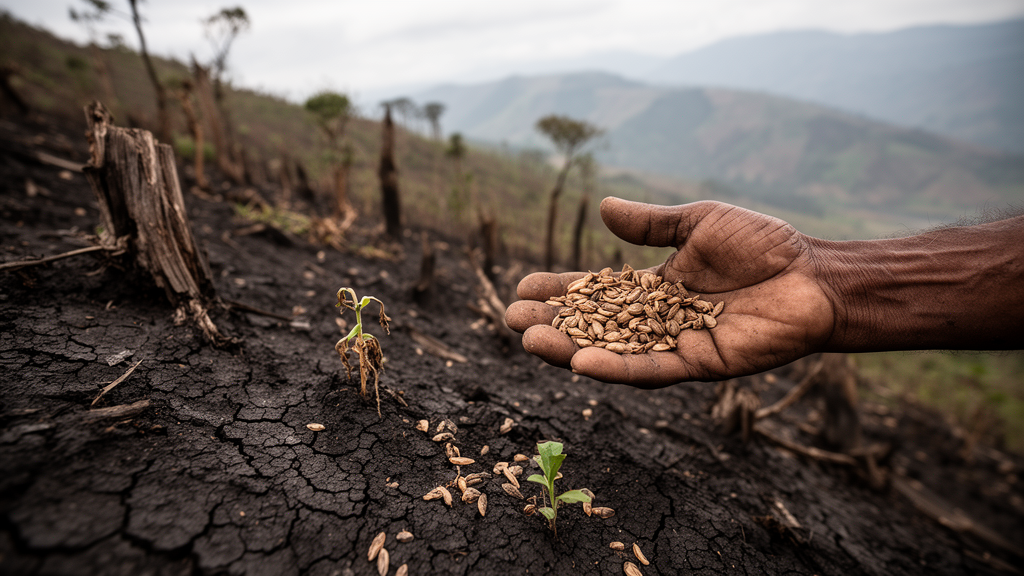
Beneath the thin skin of soil that covers the degraded RasAmba Mountain Forest in northwestern Ethiopia lies a hidden archive of the landscape’s ecological future, and a new study of that archive delivers an uncomfortable verdict. Researchers from Ethiopian Forestry Development, working in the Libo Kemkem District near Addis Zemen town, excavated soil from three vertical layers across the forest and coaxed its dormant seeds to life in a greenhouse. What emerged from the trays was not the seed legacy of a recovering Afromontane forest but a roster of opportunistic weeds. Of 2,890 seedlings that sprouted, representing 36 species from 16 families, the overwhelming majority were herbaceous plants, and only a handful of woody species appeared at all. The finding, published in the journal Discover Forests, suggests that one of Ethiopia’s most important mountain ecosystems has lost the internal machinery it needs to rebuild itself.
The soil seed bank, the natural reservoir of viable seeds buried in leaf litter and mineral soil, is often described as a forest’s insurance policy. In intact ecosystems, these buried seeds preserve genetic diversity, buffer populations against drought, fire, and other shocks, and provide the raw material for regeneration after disturbance. When a mature tree falls or a gap opens in the canopy, the seed bank supplies the next generation. But the insurance only pays out if the right species are in the vault. In forests that have suffered sustained human pressure, scientists typically find a depleted and skewed seed bank, dominated by fast-colonizing generalists rather than the slow-growing, shade-tolerant trees that define a mature forest. The question the Ethiopian team set out to answer was whether the RasAmba forest, an unmanaged communal remnant of the dry Afromontane biome, still held enough of the right seeds to recover on its own.
To find out, the researchers laid out six parallel transects spaced 200 meters apart across the mountain’s elevational gradient, which ranges from roughly 2,008 to 2,373 meters above sea level. Along each transect, they established 20 by 20 meter quadrats at 100 meter intervals to survey the standing vegetation, and within each quadrat they placed five small subplots at the corners and center. From each subplot they excavated soil in three distinct layers: zero to three centimeters, three to six centimeters, and six to nine centimeters. Samples from the same depth within a quadrat were pooled into composite samples, yielding 90 composites across 30 quadrats and three depths. The soil was sieved, spread thinly in plastic trays, and monitored weekly for six months in a greenhouse at the Central Ethiopia Environment and Forest Research Centre in Addis Ababa, with sterilized control trays standing guard against airborne contamination. The seedling emergence method, laborious as it is, remains the most reliable way to count only the seeds that are actually alive and capable of germinating.
The numbers that emerged told a story of compositional collapse. Asteraceae, the daisy family, contributed nine species, a quarter of all richness, followed by Fabaceae with eight species and Poaceae, the grasses, with four. Together these three families accounted for more than 58 percent of the species recorded, a signature of disturbed, early-successional landscapes. Life-form analysis was even more damning: 28 of the 36 species, or 77.78 percent, were herbaceous, while woody plants amounted to just seven species, two trees and five shrubs, plus a single liana. The overall seed density averaged 856.3 seeds per square meter, a figure comparable to other degraded Afromontane forests but well below the densities documented in Ethiopia’s relatively undisturbed church forests, the sacred woodland patches that have long served as informal biodiversity refuges in the northern highlands.
Dominance within the seed bank was extreme. The herb Galinsoga parviflora alone produced 153.2 seedlings per square meter, representing 17.89 percent of total emergence, followed by the grass Hyparrhenia hirta at 134.5 seedlings per square meter and the cereal Eleusine coracana at 70.5. Just three species made up nearly 42 percent of everything that germinated, while eight species appeared at densities below ten seeds per square meter. A Simpson’s Dominance Index of 0.0924 confirmed what the raw counts implied: the seed bank is structurally controlled by a small clique of aggressive, wind-dispersed colonizers that crowd out more sensitive taxa. In ecological terms, the buried flora of RasAmba is not a dormant forest waiting for its chance. It is a weed reservoir.
The vertical dimension of the study added a further layer of vulnerability. Seedling emergence fell steadily with depth: 41.04 percent of individuals emerged from the top zero-to-three-centimeter layer, 31.90 percent from the middle layer, and 27.06 percent from the deepest six-to-nine-centimeter horizon. Species richness followed the same trajectory, dropping from 34 species in the surface layer to 22 in the lowest. This pattern indicates a young seed bank, replenished by recent seed rain and concentrated where oxygen and light conditions are most favorable for germination. It also means the forest’s entire regeneration capital sits within a few millimeters of the surface, precisely where erosion, livestock trampling, and repeated grazing do their damage. A single season of overgrazing or a heavy rainstorm on a denuded slope could strip away a large fraction of the viable seeds the forest still possesses.
Perhaps the most consequential number in the study is the Jaccard Coefficient of Similarity between the seed bank and the standing vegetation: 0.0481, a value so low it borders on statistical indifference. The researchers documented 73 species in the aboveground flora but only 36 in the soil, and just five species, Dombeya torrida, Calpurnia aurea, Dodonaea angustifolia, Achyranthes aspera, and Urtica simensis, appeared in both compartments. Sixty-eight species of the living forest were entirely absent from the soil, while 31 seed bank species existed nowhere in the mature vegetation. The Shannon-Wiener diversity index of the seed bank, at 2.74 with an evenness of 0.76, indicates moderate diversity with highly uneven abundance, but diversity alone is meaningless if the species present are the wrong ones. The late-successional canopy trees that define a dry Afromontane forest are, for practical purposes, missing from the vault altogether.
This floristic disconnect constitutes what the authors call a regeneration bottleneck, and it has direct implications for how Ethiopia manages its shrinking mountain forests. Passive restoration, the strategy of simply fencing off degraded land and letting nature take its course, depends on the seed bank and incoming seed rain being able to rebuild something resembling the original community. At RasAmba, that assumption fails. Left alone, the researchers warn, the forest will likely settle into an arrested state dominated by opportunistic herbs and pioneer shrubs rather than transitioning toward native climax woodland. Area closures, a widely used and often successful conservation tool in the Ethiopian highlands, may protect what remains of the surface seed bank, but they cannot conjure canopy trees whose seeds no longer exist in the soil. The ongoing harvest of trees for firewood compounds the problem, simultaneously removing the mature seed sources and depleting the buried reserve.
The study’s recommendations therefore pivot toward active intervention. The authors call for enrichment planting with nursery-raised seedlings of indigenous tree species, community-managed exclosures to shield the fragile surface seed layer from grazing, and physical soil conservation structures such as terraces and bunds to prevent erosion from washing away the remaining seeds. They also advocate participatory forest management frameworks that address the root drivers of degradation, including the distribution of energy-efficient stoves and the establishment of fast-growing woodlots to decouple household fuel needs from the forest itself. Further research into seed rain and seed longevity would sharpen the picture of long-term recovery dynamics. For now, the message from RasAmba is stark and broadly relevant: in heavily degraded tropical mountain forests, the soil beneath your feet may look like a promise of renewal, but if decades of deforestation, grazing, and logging have rewritten its contents, restoration will not happen by wishful waiting. It will require deliberate, hands-on replanting of the species the seed bank has already forgotten.
Subject of Research: Soil seed bank diversity and vertical distribution in a degraded dry Afromontane forest in northwestern Ethiopia
Article Title: Soil seed bank diversity, composition, and structure along vertical soil layers in Libo Kemkem District, Northwestern Ethiopia
Article References: Worku, T., Getie, S., Teshager, Z., Agidie, A., Eshete, A., & Guday, S. (2026). Soil seed bank diversity, composition, and structure along vertical soil layers in Libo Kemkem District, Northwestern Ethiopia. Discover Forests, 2(1), Article 77. https://doi.org/10.1007/s44415-026-00140-6
Image Credits: AI Generated
DOI: 10.1007/s44415-026-00140-6
Keywords: soil seed bank, dry Afromontane forest, Ethiopia, forest restoration, seedling emergence, vertical seed distribution, Jaccard similarity, biodiversity, land degradation, enrichment planting, regeneration bottleneck, restoration ecology
Cite Scienmag News
Gavin Prescott. (October 9, 2026). Buried Seeds Reveal a Broken Promise: Ethiopia’s Degraded Mountain Forest Cannot Heal Itself. Scienmag. https://scienmag.com/buried-seeds-reveal-a-broken-promise-ethiopias-degraded-mountain-forest-cannot-heal-itself/
Gavin Prescott. "Buried Seeds Reveal a Broken Promise: Ethiopia’s Degraded Mountain Forest Cannot Heal Itself." Scienmag, 9 October 2026, https://scienmag.com/buried-seeds-reveal-a-broken-promise-ethiopias-degraded-mountain-forest-cannot-heal-itself/. Accessed 9 October 2026.
Gavin Prescott. "Buried Seeds Reveal a Broken Promise: Ethiopia’s Degraded Mountain Forest Cannot Heal Itself." Scienmag. October 9, 2026. https://scienmag.com/buried-seeds-reveal-a-broken-promise-ethiopias-degraded-mountain-forest-cannot-heal-itself/


