


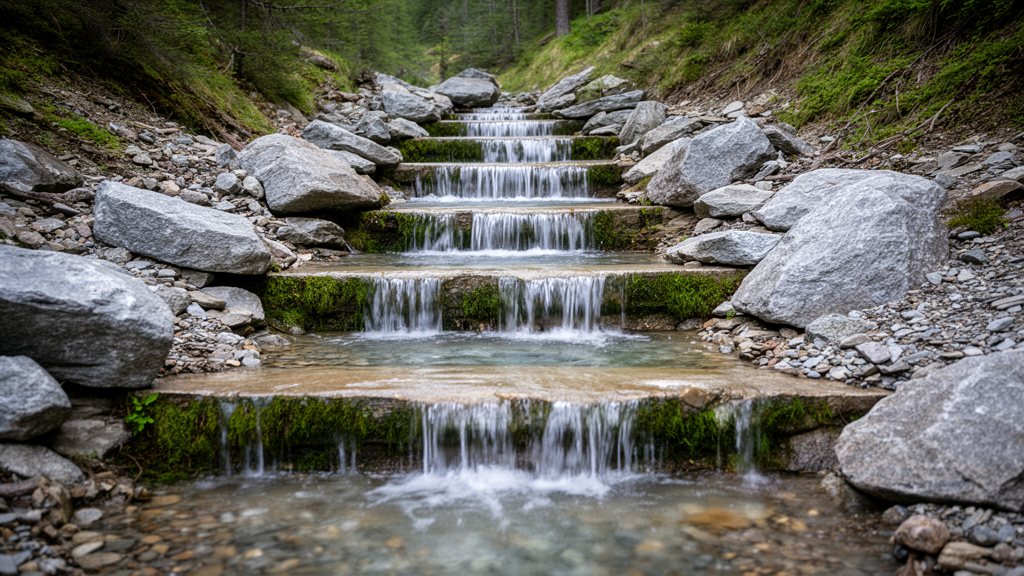
High in the world’s mountain ranges, steep streams often arrange themselves into striking natural staircases: water crests over a near-vertical drop of cobbles and boulders, plunges into a scourered depression, and then repeats the pattern again and again down the channel. These step-pool sequences are among the most recognizable bedforms in fluvial geomorphology, and they matter far beyond their aesthetic appeal. Because they dissipate the enormous energy of floodwaters and stabilize the transport of sediment in hazardous mountain catchments, engineers and restoration practitioners routinely try to imitate them, installing boulder steps and check dams to protect roads, villages, and infrastructure. Yet for decades the field has been divided by a deceptively simple question: are natural steps spaced at regular intervals, or are they scattered randomly along the channel? A new study argues that the question itself has been posed the wrong way.
Christian M. Erikson and Jens M. Turowski of the GFZ Helmholtz Centre for Geosciences in Potsdam, Germany, publish their analysis in the journal Earth Surface Dynamics as a highlight letter. Their central claim is that step-pool spacing occupies a continuum between regularity and randomness, with the full range of possible configurations realized in nature and no single formation mechanism dominating. The finding, drawn from a compilation of 131 step-pool sequences spanning field sites, laboratory flume experiments, and numerical simulations, resolves a long-standing tension between competing models that had produced contradictory expectations about what a healthy mountain stream should look like.
The stakes are considerable. Mountain streams account for an estimated 60 to 80 percent of total global river length, and the transport of floodwaters and sediment through them is a costly natural hazard in populated mountainous regions. Step-pools are prominent in rivers with slopes exceeding roughly 3 percent, and their ability to provide flow resistance makes them a favored tool in hazard management. They are also used as a benchmark of channel recovery in river restoration, particularly in the growing number of dam-removal projects worldwide. Without a clear, mechanism-independent expectation for step spacing, practitioners have had no reliable target: one scientific camp predicted regular spacing tied to channel hydraulics, another predicted random spacing tied to the size and location of large boulders, and restoration designs inherited the confusion.
The roots of the dispute run deep. Mechanisms linked to hydraulics, such as the antidune mechanism, associate steps with regular spacing. Antidunes are bedforms that organize under rapidly flowing water into roughly periodic crests, and the idea, first proposed from flume experiments in 1982, was that these precursory bedforms act as nucleation points for developing steps. The pool-scour mechanism offers another hydraulic route to regularity: high-energy flow over a step scours a pool downstream, and the excavated material builds the next step, propagating a rhythmically spaced sequence. In contrast, mechanisms tied to channel properties and particle interactions predict randomness. In particle jamming, grains chain together across the channel, often in narrow sections; in keystone clustering, sediment accumulates around large immobile boulders. Because the underlying boulders and rough patches are themselves randomly distributed, the resulting steps inherit that randomness.
The scientific literature has swung back and forth between these camps, and the antidune mechanism is the emblematic case. Once a commonly invoked explanation, it fell from prominence as random-interaction models gained ground, was at one point called on to be abandoned entirely, and has recently been resurrected and again put forward as the dominant mechanism. Erikson and Turowski argue that this vacillation reflects a structural problem: without a comparative framework transferable across mechanisms, interpretations of step spacing have been constrained by prior assumptions about the formative process. A researcher who assumes antidunes will find regularity; one who assumes jamming will find randomness. Both may be partly right, and neither can settle the debate alone.
To break the deadlock, the researchers built a diagnostic framework from two statistical measures of spacing variability that can be calculated from readily obtainable measurements. The first is the coefficient of variation, the standard deviation of step spacing divided by the mean spacing, a standard measure of scatter. The second is a new metric they call the relative minimum: the smallest observed gap between steps divided by the mean spacing. The relative minimum exists to capture the effect of exclusion zones, the stretches of channel immediately downstream of a step where the hydraulic influence of that step prevents a new one from forming. The longer the exclusion zone, the less room remains for new steps, and the lower the maximum achievable coefficient of variation. Because no general method exists to measure exclusion-zone length directly, the minimum spacing serves as a practical proxy.
With these two metrics defining a two-axis plotting space, the team established two reference lines using Monte Carlo simulations repeated 100,000 times. A regular reference line was generated by taking a perfectly regular step sequence, adding Gaussian noise to the spacing, and adjusting positions until all steps respected the minimum-spacing constraint. A random reference line came from a modified Poisson process, in which spacings were drawn from an exponential distribution and any spacing below the minimum constraint was rejected, mimicking the way an exclusion zone limits pure randomness. A range-normalized coefficient of variation then places any real sequence between the two lines: values below 0.5 indicate a sequence closer to regular, values above 0.5 closer to random.
The compiled dataset of 131 sequences, drawn from channels with slopes spanning an order of magnitude from about 3 to 35 percent, revealed that natural step-pool sequences span nearly the full range of possible relative minimum spacing, from 0.07 to 0.84 against a possible range of 0 to 1. The observed coefficients of variation fell almost entirely within the bounds set by the two reference lines, with only three exceptions. Crucially, most sequences sat somewhere between the lines rather than clustering near either one. Of 27 averaged data sources, 18 were closer to the random reference line and 9 closer to the regular line, but the dominant impression was of a continuum fully occupied rather than two distinct populations. Sequences explicitly tied to roughness, keystone, and jamming mechanisms plotted nearest the random line, as expected, while pool-scour sequences and true antidunes plotted nearest the regular line. Channel slope showed no strong correlation with spacing variability.
The framework also produced surprises that cut against cherished assumptions. The flume experiments of Whittaker and Jaeggi, from which the antidune mechanism was first proposed, plotted closer to the random reference line than to the regular one, in an opposite corner of the diagram from genuine antidunes, suggesting that a roughness-based mechanism better explains their observations. The three outliers beyond the random reference line proved diagnostic in their own right: wood-constructed steps in the Vogelbach in Switzerland and Shatford Creek in Canada, and newly developed steps in Charles Brown Brook in the United States after a dam removal, where steps clustered around rough patches with large gaps between clusters. Artificially close spacing or isolated clustering can push a sequence past what pure randomness allows, turning the random reference line into a practical tool for spotting reaches where spacing has been forced by wood, engineering, or disturbance.
The implications reach directly into stream management. Because irreducible natural variability prevents full regularity and hydraulic exclusion zones prevent full randomness, any isolated set of observations will fail to match a truly regular or truly random ideal, meaning that restoration designs built on either assumption are fundamentally misguided. The authors suggest that channel equilibrium, a central concept in restoration, may need redefinition away from a static spacing target toward objectives that accommodate a range of configurations and multiple simultaneous processes. Moreover, because the random reference line is explicitly tied to channel hydraulics, it offers a testable prediction for how spacing evolves in channels that are not in equilibrium, potentially serving as an indicator of river adjustment. In the context of accelerating dam removals, where recovery is currently gauged by metrics tied to assumptions of regularity, such a mechanism-independent yardstick could eventually define concrete, physically grounded targets for restoring the staircases of the world’s mountain streams.
Subject of Research: Spacing regularity and randomness of step-pool sequences in steep mountain streams
Article Title: From regular to random: a unifying framework for step-pool spacing
Article References: Erikson, C. M., & Turowski, J. M. (2026). From regular to random: a unifying framework for step-pool spacing. Earth Surface Dynamics, 14(4), 653-659. https://doi.org/10.5194/esurf-14-653-2026
Image Credits: AI Generated
DOI: 10.5194/esurf-14-653-2026
Keywords: step-pools, mountain streams, geomorphology, fluvial processes, stream restoration, hydraulics, antidunes, particle jamming, sediment transport, dam removal, channel equilibrium, Earth Surface Dynamics
Cite Scienmag News
Violet Maxwell. (October 9, 2026). Mountain stream staircases are neither regular nor random, study finds. Scienmag. https://scienmag.com/mountain-stream-staircases-are-neither-regular-nor-random-study-finds/
Violet Maxwell. "Mountain stream staircases are neither regular nor random, study finds." Scienmag, 9 October 2026, https://scienmag.com/mountain-stream-staircases-are-neither-regular-nor-random-study-finds/. Accessed 9 October 2026.
Violet Maxwell. "Mountain stream staircases are neither regular nor random, study finds." Scienmag. October 9, 2026. https://scienmag.com/mountain-stream-staircases-are-neither-regular-nor-random-study-finds/


