


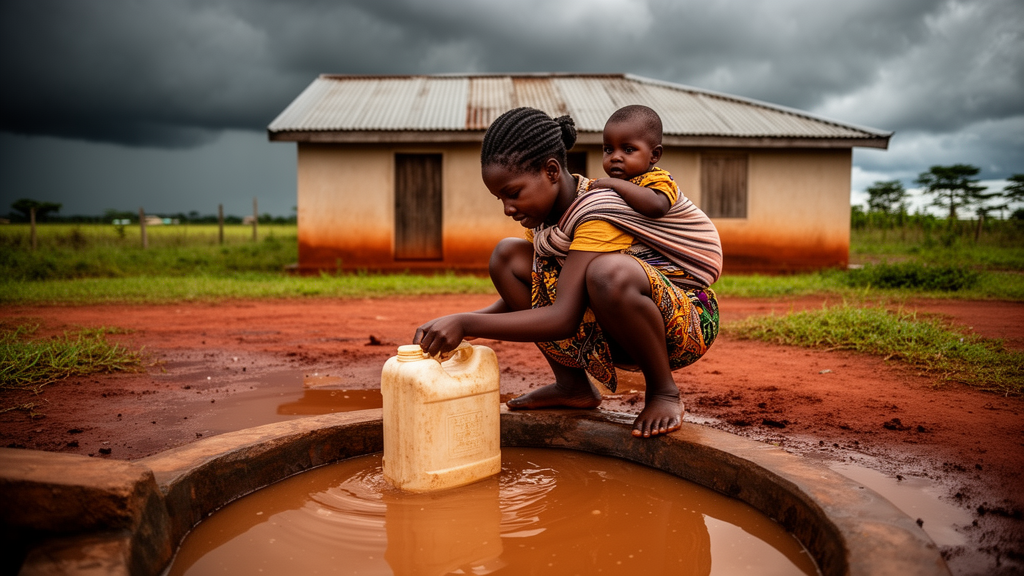
In the coastal city of Beira, Mozambique, the weather is more than a topic of small talk. It is a matter of life and death for the youngest residents. A new study published in PLOS Water has traced, with unusual precision, how rainfall, temperature, flooding and seasonal cycles shape two intertwined threats to infant health: the microbial contamination of household stored drinking water and the incidence of diarrhea in babies during their first year of life. The findings come at a moment when climate change is intensifying both droughts and downpours across southern Africa, and they offer some of the clearest quantitative evidence yet that meteorological conditions leave measurable fingerprints on the water families drink and the illnesses their children suffer.
Diarrheal disease remains one of the leading causes of illness and death among children under five worldwide. Although the global burden has declined substantially over recent decades, thanks to improved sanitation, oral rehydration therapy and vaccination against rotavirus, that progress is unevenly distributed. Low-income urban settlements, where piped water may be intermittent, sanitation infrastructure strained and housing precarious, remain hotspots of risk. Climate change threatens to stall or even reverse decades of gains in these communities, because the meteorological conditions associated with a warming world, including heavy rainfall events, elevated ambient temperatures and flooding, are precisely the conditions that disrupt water safety and accelerate pathogen transmission. Quantifying those relationships is therefore a critical step toward anticipating the health burden that climate change will impose on vulnerable populations.
The research, conducted by an international team led by investigators from the PAASIM Study Authorship Consortium, including Rebecca S. Kann, Sydney Hubbard, Jedidiah Snyder, Karen Levy and Matthew C. Freeman, focused on Beira, a low-lying port city that is widely regarded as one of the most climate-vulnerable urban areas in Africa. Cyclones and flooding have repeatedly battered the region in recent years, and its dense, rapidly growing neighborhoods combine high water tables with aging or absent drainage systems. Against this backdrop, the team followed mother-child dyads from the third trimester of pregnancy through the infant’s first birthday, collecting data when the infants were three, six, nine and twelve months old. This longitudinal design allowed the researchers to observe how the same households fared as seasons turned and weather shifted.
At each contact, the study team recorded whether the infant had experienced diarrhea and collected samples of water stored in the household for drinking, along with information about the source from which that water had been drawn. The stored water samples were analyzed for contamination with fecal indicator bacteria, a standard proxy for the presence of pathogens that cause diarrheal illness. Weather data, including ambient temperature, heavy rainfall events and flooding, were linked to each household observation, and each visit was classified as occurring in either the rainy or the dry season. The researchers then applied modified Poisson regression mixed effects models, a statistical framework well suited to repeated measures and binary health outcomes, to estimate the strength of the associations between weather variables and the two outcomes of interest: stored water contamination and infant diarrhea.
The results reveal a pronounced seasonal signature in household water safety. During the rainy season, the prevalence of contamination in stored household water was 49 percent higher than during the dry season, with an adjusted prevalence ratio of 1.49 and a 95 percent confidence interval spanning 1.34 to 1.67. This finding is consistent with the mechanistic expectation that heavy rains wash fecal material from latrines, open drains and soil into shallow wells, piped networks and other water sources, overwhelming any treatment barriers that exist. In a city like Beira, where flooding is frequent during the wet months, rain does not merely fall on the city; it mobilizes the microbial contents of its streets and sanitation systems into the water that families collect and store.
Temperature told a different and equally instructive story. Higher ambient temperatures were associated with a higher prevalence of stored water contamination, but only during the dry season, with an adjusted prevalence ratio of 1.14 and a 95 percent confidence interval of 1.03 to 1.27. The seasonal asymmetry makes biological sense. During dry months, when water may sit longer in storage containers and ambient heat accelerates bacterial regrowth, warmth can amplify contamination within the household itself. During the rainy season, by contrast, the dominant driver of contamination appears to be the influx of pathogens from the environment, which may swamp the more modest effect of temperature on bacterial multiplication in storage vessels. The distinction matters for intervention design: protecting stored water from recontamination may yield the greatest benefits in hot, dry periods, while safeguarding sources from flood-driven infiltration is paramount when the rains arrive.
The study also quantified the link between the quality of water at its source and the quality of water in the home. When the source water was contaminated, the prevalence of contamination in stored household water rose by 32 percent during the rainy season, with an adjusted prevalence ratio of 1.32 and a confidence interval of 1.11 to 1.56, and by 56 percent during the dry season, with a ratio of 1.56 and a confidence interval of 1.22 to 2.00. That the association was stronger in the dry season suggests that when environmental dilution and flushing are minimal, the quality of the source dominates the quality of what families ultimately drink. It also underscores a sobering reality documented in many settings: water that leaves a tap or well clean can become contaminated inside the home through dirty containers, hands and utensils, so source protection alone is insufficient.
Crucially, the weather patterns that degraded water quality also translated into illness. Infants were 18 percent more likely to experience diarrhea during the rainy season than during the dry season, with an adjusted prevalence ratio of 1.18 and a confidence interval of 1.01 to 1.38. Higher temperatures again exerted a dry-season-specific effect, raising the prevalence of infant diarrhea by 19 percent for each increment of elevated heat, with a ratio of 1.19 and a confidence interval of 1.05 to 1.35. The parallel structure of the water-quality and illness findings, with rainy season and dry-season heat each leaving its mark on both outcomes, strengthens the plausibility of a causal chain running from meteorology through water contamination to child health, although the authors are careful to note that the study characterizes associations rather than proving mechanisms.
For public health planners, the implications are concrete. The findings argue for interventions that are timed and targeted to the seasons: household water treatment and safe storage promotion may be most urgent as the rains approach, while attention to source water protection and thermal risks to stored water becomes critical during hot, dry months. They also argue for integrating climate information into water, sanitation and hygiene programming in climate-vulnerable cities, rather than treating weather as background noise. As global temperatures rise and extreme rainfall events become more frequent, the seasonal and weather-dependent variation documented in Beira is likely to intensify, and the communities least responsible for climate change will continue to bear a disproportionate share of its health consequences.
The study, published on September 22, 2026, in PLOS Water under the title describing the impact of weather and season on stored water contamination and infant diarrhea in climate-vulnerable, urban Mozambique, adds an important piece to the growing evidence base linking climate and child health. Its longitudinal design, repeated measurement of both exposure and outcome, and explicit modeling of seasonal interactions set a methodological standard for future work in other climate-exposed cities. For the mothers and infants of Beira, the message is stark but actionable: the risks their children face are not random, but follow the rhythm of the seasons and the mercury of the thermometer, and that rhythm can be anticipated, planned for and, with sustained investment in water safety, blunted.
Subject of Research: The impact of weather and season on stored drinking water contamination and infant diarrhea in climate-vulnerable urban Mozambique
Article Title: Impact of weather and season on stored water contamination and infant diarrhea in climate-vulnerable, urban Mozambique
Article References: Kann, R. S., Hubbard, S., Snyder, J., McGunegill, S., Muneme, B., Manuel, J. L., Waller, L. A., Nalá, R., Levy, K., Freeman, M. C., & the PAASIM Study Authorship Consortium (2026). Impact of weather and season on stored water contamination and infant diarrhea in climate-vulnerable, urban Mozambique. PLOS Water, 5(9), e0000599. https://doi.org/10.1371/journal.pwat.0000599
Image Credits: AI Generated
DOI: 10.1371/journal.pwat.0000599
Keywords: infant diarrhea, water contamination, Mozambique, climate change, rainy season, ambient temperature, flooding, stored water quality, PLOS Water, public health, Beira, epidemiology
Cite Scienmag News
Harold Sullivan. (October 9, 2026). Rain, Heat and Risk: How Weather Drives Water Contamination and Infant Diarrhea in Mozambique. Scienmag. https://scienmag.com/rain-heat-and-risk-how-weather-drives-water-contamination-and-infant-diarrhea-in-mozambique/
Harold Sullivan. "Rain, Heat and Risk: How Weather Drives Water Contamination and Infant Diarrhea in Mozambique." Scienmag, 9 October 2026, https://scienmag.com/rain-heat-and-risk-how-weather-drives-water-contamination-and-infant-diarrhea-in-mozambique/. Accessed 9 October 2026.
Harold Sullivan. "Rain, Heat and Risk: How Weather Drives Water Contamination and Infant Diarrhea in Mozambique." Scienmag. October 9, 2026. https://scienmag.com/rain-heat-and-risk-how-weather-drives-water-contamination-and-infant-diarrhea-in-mozambique/


