


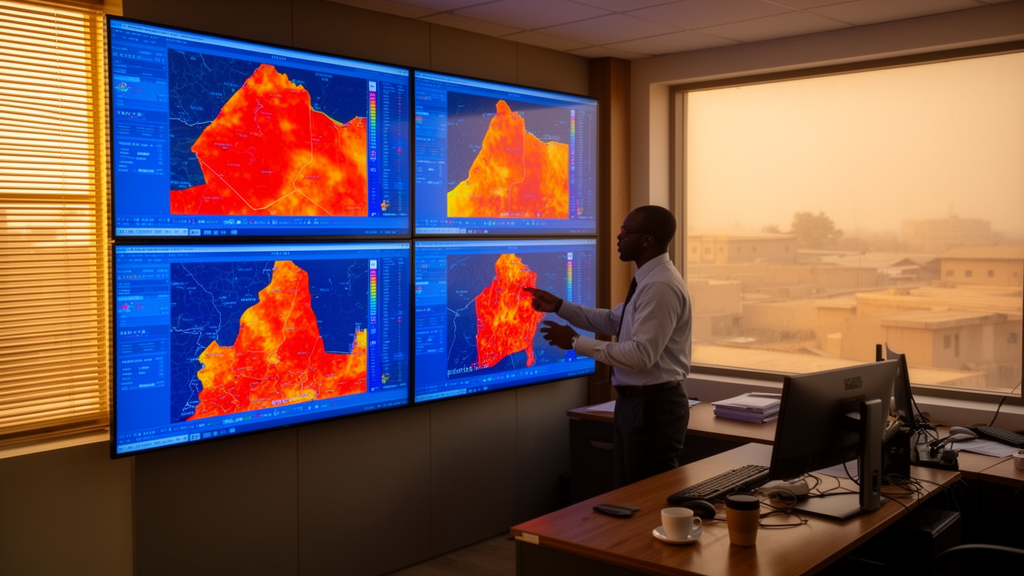
Northwestern Nigeria is heating up, and a new study suggests the worst may still be ahead. Researchers have built a deep learning model capable of forecasting heatwave trends across the region with remarkable accuracy, and its analysis of more than four decades of weather data reveals a pronounced intensification of extreme heat events. The work, published in PLOS Climate, combines machine learning with classical statistical trend analysis to offer one of the most detailed pictures yet of how heat stress is evolving in this part of West Africa.
The research team, led by Saadatu Umaru Baba with colleagues Abu-hanifa Babati and Zaharaddeen Isa, set out to address a persistent gap in regional climate adaptation. Heatwaves are among the most dangerous climate extremes, threatening human health, agricultural productivity, and ecosystems, yet many developing regions lack the localized forecasting tools needed to prepare for them. Global climate models often operate at scales too coarse to capture the specific dynamics of heat stress in places like Sokoto, Kano, or Katsina, where dry Sahelian conditions and rapid population growth combine to make extreme heat especially hazardous.
To build their predictive system, the researchers turned to long short-term memory networks, a class of artificial neural networks designed specifically to learn from sequential data. LSTM models are a specialized form of recurrent neural network that use internal memory cells and gating mechanisms to decide what information to retain, discard, and pass forward through time. This architecture allows them to capture long-range dependencies in data, making them well suited to meteorological time series in which today’s conditions are shaped by patterns established days, weeks, or even seasons earlier. Unlike simpler statistical models, LSTMs can learn nonlinear relationships between temperature, humidity, and seasonality without those relationships being explicitly programmed.
The training data came from the Nigerian Meteorological Agency, which provided daily records of maximum temperature, minimum temperature, and relative humidity stretching from 1980 to 2024. That forty-five-year span gives the model a rich historical foundation, encompassing multiple decades during which global and regional warming trends have accelerated. By feeding this archive into the network, the researchers enabled it to internalize both the seasonal rhythms of the West African climate and the slower, longer-term drift toward hotter conditions that has accompanied climate change.
Defining and measuring a heatwave is itself a technical challenge, and the study approached it through the heat index, a metric that combines air temperature and relative humidity to estimate how hot conditions actually feel to the human body. The heat index matters because humidity dramatically changes the physiological burden of heat: at high humidity, the body’s primary cooling mechanism, the evaporation of sweat, becomes far less efficient, so a given air temperature can pose a much greater health risk. By computing heat index values across the full historical record, the researchers quantified heatwave intensity in a way that reflects genuine human exposure rather than raw thermometer readings alone.
Alongside the machine learning forecast, the team applied two complementary statistical techniques to characterize how heatwaves have changed over time. The Modified Mann Kendall test is a widely used non-parametric method for detecting monotonic trends in time series data, and its modified variant corrects for autocorrelation, the tendency of consecutive measurements in climate data to influence one another, which can otherwise produce spurious signals of change. Innovative Trend Analysis, a more recently developed approach, compares data points from the first and second halves of a record plotted against one another, allowing researchers to identify trends at low, medium, and high intensity ranges and to spot hidden trends that traditional tests may miss. To map how heatwave intensity varies across space, the researchers used the Inverse Distance Weighting method, an interpolation technique that estimates values at unsampled locations by weighting nearby observation points more heavily than distant ones, producing continuous spatial surfaces from discrete station measurements.
The results of the trend analyses were unambiguous. Across northwestern Nigeria, the study found a pronounced increase in both the frequency and the severity of heatwaves over the period of record. The spatial mapping revealed that this intensification is not uniform, with variations in heatwave intensity distributed across the region in patterns that reflect local climatic and geographic conditions. For a region where much of the population works outdoors in agriculture and where access to cooling infrastructure remains limited, an upward trajectory in heat stress carries serious implications for labor productivity, food security, and public health, particularly for vulnerable groups such as the elderly, children, and those with pre-existing health conditions.
The predictive performance of the LSTM model was the study’s central technical achievement. During the testing phase, when the network was evaluated on data it had never seen, it achieved correlation coefficients ranging from 0.87 to 0.91, indicating a strong positive relationship between predicted and observed values. The coefficients of determination, which express the proportion of variance in the observations explained by the model, ranged from 0.76 to 0.83. In practical terms, this means the model accounted for roughly three-quarters or more of the variability in heatwave-related conditions during testing, a level of accuracy that positions it as a genuinely useful forecasting tool rather than a proof of concept. Such performance suggests that LSTM-based approaches can deliver reliable heatwave predictions even in data-sparse regions where sophisticated physical climate modeling infrastructure may be limited.
The implications extend well beyond the academic literature. The authors highlight the potential of LSTM models to support regional climate adaptation strategies, heat early warning systems, and evidence-based decision making. Early warning systems for extreme heat depend on accurate, actionable forecasts delivered with enough lead time for authorities to open cooling centers, adjust work schedules, warn agricultural communities, and prepare health services for surges in heat-related illness. A model that can anticipate heatwave trends from routinely collected meteorological data offers a pathway to such capabilities at relatively low cost, since the approach leverages existing weather station records rather than requiring expensive new observation networks or supercomputing facilities.
The study also contributes to a broader conversation about the role of artificial intelligence in climate science. As machine learning techniques mature, they are increasingly being deployed to downscale global climate projections, fill gaps in observational records, and generate localized forecasts in regions that have historically been underserved by climate services. This research demonstrates that deep learning architectures originally developed for tasks such as language processing can be repurposed to address urgent environmental challenges, provided they are paired with rigorous statistical validation and grounded in quality historical data. For northwestern Nigeria, the message from the model is clear: heatwaves are becoming more frequent and more severe, and the tools now exist to see that trend coming. Turning that foresight into policy, from heat action plans to resilient urban design, is the challenge that remains.
Subject of Research: LSTM-based machine learning prediction of heatwave trends in northwestern Nigeria
Article Title: Long Short-Term Memory (LSTM)-based prediction of heatwave trends in northwestern Nigeria
Article References: Baba, S. U., Babati, A.-H., & Isa, Z. (2026). Long Short-Term Memory (LSTM)-based prediction of heatwave trends in northwestern Nigeria. PLOS Climate, 5(9), e0001005. https://doi.org/10.1371/journal.pclm.0001005
Image Credits: AI Generated
DOI: 10.1371/journal.pclm.0001005
Keywords: heatwaves, LSTM, deep learning, Nigeria, climate change, heat index, Mann Kendall test, Innovative Trend Analysis, early warning systems, NiMet, climate adaptation, machine learning
Cite Scienmag News
Sloane Callahan. (October 9, 2026). AI Model Forecasts Rising Heatwave Threat Across Northwestern Nigeria. Scienmag. https://scienmag.com/ai-model-forecasts-rising-heatwave-threat-across-northwestern-nigeria/
Sloane Callahan. "AI Model Forecasts Rising Heatwave Threat Across Northwestern Nigeria." Scienmag, 9 October 2026, https://scienmag.com/ai-model-forecasts-rising-heatwave-threat-across-northwestern-nigeria/. Accessed 9 October 2026.
Sloane Callahan. "AI Model Forecasts Rising Heatwave Threat Across Northwestern Nigeria." Scienmag. October 9, 2026. https://scienmag.com/ai-model-forecasts-rising-heatwave-threat-across-northwestern-nigeria/


