


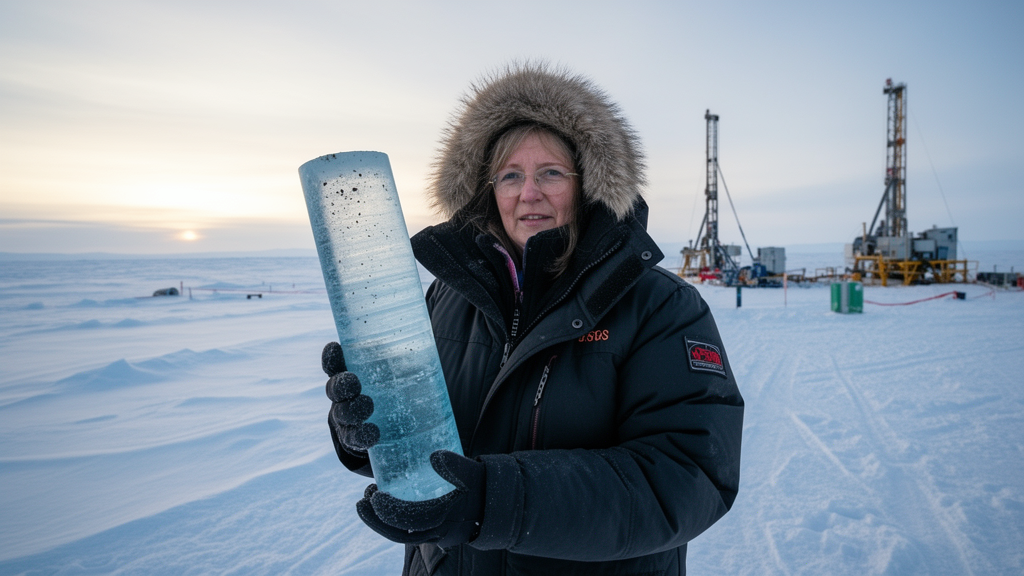
Deep beneath the South Pole, buried in layers of ancient snow, tiny particles of mineral dust have been quietly recording the behavior of the most powerful surface wind system on Earth. A new analysis of the South Pole Ice Core, known as SPC14, suggests that the Southern Hemisphere Westerly Winds have grown stronger and shifted toward the pole over the past several thousand years, driven by a slow, orbitally paced warming of the Southern Hemisphere. The finding, published in the journal Climate of the Past, offers one of the most complete continuous records yet of how these winds evolved through the Holocene, the roughly 12,000-year epoch that began as the last ice age ended.
The Southern Hemisphere Westerly Winds are far more than a meteorological curiosity. They encircle the globe across the southern mid-latitudes, driving the circulation of the Southern Ocean, regulating how much carbon dioxide escapes from the deep ocean to the atmosphere, and influencing the stability of the Antarctic ice sheets. When the winds strengthen and migrate southward, they intensify the upwelling of deep, carbon-rich water around Antarctica and can accelerate the delivery of relatively warm circumpolar deep water to the edges of the ice sheet. Understanding how these winds behaved during past warm intervals is therefore critical for projecting the future of the West Antarctic Ice Sheet and the global carbon cycle.
Yet reconstructing the winds over thousands of years has proven stubbornly difficult. Existing proxy records from lake sediments, glacier moraines, and ocean cores scattered across South America, New Zealand, and sub-Antarctic islands tell conflicting stories: some suggest the winds shifted south early in the Holocene and then moved back north, others indicate a progressive strengthening beginning around 8,000 to 7,000 years ago, and still others point to a tightening of the wind belt’s core without much latitudinal movement. The new study, led by Aaron Chesler of the Climate Change Institute at the University of Maine together with colleagues from Dartmouth College, Colby College, and South Dakota State University, adds a crucial data point from a location that sits almost symmetrically within the annular wind belt, making it well suited for capturing hemispheric-scale signals rather than regional quirks.
The team measured dust particles preserved in the SPC14 core using a Klotz Abakus laser dust sensor mounted on a continuous flow analysis system at Dartmouth College. Because the South Pole accumulates snow relatively quickly for East Antarctica, about eight centimeters of water equivalent per year, the core’s chronology is tightly constrained, with age uncertainty of only about 18 years through most of the Holocene. The researchers focused on particles between 1.1 and 5.1 micrometers in diameter, resampling the data into 50-year intervals, and tracked two key metrics: the total number concentration of dust particles and the coarse particle percentage, the proportion of particles in the larger 3.2 to 5.1 micrometer range.
What they found was a striking divergence. Total dust concentrations declined steadily through the Holocene, dropping by roughly 40 percent from the early to the late Holocene, while the coarse particle percentage actually rose, climbing from 8.6 percent to 9.4 percent. The two trends began to diverge around 7,000 years before present, during what the authors define as the mid-Holocene, spanning roughly 7,000 to 3,000 years ago. During this interval, dust concentrations fell at a rate of about 50 particles per milliliter per thousand years, double the rate of decline seen in the late Holocene, while the finer 1.1 to 3.2 micrometer fraction shrank disproportionately. The result is an atmosphere over Antarctica that carried progressively less dust overall, but dust that was, on average, coarser.
The interpretation hinges on where that dust came from and how the winds moved it. Back-trajectory modeling with NOAA’s HYSPLIT system, run on hourly data from 1980 to 2022, shows that air reaching the South Pole today originates predominantly from the Atlantic sector, particularly the Weddell Sea region during the austral summer, with winter air masses drawing more broadly from the Atlantic and Pacific sectors of the Southern Ocean. Combined with the weak relationship between the dust record and local temperature proxies, and the similarity of South Pole dust fluxes to other East Antarctic Plateau sites such as EPICA Dome C and Vostok, the evidence points to remote mid-latitude sources, chiefly southern South America and Australia, rather than local Antarctic dust.
With the source regions pinned down, the opposing dust trends begin to make sense as a story about the winds themselves. As the Southern Hemisphere Westerly Winds migrated southward during the mid-Holocene, their core moved away from the major dust sources in the mid-latitudes, reducing the entrainment and transport of fine particles toward Antarctica. At the same time, stronger winds south of roughly 51 degrees south increased the atmosphere’s capacity to carry coarser particles on the long journey to the pole. An ensemble of eleven CMIP6-PMIP4 climate model simulations supports this picture: comparing mid-Holocene conditions, 6,000 years ago, with pre-industrial controls, the models consistently show weakened surface winds over South America and the 40 to 50 degree mid-latitude oceans, alongside strengthened winds around the Antarctic periphery, together with warming and increased precipitation across the dust source regions.
Independent proxy records from across the Southern Hemisphere corroborate the timing. Lake sediments at Emerald Lake on Macquarie Island, near 55 degrees south, record sustained and strengthened winds from about 5,300 years ago onward. Pollen-based precipitation reconstructions from Lago Guanaco and Lago Condorito in southern South America indicate a southward shift in wind-driven rainfall beginning around 7,800 years ago, accompanied by expanding Nothofagus forest at the expense of grassland, a vegetation change that would have stabilized soils and further suppressed dust mobilization. In New Zealand, glaciers retreated progressively between roughly 9,800 and 6,900 years ago, consistent with a warming, wind-shifting early to mid-Holocene. The authors also found that the dust record anticorrelates strongly with reconstructed sea surface temperature gradients in the western Pacific, with a correlation coefficient of minus 0.76, suggesting that steepening equator-to-pole temperature gradients drove the wind strengthening.
The rise in coarse particles carries an additional, more sobering implication for Antarctica itself. The increase in the coarse particle percentage between about 8,000 and 6,000 years ago coincides with widespread glacial retreat and the exposure of newly deglaciated terrain around the continent, documented by beryllium-10 surface exposure dating at Pine Island Glacier, the Ross Sea, and Dronning Maud Land. The researchers suggest that as the winds strengthened and shifted poleward, they enhanced the upwelling of warm circumpolar deep water and increased warm air incursions onto the Antarctic plateau, contributing to mid-Holocene ice sheet thinning. That thinning, in turn, exposed fresh dust sources in lower-elevation Antarctic regions, particularly in the Weddell Sea sector, which may have supplied some of the coarser particles arriving at the South Pole.
Perhaps the most consequential conclusion concerns the present. Climate scientists have often treated the early Holocene as a climatically similar analogue for today’s warming world, a natural baseline against which modern change can be measured. The South Pole dust record, with its insolation-like structure of progressive change, aligns instead with temperature reconstructions showing steady Southern Hemisphere warming throughout the Holocene, such as that of Osman and colleagues in 2021, rather than with reconstructions depicting a flat Holocene temperature history. If the early Holocene was not a comparable period, then the wind strengthening, ocean carbon outgassing, and ice sheet thinning documented over the past seven millennia represent an ongoing trajectory that human-caused warming is now accelerating. The authors note that the link between poleward-shifting westerlies and enhanced Southern Ocean carbon dioxide release, evident in the significant relationships between their dust metrics and the composite Antarctic carbon dioxide record, makes pinning down the winds’ future behavior, and the stability of the West Antarctic Ice Sheet under their influence, an urgent priority for the decades ahead.
Subject of Research: Holocene reconstruction of Southern Hemisphere Westerly Wind strength and position from South Pole ice core dust records
Article Title: Trends in south pole particle concentrations imply holocene westerly wind strengthening
Article References: Chesler, A., Winski, D., Kreutz, K., Koffman, B., Osterberg, E., Ferris, D., Thundercloud, Z., Cole-Dai, J., Wells, M., Putnam, A., & Anderson, K. (2026). Trends in south pole particle concentrations imply holocene westerly wind strengthening. Climate of the Past, 22(9), 1741-1756. https://doi.org/10.5194/cp-22-1741-2026
Image Credits: AI Generated
Keywords: Southern Hemisphere Westerly Winds, South Pole Ice Core, mineral dust, Holocene, Antarctica, paleoclimate, CMIP6-PMIP4, ice sheet stability, Southern Ocean, dust microparticles, orbital forcing, Climate of the Past
Cite Scienmag News
Sloane Callahan. (October 9, 2026). Dust Trapped in Antarctic Ice Reveals 7,000 Years of Strengthening Southern Winds. Scienmag. https://scienmag.com/dust-trapped-in-antarctic-ice-reveals-7000-years-of-strengthening-southern-winds/
Sloane Callahan. "Dust Trapped in Antarctic Ice Reveals 7,000 Years of Strengthening Southern Winds." Scienmag, 9 October 2026, https://scienmag.com/dust-trapped-in-antarctic-ice-reveals-7000-years-of-strengthening-southern-winds/. Accessed 9 October 2026.
Sloane Callahan. "Dust Trapped in Antarctic Ice Reveals 7,000 Years of Strengthening Southern Winds." Scienmag. October 9, 2026. https://scienmag.com/dust-trapped-in-antarctic-ice-reveals-7000-years-of-strengthening-southern-winds/


