


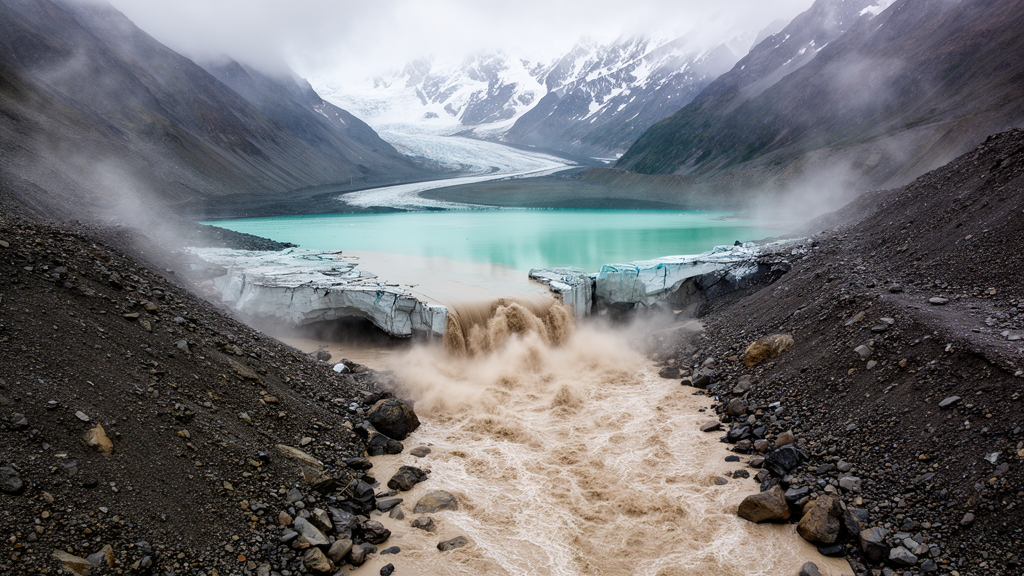
Deep beneath the world’s glaciers, water can gather with terrifying patience. Lakes pressed against the ice margins of glaciers, dammed by nothing but ice itself, fill quietly for years before draining in catastrophic bursts known as jökulhlaups, Icelandic for glacier bursts. These floods can sweep away roads, bridges, and entire communities downstream, and they have grown more frequent as a warming climate swells glacial lakes around the world. Now, a team of glaciologists led by Adam Hepburn of Aberystwyth University has unveiled the first two-dimensional computer model capable of simulating how these floods propagate across an entire glacier bed, a leap beyond the one-dimensional conduits that have dominated jökulhlaup theory for nearly half a century. The work, published in The Cryosphere, offers the most complete picture yet of how water, ice, and the ground beneath them conspire to unleash some of nature’s most violent floods.
The classical theory of jökulhlaups dates to John Nye’s landmark 1976 paper, which described a lake draining through a single semi-circular tunnel melted upward into the ice by the heat of flowing water. As the tunnel widens, more water flows through it, dissipating more energy and melting the walls faster, a runaway feedback that escalates discharge until the lake empties. Then, as water pressure drops, ice creep closes the conduit and the flood dies away. Successive generations of researchers, from Spring and Hutter in the 1980s through Fowler, Ng, and Kingslake in later decades, refined this picture, showing that stable, repeating flood cycles require careful coupling between the lake and the drainage system, and often a retrograde bed slope that lets a hydraulic seal re-form between floods. But all of these models shared a fundamental constraint: they traced the flood along a single line, a one-dimensional pathway that could not represent how water spreads sideways across a real glacier bed.
The new model shatters that constraint. Hepburn and his colleagues, including Sammie Buzzard of Northumbria University, Andrew Sole, Stephen Livingstone, and Felix Ng of the University of Sheffield, and Mathieu Morlighem of Dartmouth College, coupled the two-dimensional Glacier Drainage System model, known as GlaDS, to the Ice-sheet and Sea-level System Model, ISSM, which simulates ice flow and basal sliding. Into this framework they introduced a time-evolving ice-marginal lake as a boundary condition, its depth rising and falling according to the balance between external inputs such as rainfall and snowmelt and the outflow through the subglacial system. Crucially, the lake exchanges water not only with a single channel but with the entire distributed network of linked cavities that carpets the glacier bed, maintaining pressure continuity across the ice-lake contact. The result is a fully coupled system in which lake level, subglacial water pressure, channel growth, and glacier sliding all respond to one another continuously.
When the team ran the model on a synthetic glacier, a ten-kilometre rectangular domain with a gently sloping bed and a five-square-kilometre lake attached at a single point, the simulation produced something remarkable: stable, recurring fill-drain cycles that repeated roughly every year and a half, each flood rising over about six months and falling over a similar span. During the filling phase, the rising lake steepened the hydraulic potential gradient across the domain, priming the bed for channelised drainage. When the flood finally triggered, an arborescent network of channels, branching like a tree, spread laterally across the full width of the domain, oriented perpendicular to the contours of hydraulic potential rather than simply following the ice surface slope. This lateral propagation, the hallmark of the two-dimensional approach, is precisely the behaviour that one-dimensional models cannot capture, and it mirrors GPS observations of sideways ice deviations recorded during real jökulhlaups at Switzerland’s Gornergletscher.
The model also reproduced a striking pattern in glacier motion. As a flood began, the ice accelerated, with the speed-up propagating from the lake outlet toward the terminus as water pressure rose and friction at the bed fell. Then, as channelised drainage became widely established and efficiently evacuated the floodwater, the glacier decelerated abruptly, in less than two months, before the flood even reached its peak. This sequence of acceleration followed by rapid slowdown matches observations from jökulhlaups at Gornergletscher and at the Skaftá cauldrons in Iceland, lending confidence that the coupled hydrology-ice dynamics framework captures genuine physical behaviour rather than numerical artefacts.
Sensitivity experiments revealed which parameters matter most. The efficiency of the subglacial drainage system, governed by the conductivity of channels and the water sheet, the height of bedrock bumps, and the spacing of basal cavities, emerged as the dominant control on flood timing, peak discharge, and the sliding response. Increasing channel conductivity caused the lake to drain sooner and more completely, producing higher peak discharges, while a more conductive sheet delayed flood onset and dampened the floods. Intriguingly, the model behaved asymmetrically with respect to basal meltwater: raising the basal melt rate from one to five metres per year nearly doubled the peak flood discharge, whereas reducing it below the baseline had almost no effect. The researchers interpret this as evidence that in low-melt systems, the lake drainage cycle itself, rather than ambient meltwater supply, governs the effective pressure at the bed and therefore the glacier’s sliding speed, a potentially important insight for understanding how ice-marginal lakes influence ice dynamics in cold, land-terminating settings.
The true test came when the team applied the model to Isunnguata Sermia, a land-terminating outlet glacier draining roughly 16,000 square kilometres of the western Greenland Ice Sheet. An ice-dammed lake about three square kilometres in area and up to 100 metres deep abuts the northern margin of the glacier’s tongue, and it has drained beneath the ice at intervals of one to three years, with at least twelve fill-drain cycles recorded between 1987 and 2024. The researchers built a high-resolution mesh, refined to fifty-metre spacing near the lake, using bed topography from BedMachine v5, and forced the model with daily runoff and accumulation from the MAR regional climate model between 2007 and 2025. Lake inflow was parameterised with a simple temperature-index scheme tied to air temperature, and basal friction was inverted from observed satellite-derived surface velocities using a Schoof-style friction law.
The results were striking. Over a seventeen-year comparison window, the model hindcast seven of the eight observed lake highstands to within about two months and twenty metres of their measured timing and elevation, reproducing both partial drainage events and complete emptying episodes, all without tuning the model to individual floods. The simulated drainage system also behaved plausibly: at the peak of a modelled 2022 flood, a channel occupying the glacier’s central bedrock trough extended more than 45 kilometres upglacier, and the predicted flood path passed directly through a region of the bed where satellite observations had documented the sudden subsidence of a subglacial lake in 2019, supporting the idea that ice-marginal lake drainage can trigger the release of stored subglacial water along the flood path. Modelled and observed ice velocity anomalies during floods agreed in their overall pattern, showing acceleration toward the lake concentrated along the western ice-lake contact.
Yet the model is not without its shortcomings, and the authors are candid about them. Simulated floods lasted three to four months, far exceeding the five to eight days observed at Isunnguata Sermia, and peak discharges of roughly 100 to 200 cubic metres per fell well short of the estimated mean discharge of at least 480 cubic metres per second for the real 2022 jökulhlaup. The team attributes these discrepancies to missing physics rather than fundamental flaws. The model contains no representation of elastic uplift of the ice when water pressure exceeds overburden pressure, a process that recent satellite observations suggest can open the bed almost instantaneously and enable very rapid flood escalation. It also assumes that lake water enters the subglacial system at the pressure melting point, when in reality ice-marginal lakes can be several degrees warmer, providing extra heat that accelerates channel wall melting and sharpens flood peaks. Previous work has shown that raising lake temperature from one to four degrees Celsius can more than double peak discharge in comparable models, suggesting that this single addition could resolve much of the gap.
Despite these limitations, the researchers view the challenge as tractable rather than fundamental. The framework is readily extensible, parameterised by a handful of geometrically interpretable quantities such as lake area and ice thickness at the ice-lake contact, meaning it can be transferred to other glacier-lake systems, including chains of multiple lakes, without modifying the numerical scheme. The authors also suggest that periodically draining ice-marginal lakes could serve as valuable benchmarks for evaluating machine-learning emulators of subglacial hydrology, since their remotely observable lake-level records integrate the behaviour of the entire drainage system and avoid the noisy point measurements of boreholes. As glacial lakes continue to multiply and grow under a warming climate, and as more than 3,300 ice-marginal lakes already ring the Greenland Ice Sheet, the ability to forecast when and how violently these hidden reservoirs will burst has never mattered more. This first two-dimensional window into the subglacial flood process brings that forecast measurably closer.
Subject of Research: Two-dimensional coupled modelling of jökulhlaups from ice-marginal lakes using subglacial hydrology and basal sliding
Article Title: Simulating jökulhlaups from an ice-marginal lake within a 2D model of subglacial drainage and basal sliding
Article References: Hepburn, A. J., Buzzard, S., Sole, A. J., Livingstone, S. J., Ng, F., Morlighem, M., Bagshaw, E. A., Clason, C., Craw, L., Dow, C. F., Doyle, S., Hawkins, J., Peacey, M., & Storrar, R. (2026). Simulating jökulhlaups from an ice-marginal lake within a 2D model of subglacial drainage and basal sliding. The Cryosphere, 20(10), 5675-5696. https://doi.org/10.5194/tc-20-5675-2026
Image Credits: AI Generated
Keywords: jökulhlaups, ice-marginal lakes, subglacial hydrology, basal sliding, GlaDS, ISSM, Isunnguata Sermia, Greenland, glacier outburst floods, ice dynamics, The Cryosphere, glacier modelling
Cite Scienmag News
Violet Maxwell. (October 9, 2026). First 2D Model Captures How Glacier Lakes Unleash Devastating Outburst Floods. Scienmag. https://scienmag.com/first-2d-model-captures-how-glacier-lakes-unleash-devastating-outburst-floods/
Violet Maxwell. "First 2D Model Captures How Glacier Lakes Unleash Devastating Outburst Floods." Scienmag, 9 October 2026, https://scienmag.com/first-2d-model-captures-how-glacier-lakes-unleash-devastating-outburst-floods/. Accessed 9 October 2026.
Violet Maxwell. "First 2D Model Captures How Glacier Lakes Unleash Devastating Outburst Floods." Scienmag. October 9, 2026. https://scienmag.com/first-2d-model-captures-how-glacier-lakes-unleash-devastating-outburst-floods/


