Wearable sensors have promised to transform how scientists measure aging, but the practical realities of deploying them in clinical trials of aging interventions have remained surprisingly murky. A new exploratory analysis from the ABLE trial, published in PLOS Digital Health, offers one of the clearest operational pictures yet of what happens when researchers ask middle-aged adults to wear research-grade accelerometers for extended periods while also adhering to a daily supplement regimen. The findings suggest that, with careful planning, digital phenotyping via wrist-worn motion sensors can be woven into gerotherapeutic studies with remarkably little friction, and that the very act of wearing the device may signal something important about a participant’s likelihood of staying in the trial at all.
The analysis drew on data from 120 generally healthy, middle-aged adults enrolled in the Alpha-ketoglutarate supplementation and BiologicaL agE in middle-aged adults trial, known as ABLE. The study was a double-blind, randomized, placebo-controlled trial registered as NCT05706389, designed to test whether six months of daily oral supplementation with one gram of alpha-ketoglutarate, a naturally occurring metabolite implicated in cellular metabolism and previously studied in aging research, would influence biological age measures in people in midlife. Participants, who had a mean age of 50.6 years with a standard deviation of 6.0 years and were evenly split between women and men, were assigned to either the supplement arm, with 59 participants, or the placebo arm, with 61 participants, and followed for six months with an additional three-month follow-up period.
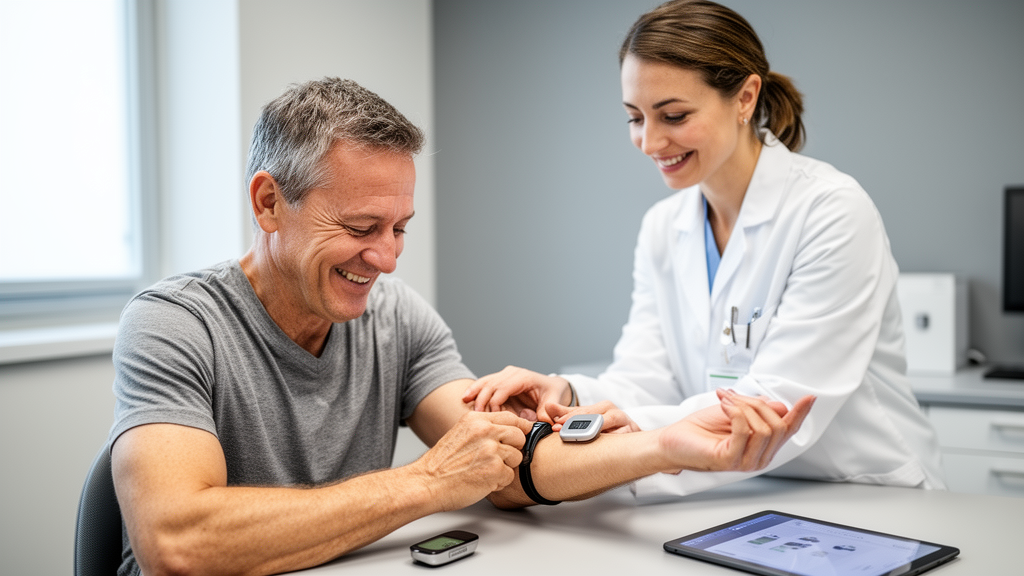
At each of four study visits, participants were instructed to wear an ActiGraph wGT3X-BT accelerometer for seven consecutive days. These devices are small, lightweight triaxial accelerometers widely used in physical activity research, capable of recording movement patterns around the clock and generating objective estimates of activity intensity, sleep timing, and circadian rhythm. In the context of a gerotherapeutic trial, such continuous data streams serve as digital phenotypes: objective, high-resolution markers of physical behavior that may change as a person’s biological aging trajectory shifts. The research team, led by Jessica K. Lu and colleagues including Brian K. Kennedy and Andrea B. Maier, set out to determine whether this level of monitoring was genuinely workable for a population of adults in their late forties and fifties, a group often overlooked in aging trials that tend to focus on either younger volunteers or frail older adults.
The adherence results were striking. The median accelerometer wear time was 24 hours per day, meaning that the typical participant kept the device on essentially continuously throughout each seven-day monitoring window, removing it only briefly if at all. More than 80 percent of participants achieved at least four valid days of wear per visit, a threshold commonly used in the field to define an adequate monitoring window for physical activity analysis. Supplement use adherence exceeded 90 percent across the six-month intervention, indicating that participants managed both the passive monitoring and the active intervention components of the trial simultaneously without meaningful compromise on either front. Device-related operational concerns, such as malfunctioning units, charging difficulties, or discomfort, were minimal across all four visits, suggesting that the ActiGraph platform and the study’s implementation protocols were well matched to the needs and habits of middle-aged participants.
Equally important was what the researchers learned about who stayed in the study. Overall dropout across the trial was 17 percent, a figure that compares favorably with many longitudinal intervention studies but still represents a meaningful loss of statistical power and resources. To understand what predicted attrition, the team turned to survival analysis, specifically Cox proportional hazards models with study visit as the time scale. This approach allowed the investigators to account for when during the trial each participant dropped out, rather than simply tallying who finished and who did not, thereby using the full longitudinal structure of the data. The models tested whether the amount of time participants wore the accelerometer, or their overall adherence to the device, was associated with their risk of leaving the study before completion.
The results of those models carried a provocative implication: every additional minute of accelerometer wear time was associated with a lower hazard of dropout, with a hazard ratio of 0.998 and a 95 percent confidence interval of 0.997 to 0.999. While a hazard ratio per minute may sound small, the effect compounds across the thousands of minutes in a seven-day wear window, and the confidence interval excludes the null value of 1.0, indicating a statistically reliable association. In practical terms, participants who kept their devices on longer were meaningfully less likely to abandon the trial. The authors suggest that wear time may function as a behavioral marker of engagement, a real-time signal that trial coordinators could monitor to identify participants at elevated risk of dropping out and intervene before they disengage entirely.
Sex emerged as the other significant predictor. Being male was associated with a substantially lower risk of dropout, with a hazard ratio of 0.208 and a 95 percent confidence interval of 0.065 to 0.663. In other words, men in this cohort were roughly one-fifth as likely to leave the study as women, a large and statistically robust difference. The finding raises questions about whether middle-aged women face different burdens or motivations in aging intervention trials, whether the supplement or monitoring protocol interacted differently with women’s daily routines, or whether other unmeasured factors drove the disparity. The authors note that understanding and addressing this gap will be important for designing future trials that retain diverse participants and produce generalizable results.
Beyond the statistical associations, the study offers a practical playbook for trial designers considering wearable-based digital phenotyping. The near-universal 24-hour wear pattern suggests that middle-aged adults are willing to treat research accelerometers much like consumer fitness trackers, integrating them into daily life with little prompting. The high rate of achieving at least four valid days per visit indicates that a seven-day monitoring window provides a comfortable buffer, allowing participants to accumulate sufficient data even with occasional removals for bathing or charging. The minimal rate of device-related operational concerns implies that established research-grade hardware, paired with clear instructions and structured visit schedules, can avoid the technical pitfalls that sometimes plague wearable deployments, such as data loss, initialization errors, or participant confusion about when to wear the device.
The implications extend to the growing field of gerotherapeutics, where interventions aim not to treat a single disease but to slow, halt, or reverse the biological processes of aging themselves. Trials in this space increasingly rely on multidimensional readouts, from epigenetic clocks and blood biomarkers to continuous sensor data, to capture the subtle, systemic changes that aging interventions are designed to produce. Accelerometer-derived phenotypes, including total activity volume, activity fragmentation, and sleep-wake rhythms, are attractive because they are objective, repeatable, and sensitive to functional change. The ABLE analysis demonstrates that such data can be collected at high fidelity in a placebo-controlled supplement trial without overburdening participants or inflating dropout, removing a key practical objection to including wearables in future gerotherapeutic study designs.
The authors are careful to frame the work as exploratory, drawn from a single trial with a relatively homogeneous cohort of generally healthy middle-aged adults, so the findings may not generalize to older, frailer, or more clinically diverse populations, where device tolerance and dropout dynamics could differ substantially. Still, the central lessons are actionable: monitor wear time as an early-warning indicator of disengagement, attend to sex differences in retention, and design monitoring protocols around the demonstrated willingness of middle-aged adults to wear accelerometers continuously. As interest in alpha-ketoglutarate and other candidate gerotherapies accelerates, the operational insights from ABLE arrive at an opportune moment, offering trialists a data-driven foundation for building studies that keep participants engaged, keep sensors on wrists, and keep the digital phenotype data flowing from the first visit to the last.
Subject of Research: Feasibility and adherence of accelerometer-based digital phenotyping in a gerotherapeutic supplementation trial in middle-aged adults
Article Title: Optimizing accelerometer implementation in a gerotherapeutic trial: Feasibility, adherence, and operational insights of ABLE
Article References: Lu, J. K., Wang, W., Chew, Y. E., Guan, L., Kennedy, B. K., & Maier, A. B. (2026). Optimizing accelerometer implementation in a gerotherapeutic trial: Feasibility, adherence, and operational insights of ABLE. PLOS Digital Health, 5(9), e0001691. https://doi.org/10.1371/journal.pdig.0001691
Image Credits: AI Generated
DOI: 10.1371/journal.pdig.0001691
Keywords: accelerometers, digital phenotyping, gerotherapeutics, alpha-ketoglutarate, clinical trial adherence, study dropout, middle-aged adults, wearable technology, ActiGraph, Cox proportional hazards, aging intervention, PLOS Digital Health
Cite Scienmag News
Beatrice Stafford. (October 9, 2026). Wearable Accelerometers Prove Highly Feasible in Middle-Aged Aging Trial. Scienmag. https://scienmag.com/wearable-accelerometers-prove-highly-feasible-in-middle-aged-aging-trial/
Beatrice Stafford. "Wearable Accelerometers Prove Highly Feasible in Middle-Aged Aging Trial." Scienmag, 9 October 2026, https://scienmag.com/wearable-accelerometers-prove-highly-feasible-in-middle-aged-aging-trial/. Accessed 9 October 2026.
Beatrice Stafford. "Wearable Accelerometers Prove Highly Feasible in Middle-Aged Aging Trial." Scienmag. October 9, 2026. https://scienmag.com/wearable-accelerometers-prove-highly-feasible-in-middle-aged-aging-trial/