


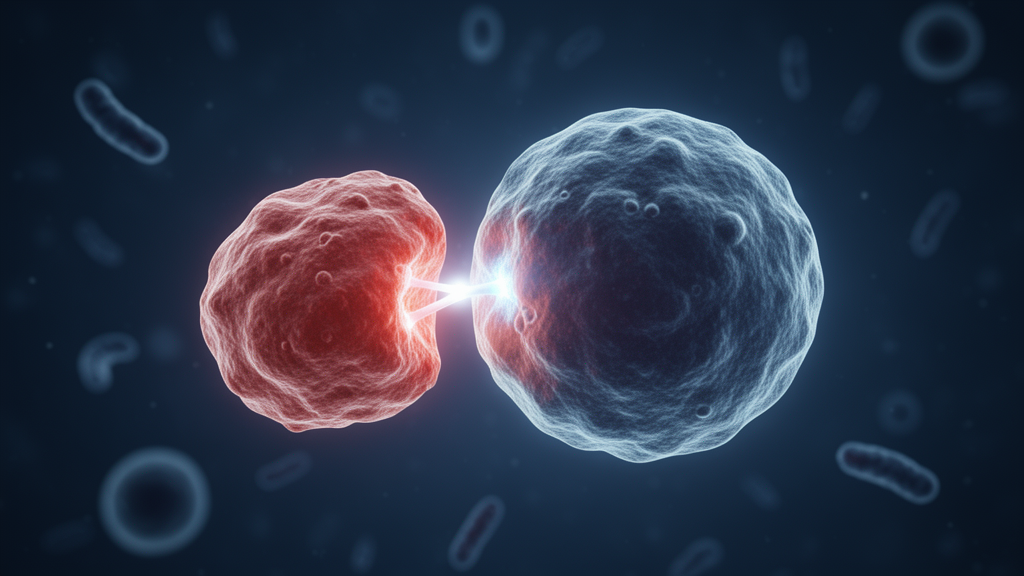
Platelets have long been viewed as the body’s emergency repair crew—tiny, anucleated cell fragments that rush to the site of a wound, plug damaged vessels, and vanish from the story once the bleeding stops. A new study published in Cancer Immunology, Immunotherapy suggests they may be playing a far darker role inside tumors. Researchers led by Sae Nishiguchi and Ryohei Katayama of the Japanese Foundation for Cancer Research, working with collaborators across several Japanese institutions, have shown that activated platelets can physically latch onto CD8-positive T cells—the immune system’s primary tumor-killing soldiers—and directly dampen their ability to destroy cancer cells. The interaction hinges on a single molecular handshake between a platelet surface protein called P-selectin and its counterpart on T cells, PSGL-1. The finding adds a striking new dimension to the already complex relationship between blood clotting and cancer, and it points to a potential strategy for making immunotherapy work better in patients whose tumors are wrapped in a veil of activated platelets.
The team’s first clue came from combination experiments in living animals. When the researchers paired anti-platelet agents with an antibody that blocks PD-L1—a cornerstone immune checkpoint target exploited by tumors to disarm T cells—they observed a synergistic anti-tumor effect that neither treatment achieved alone. That synergy hinted that platelets were actively contributing to the tumor’s defenses rather than merely bystanders in the tumor microenvironment. When the investigators looked more closely at tumors, they found that activated platelets were adhering directly to tumor-infiltrating CD8-positive T cells. Critically, when platelet activity was suppressed alongside PD-L1 blockade, this adhesion was reduced, and the T cells showed enhanced activation. In other words, stripping platelets away from the immune cells appeared to unleash at least some of the anti-tumor firepower that checkpoint inhibitors are designed to restore.
To determine whether this was a direct cause-and-effect relationship rather than an indirect consequence of the tumor environment, the team built a controlled laboratory system that isolated the players. They used cytotoxic T lymphocytes derived from induced pluripotent stem cells—a line known as CTL3-3—engineered to specifically recognize the WT1 antigen, a protein expressed on many cancer cells and a well-established tumor-associated target. When intact platelets were added to the co-culture of these antigen-specific killer cells and cancer cells, the platelets suppressed the T cells’ cytotoxic activity. The suppression was unmistakable: T cells that would otherwise have efficiently killed their WT1-expressing targets became measurably less lethal in the presence of platelets.
One obvious question was whether platelets were exerting this effect through soluble factors—chemical signals released into the surrounding fluid—rather than through physical contact. To test this, the researchers collected supernatants, the liquid fractions from cultures of activated platelets, and applied them to the T cells. These supernatants did partially suppress cytotoxicity, suggesting that platelet-derived soluble mediators contribute something to the inhibitory effect. But the suppression achieved by soluble factors alone was consistently weaker than the suppression caused by intact platelets. That difference was telling. It implied that the dominant mechanism required the platelets themselves to be physically present, in contact with the T cells, rather than merely whispering chemical instructions from a distance.
Flow cytometry analysis then revealed the nature of that physical contact. Activated platelets express P-selectin, also known as CD62P, a transmembrane adhesion molecule stored in platelet granules and rapidly displayed on the cell surface when platelets are activated. The analysis showed that these P-selectin-bearing platelets directly interact with the CTL3-3 T cells. The team confirmed the interaction with two independent imaging approaches: immunofluorescence staining, which visualized the molecular partners at the interface between the cells, and electron microscopy, which captured the ultrastructural detail of platelets clinging to T cell surfaces. Together, these techniques established that the platelet-T cell adhesion was not an artifact of the assay but a reproducible, physically verifiable phenomenon.
The molecular identity of the T cell-side partner proved to be PSGL-1, the canonical ligand for P-selectin. PSGL-1 is a glycoprotein best known for its role in guiding leukocytes through the bloodstream and into tissues during inflammation, where it engages selectins on vascular endothelial cells. The researchers used neutralizing antibodies to block either P-selectin on the platelets or PSGL-1 on the T cells. Either intervention inhibited the adhesion between the two cell types and, crucially, restored the cytotoxic activity of the T cells in the presence of platelets. This bidirectional blockade experiment is the strongest evidence in the study that the P-selectin–PSGL-1 axis is the functional conduit through which platelets suppress tumor killing. When the handshake is interrupted, the T cells recover their ability to destroy their targets.
Equally important is what the platelets did not do. The researchers found that the interaction suppressed the antigen-specific killing activity of the T cells without affecting their proliferation. The T cells continued to divide and expand normally; they simply became less effective executioners while in contact with platelets. This distinction matters for therapeutic thinking. A mechanism that throttles the cytotoxic function of T cells while leaving their numbers intact suggests a reversible, contact-dependent form of immune regulation—one that could potentially be switched off pharmacologically without causing the broader immune dysfunction that might accompany agents that deplete or globally suppress T cells. It also distinguishes this mechanism from classical checkpoint pathways such as PD-1/PD-L1, which alter T cell activation states through signaling rather than through physical sequestration.
The broader context of this work sits at the intersection of hematology and tumor immunology, a crossroads that has attracted growing attention in recent years. Platelets are known to interact with cancer cells in ways that facilitate tumor progression and enhance malignancy—they shield circulating tumor cells from immune surveillance in the bloodstream, promote metastatic seeding, and release a cargo of growth factors and immunomodulatory molecules. Cancer patients frequently exhibit platelet activation and thrombocytosis, and high platelet counts have been associated with poorer prognosis across multiple tumor types. What has remained murky is the direct effect of platelets on the anti-tumor activity of CD8-positive T cells, the population that immunotherapies from checkpoint inhibitors to engineered T cell therapies ultimately depend upon. By demonstrating a direct, receptor-defined inhibitory interaction, this study fills a conceptual gap and provides a mechanistic explanation for why anti-platelet strategies might synergize with immunotherapy.
The therapeutic implications are tantalizing but must be tempered with caution. The combination of anti-platelet agents and PD-L1 blockade produced synergistic anti-tumor effects in the preclinical setting, and the mechanistic work identifies P-selectin and PSGL-1 as druggable nodes—both are accessible to neutralizing antibodies, and agents targeting the selectin pathway already exist in other clinical contexts. Yet translating these findings into patients will require careful navigation of platelet biology’s essential role in hemostasis. Systemic platelet inhibition carries bleeding risks, and any strategy would need to selectively disrupt the platelet-T cell interaction without compromising clotting. Blocking the P-selectin–PSGL-1 axis specifically, rather than platelet function broadly, may offer a narrower therapeutic window, but this remains to be tested in clinical studies. The current work was conducted in animal models and in vitro systems, and tumor immunology is notorious for promising mechanisms that fail to survive translation.
Nevertheless, the study reframes platelets from passive clotting agents into active participants in the immune battlefield of cancer, and it does so with unusual mechanistic precision—identifying the cell types, the contact dependence, the receptor-ligand pair, and the functional consequence, all within a single coherent experimental arc. For a field racing to explain why immunotherapies work spectacularly in some patients and fail in others, the discovery that activated platelets can handcuff CD8-positive T cells through P-selectin binding offers a new variable to measure, a new biomarker to explore, and a new combination to test. If subsequent studies confirm that the same interaction operates in human tumors and that disrupting it safely enhances checkpoint inhibitor responses, the humble platelet—long celebrated for saving lives one clot at a time—may find itself recast as an accomplice of cancer, and its inhibition as an unexpected weapon in the immunotherapy arsenal.
Subject of Research: The inhibition of CD8-positive T cell anti-tumor activity by platelet P-selectin binding to PSGL-1
Article Title: P-Selectin on activated platelets inhibits the anti-tumor activity of CD8+ T cells through PSGL-1 binding
Article References: Nishiguchi, S., Yokomura, M., Gomibuchi, Y., Nagano, S., Yasunaga, T., Hirohashi, Y., Kawamoto, H., Takagi, S., & Katayama, R. (2026). P-Selectin on activated platelets inhibits the anti-tumor activity of CD8+ T cells through PSGL-1 binding. Cancer Immunology, Immunotherapy. https://doi.org/10.1007/s00262-026-04578-7
Image Credits: AI Generated
DOI: 10.1007/s00262-026-04578-7
Keywords: platelets, P-selectin, PSGL-1, CD8-positive T cells, cancer immunotherapy, PD-L1 blockade, WT1 antigen, cytotoxic T lymphocytes, tumor microenvironment, immune checkpoint inhibitors, iPSC-derived T cells, tumor immunology
Cite Scienmag News
Nathaniel Bowman. (October 8, 2026). Platelets Caught Sabotaging Cancer-Killing Immune Cells Through a Single Molecular Handshake. Scienmag. https://scienmag.com/platelets-caught-sabotaging-cancer-killing-immune-cells-through-a-single-molecular-handshake/
Nathaniel Bowman. "Platelets Caught Sabotaging Cancer-Killing Immune Cells Through a Single Molecular Handshake." Scienmag, 8 October 2026, https://scienmag.com/platelets-caught-sabotaging-cancer-killing-immune-cells-through-a-single-molecular-handshake/. Accessed 8 October 2026.
Nathaniel Bowman. "Platelets Caught Sabotaging Cancer-Killing Immune Cells Through a Single Molecular Handshake." Scienmag. October 8, 2026. https://scienmag.com/platelets-caught-sabotaging-cancer-killing-immune-cells-through-a-single-molecular-handshake/


