


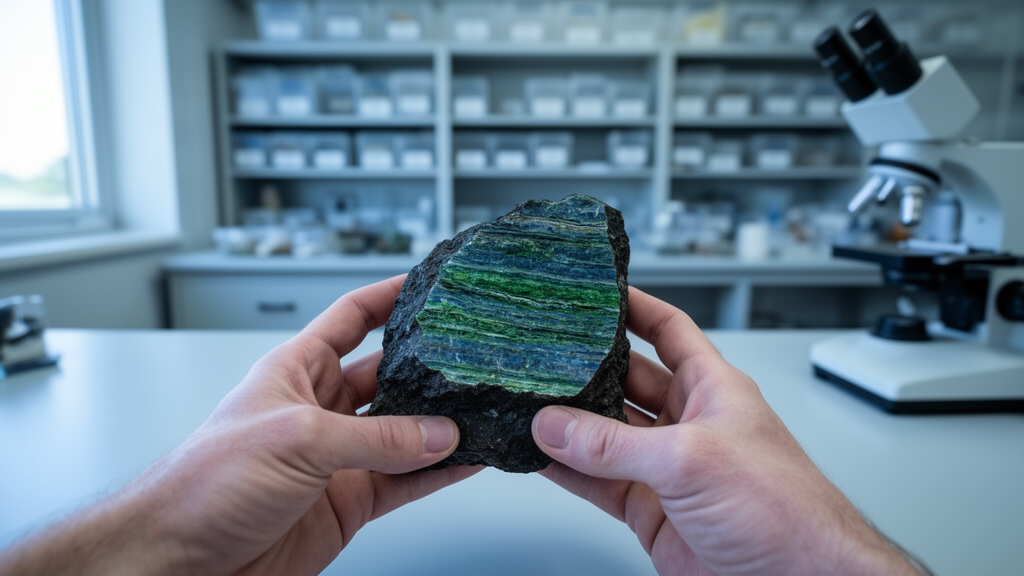
Deep beneath the ocean floors of the world, slabs of crust slide relentlessly into the Earth’s interior, and the rocks they carry record the journey in their minerals. A team of geologists led by Katherine F. Fornash of Ohio University has now documented one of the rarest of these records: a beautifully preserved lawsonite eclogite from the Elekdağ massif in the Central Pontides of Türkiye. Reported in the European Journal of Mineralogy, the find is only the tenth well-documented locality on Earth where the diagnostic mineral trio of garnet, omphacite, and lawsonite occurs together in the rock matrix, apparently in equilibrium. The discovery matters because lawsonite eclogites are among the most faithful archives of cold subduction, the process by which oceanic plates descend at unusually low temperatures, and because the new rock allows the first reliable measurement of peak conditions in a complex that had previously yielded only ambiguous estimates.
Lawsonite is the star of the story. This hydrous calcium-aluminum silicate contains a remarkable 11.5 percent water by weight and has a strong chemical affinity for elements that matter enormously to Earth’s geochemical cycles, including uranium, thorium, strontium, rare earth elements, and transition metals such as iron, titanium, and chromium. When oceanic crust subducts, lawsonite acts as a conveyor for water and these elements into the mantle, influencing where fluids are released, where melting generates arc volcanoes, and how the subduction interface deforms. Yet despite predictions from experiments, thermodynamic modeling, and geophysical observations that lawsonite should be common in cold subduction zones, rocks that preserve it in pristine form are vanishingly rare. The mineral readily breaks down or is replaced during the return trip to the surface, so most exhumed rocks retain only ghostly traces of it.
Before this study, a global review had identified just nine localities with convincing matrix lawsonite alongside garnet and omphacite: the Sivrihisar massif in Türkiye, Alpine Corsica in France, the Samana Metamorphic Complex in the Dominican Republic, the South Motagua Fault Zone in Guatemala, the Voltri massif in the Western Alps, the Port Macquarie mélange in Australia, rare layers in the Franciscan Complex of California, Pinchi Lake in British Columbia, and the Garnet Ridge xenolith in Arizona. Seven additional sites, including Elekdağ, had reported lawsonite and omphacite only as tiny inclusions trapped inside garnets, with no lawsonite surviving in the matrix. Those inclusion-only occurrences hint at lawsonite eclogite conditions but leave room for doubt, because without coexisting omphacite it is hard to tell whether the lawsonite formed during early blueschist metamorphism or at peak eclogite-grade pressures.
The Elekdağ metabasites occur as blocks and lenses within and along the margins of a large serpentinite body, roughly 35 kilometers long, as part of a Cretaceous subduction complex about 105 million years old. Earlier work had estimated maximum conditions of around 490 degrees Celsius at 1.7 gigapascals, while a tourmaline-bearing eclogite suggested 400 to 430 degrees Celsius at pressures exceeding 1.35 gigapascals. The new sample, designated ELEK23-05b, changes that picture dramatically. Its matrix contains approximately 20 percent garnet, 35 percent omphacite, 20 percent lawsonite, 14 percent phengite, and 9 percent chlorite, along with accessory rutile. Quartz appears only as inclusions in garnet and lawsonite, never in the matrix, a detail that proved crucial for interpreting the pressure-temperature history.
The garnets, about a millimeter across, display intricate concentric zoning that reads like a growth diary. Manganese and calcium decrease from core to edge in the inner regions, then a manganese- and iron-rich annulus gives way to a low-manganese, higher-calcium rim, with a final thin zone of elevated magnesium. Rutile first appears on the inner side of the annulus and continues into the rim, while quartz and titanite inclusions vanish at the same boundary. That switch marks where the rock crossed into eclogite-facies conditions. The omphacite shows patchy zoning with a jadeite component varying between 16 and 28 percent, and the matrix lawsonite is itself zoned, with iron, titanium, and strontium generally increasing from core to rim, and traces of chromium detected in some grains.
To pin down the conditions of formation, the team combined two independent approaches. The first was Zr-in-rutile thermometry, which relies on the temperature-dependent incorporation of zirconium in rutile when rutile, zircon, and quartz coexist. Because quartz in the fresh eclogite occurs only as inclusions, the researchers applied the thermometer to rutile inclusions in a narrow garnet zone where quartz, rutile, and zircon overlap, interpreted as late prograde to near-peak conditions. Zirconium contents of 30 to 50 parts per million yielded temperatures of roughly 490 to 540 degrees Celsius across the evaluated pressure range. The second approach was a bulk-composition-specific phase diagram, or pseudosection, calculated with Perple_X using the Holland and Powell thermodynamic database. The quartz-absent assemblage matching the observed matrix minerals occupies a narrow temperature window of about 470 to 520 degrees Celsius at pressures above 2.1 gigapascals.
Intersecting the eclogite assemblage field with the zirconium isopleths produced a near-peak estimate of approximately 500 degrees Celsius at 2.3 gigapascals, equivalent to burial depths of roughly 75 to 85 kilometers at temperatures corresponding to a geothermal gradient near 5 to 6 degrees Celsius per kilometer. That pressure is substantially higher than previous estimates for the area, yet the conditions closely match those recorded by other fresh lawsonite eclogites worldwide and align with thermal models of the slab surface in modern cold subduction zones such as Tonga and Tohoku. Notably, the team found that recalculating earlier Zr-in-rutile data with a newer pressure-dependent calibration by Kohn raises previously reported temperatures into the same range, suggesting some apparent discrepancies between studies reflect methodological differences rather than geological ones.
The contrast with a second sample from the same locality is instructive. ELEK23-08a2, a retrogressed eclogite now classified as an epidote blueschist, contains large four-to-five-millimeter garnets packed with lawsonite inclusions from core to near-rim, along with rare omphacite, glaucophane, and epidote. Its matrix, however, is dominated by glaucophane, epidite porphyroblasts up to six millimeters long, albite, chlorite, and phengite, with only minor lawsonite. Some lawsonite inclusions in epidote have been partially replaced by lower-iron epidote rims that preserve the original lawsonite outlines as so-called ghosts. Rutile in this rock carries far less zirconium, only 9 to 12 parts per million, yielding temperatures of about 420 to 450 degrees Celsius, and its phengite is less siliceous than that of the fresh eclogite. In short, the retrogressed rock records lower pressures and cooler temperatures than the peak conditions, confirming that such altered samples cannot reliably indicate maximum burial.
The broader implication is a caution about how subduction complexes are read. Most Elekdağ metabasites were retrogressed to epidote-bearing blueschists during exhumation, aided by deformation and fluids that also generated chlorite-rich metasomatic zones along contacts with the serpentinite. The prevalence of epidote in eclogites and blueschists here and elsewhere indicates that exhumation occurred under conditions warmer than prograde or peak metamorphism. The authors emphasize that these relatively warm retrograde conditions should not be extrapolated to characterize the overall thermal state of subduction in the forearc region that subduction complexes typically represent. The fresh lawsonite eclogite, a fortuitously preserved relic, is the true messenger of peak conditions, and it reaffirms that cold subduction, with its capacity to transport water and trace elements deep into the mantle, has operated much as thermal models predict. With only ten confirmed localities globally, and just six with meaningful geological context, each new discovery sharpens our window into the planet’s deepest recycling engine.
Subject of Research: Discovery and pressure-temperature analysis of a rare well-preserved lawsonite eclogite from the Cretaceous subduction complex of the Elekdağ massif, Central Pontides, Türkiye
Article Title: Report of a rare, well-preserved lawsonite eclogite (Elekdağ, Central Pontides, Türkiye)
Article References: Fornash, K. F., Petty, C., Toraman, E., Topuz, G., & Whitney, D. L. (2026). Report of a rare, well-preserved lawsonite eclogite (Elekdağ, Central Pontides, Türkiye). European Journal of Mineralogy, 38(5), 567-574. https://doi.org/10.5194/ejm-38-567-2026
Image Credits: AI Generated
Keywords: lawsonite eclogite, subduction zone, Elekdağ, Central Pontides, Türkiye, metamorphic petrology, garnet, omphacite, Zr-in-rutile thermometry, pseudosection modeling, high-pressure low-temperature metamorphism, blueschist
Cite Scienmag News
Violet Maxwell. (October 8, 2026). Rare Turkish Rock Captures the Chilly Depths of an Ancient Subduction Zone. Scienmag. https://scienmag.com/rare-turkish-rock-captures-the-chilly-depths-of-an-ancient-subduction-zone/
Violet Maxwell. "Rare Turkish Rock Captures the Chilly Depths of an Ancient Subduction Zone." Scienmag, 8 October 2026, https://scienmag.com/rare-turkish-rock-captures-the-chilly-depths-of-an-ancient-subduction-zone/. Accessed 8 October 2026.
Violet Maxwell. "Rare Turkish Rock Captures the Chilly Depths of an Ancient Subduction Zone." Scienmag. October 8, 2026. https://scienmag.com/rare-turkish-rock-captures-the-chilly-depths-of-an-ancient-subduction-zone/


