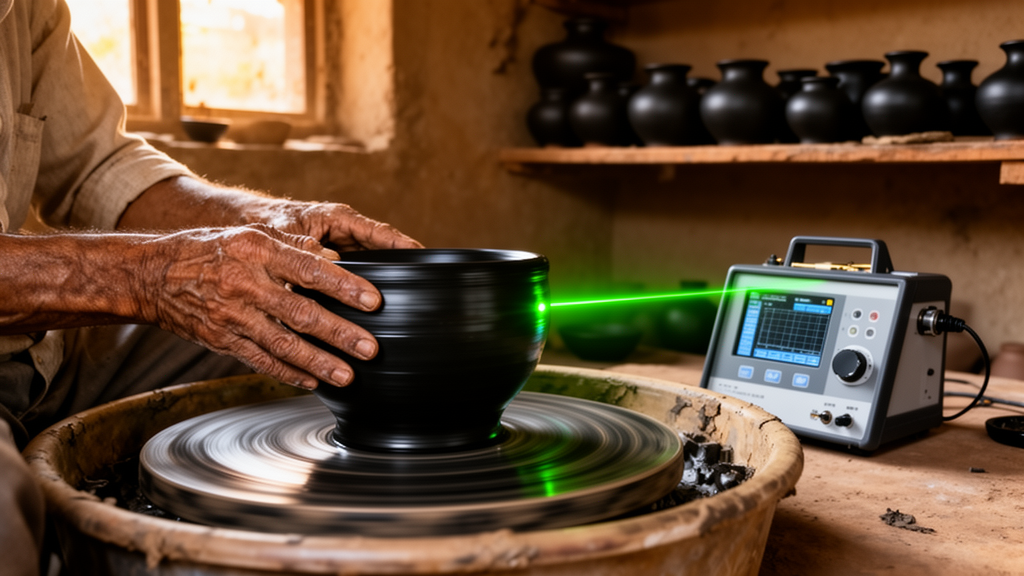
More than two thousand years ago, potters working in the plains of northern India between the Ghaghara and Tamsa rivers mastered a technique that still puzzles modern scientists: how to give ordinary clay vessels a lustrous, mirror-like black surface. A new study published in Asian Archaeology has now taken a close look at fragments of this so-called black slipped ware, excavated from the ancient mound of Khapura in Uttar Pradesh’s Ambedkar Nagar district, and used a battery of modern analytical instruments to work out what the pottery is made of and how its striking finish may have been produced. The research, led by Nidhi Pandey of Banaras Hindu University’s Department of Ancient Indian History, Culture and Archaeology together with chemists from the university’s Institute of Science, offers one of the most detailed physicochemical portraits yet of a ceramic tradition that flourished across the early historic Ganges plain.
The material at the heart of the study comes from a series of excavations carried out at Khapura between 2017 and 2021, which exposed a deep sequence of cultural deposits stretching from roughly 1100 BCE to 500 CE. The archaeologists divided this long occupation into four distinct periods. Period I represents a pre-Northern Black Polished Ware culture that already used iron, dating to around 1100 to 600 BCE. Period II coincides with the famous Northern Black Polished Ware culture, from roughly 600 to 200 BCE, an era when this glossy black pottery became a hallmark of sophisticated craft production across the subcontinent. Period III covers the Shunga-Kushan era, and Period IV corresponds to the Gupta period. Alongside the ceramics, the dig yielded terracotta objects, bone tools and beads of semi-precious stone, painting a picture of a settlement whose material culture evolved steadily over more than a millennium and a half.
Black slipped ware, often abbreviated BSW, is one of the key ceramic categories recovered from the site, and it is the predecessor and companion of the celebrated Northern Black Polished Ware. The characteristic black slip that gives the pottery its name has long been a subject of debate among archaeologists and ceramic technologists. Was the dark surface produced by an iron-rich coating fired under reducing conditions, by organic materials painted on the vessel and burned in, or by some combination of clay, pigment and kiln atmosphere? Because the answer speaks directly to the technological skill of ancient potters and to the trade networks that may have carried their wares, resolving it has been a persistent gap in the study of ancient Indian ceramics. The Khapura study was designed specifically to address that gap by subjecting the potsherds to a suite of complementary analytical techniques.
The team turned to four main methods, each of which interrogates the pottery in a different way. X-ray diffraction, or XRD, identifies the crystalline mineral phases present in the ceramic fabric by measuring how X-rays scatter from the ordered planes of atoms inside mineral grains. Because different minerals form and transform at different firing temperatures, the mineral assemblage acts as a record of the heat the pottery experienced in the kiln. Scanning electron microscopy, or SEM, provides high-resolution images of the microstructure, revealing the texture of the clay body, the morphology of inclusions and the fine structure of the slip layer at magnifications far beyond the reach of optical microscopes. When SEM is paired with energy-dispersive X-ray analysis, known as EDX, the instrument can also determine the elemental composition of specific regions, mapping the distribution of elements such as iron, silicon, aluminium and alkali metals across the fabric and its surface coating.
The fourth technique, Raman spectroscopy, adds a molecular dimension to the picture. By shining laser light on the sample and analysing the tiny shifts in wavelength of the scattered photons, Raman spectroscopy can identify specific chemical bonds and compounds, including iron oxides such as magnetite and hematite, as well as carbonaceous material. This capability is particularly valuable for black-slipped pottery, because the distinction between a black surface produced by magnetite, an iron oxide that forms under reducing conditions, and one darkened by trapped carbon from organic matter is central to any reconstruction of the firing process. Applied together, the four methods allow the researchers to cross-check their findings: the mineralogy from XRD, the microstructure from SEM, the elemental data from EDX and the molecular signatures from Raman each constrain the possible production technologies, so that a coherent account of how the vessels were made can emerge only when all of the evidence agrees.
The analytical campaign focused on black slipped ware from the two earliest and most culturally significant phases of the site, the pre-Northern Black Polished Ware period from about 1100 to 600 BCE and the Northern Black Polished Ware period from about 600 to 200 BCE. By comparing samples from these two periods, the researchers could ask whether the potters of the later, more famous phase used a different recipe or firing regime than their predecessors, or whether the technology was continuous across the transition. Such questions matter because the emergence of Northern Black Polished Ware has often been treated as a technological leap, and compositional data from a single site with a long stratified sequence offers a rare opportunity to test that idea at the level of the raw materials and the kiln practice themselves.
The study situates Khapura within a broader landscape of early historic settlement in the Ghaghara-Tamsa region, an area that has seen increasing archaeological attention as excavations fill in the picture of urbanisation in the middle Ganges plain. Previous preliminary reports of the Khapura excavations, published in the journal Man and Environment, documented the site’s stratigraphy and its assemblages of ceramics, terracotta figurines, bone implements and stone beads. The new spectroscopic work builds directly on those field campaigns, moving the investigation from what was found to how it was made. In doing so, it joins a growing body of archaeometric research worldwide in which chemistry and physics are used to read the technological decisions embedded in ancient artefacts, from the firing temperatures of Korean pottery of the Baekje kingdom to the black coatings on prehistoric European ceramics and the slipped wares of ancient Nepal, where Mössbauer spectroscopy has played a role analogous to the Raman and X-ray methods used at Khapura.
The collaborative structure of the project reflects the interdisciplinary nature of the work. The archaeological questions, the sampling of the potsherds and the interpretation of the data were anchored in the Department of Ancient Indian History, Culture and Archaeology at Banaras Hindu University, where Pushp Lata Singh supplied the excavated samples and Nidhi Tripathi contributed to the formal analysis. The instrumental characterisation was carried out with colleagues in the university’s Centre of Advanced Study in the Department of Chemistry, with Shreanshi Agrahari responsible for data curation and formal analysis and Ida Tiwari supervising and validating the results. The authors acknowledge financial assistance from the Institution of Excellence scheme at Banaras Hindu University for the analysis of the black slipped ware potsherds, and they thank Professor Vibha Tripathi, former head and emeritus professor of the archaeology department, for her suggestions and support in interpreting the data.
Why should a reader care about the chemistry of a few black potsherds from a mound in Uttar Pradesh? The answer lies in what pottery technology reveals about the societies that produced it. The ability to control kiln atmospheres, to select or prepare clays with the right iron content, and to apply slips that respond predictably to firing represents accumulated craft knowledge passed across generations. Tracing that knowledge through time, from the iron-using communities of the early first millennium BCE to the polished wares of the Northern Black Polished Ware culture and beyond, helps archaeologists understand whether such skills spread by migration, trade or local innovation. Compositional analyses like those performed at Khapura can also, in principle, distinguish locally made vessels from imports, since clay chemistry carries a fingerprint of the geological source, and that in turn illuminates exchange networks in the Ghaghara-Tamsa region during a formative period of Indian history.
The study also demonstrates how modern laboratory techniques have become indispensable tools of archaeology, capable of extracting information from fragments that would otherwise remain silent. A potsherd that looks uniformly black to the eye may, under Raman spectroscopy, reveal the signature of magnetite rather than amorphous carbon; under X-ray diffraction, it may disclose quartz, feldspar and high-temperature minerals that bracket its firing temperature; under the electron microscope, it may show whether the slip was applied as a fine coating or diffused into the surface of the clay. Each observation narrows the space of plausible reconstructions of the ancient workshop. By publishing the results in Asian Archaeology, the team hopes to fill a documented gap in ancient ceramic studies and to encourage similar physicochemical investigations of pottery from other sites in the region, so that the technological history of the Ganges plain can eventually be written with the same rigour as its political chronology. The data supporting the findings are available from the corresponding author upon reasonable request, and the article, published on 8 October 2026, carries the DOI 10.1007/s41826-026-00134-5.
Subject of Research: Spectroscopic and mineralogical analysis of ancient black slipped ware pottery from the Khapura archaeological site in the Ghaghara-Tamsa region of Uttar Pradesh, India
Article Title: An elaborate spectroscopic study of black slipped ware of Khapura’s archaeological site of Ghaghara – Tamsa Region
Article References: Pandey, N., Agrahari, S., Tripathi, N., Singh, P. L., & Tiwari, I. (2026). An elaborate spectroscopic study of black slipped ware of Khapura’s archaeological site of Ghaghara – Tamsa Region. Asian Archaeology. https://doi.org/10.1007/s41826-026-00134-5
Image Credits: AI Generated
DOI: 10.1007/s41826-026-00134-5
Keywords: black slipped ware, Northern Black Polished Ware, Khapura excavation, archaeometry, X-ray diffraction, Raman spectroscopy, scanning electron microscopy, EDX analysis, ancient ceramics, Uttar Pradesh archaeology, Ghaghara-Tamsa region, Banaras Hindu University
Cite Scienmag News
Courtney Benton. (October 8, 2026). Ancient Indian Potters’ Black-Slipped Secrets Revealed by X-Rays and Lasers. Scienmag. https://scienmag.com/ancient-indian-potters-black-slipped-secrets-revealed-by-x-rays-and-lasers/
Courtney Benton. "Ancient Indian Potters’ Black-Slipped Secrets Revealed by X-Rays and Lasers." Scienmag, 8 October 2026, https://scienmag.com/ancient-indian-potters-black-slipped-secrets-revealed-by-x-rays-and-lasers/. Accessed 8 October 2026.
Courtney Benton. "Ancient Indian Potters’ Black-Slipped Secrets Revealed by X-Rays and Lasers." Scienmag. October 8, 2026. https://scienmag.com/ancient-indian-potters-black-slipped-secrets-revealed-by-x-rays-and-lasers/