


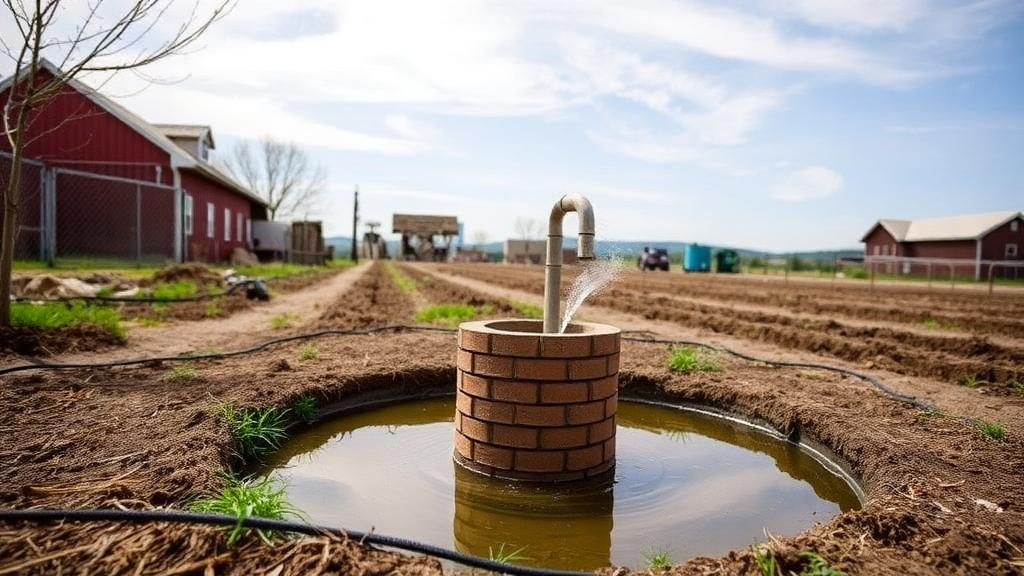
Nearly half of the private drinking water wells sampled on Maryland farms are contaminated with fecal indicator bacteria, according to the first statewide study of its kind, and the findings reveal a troubling disconnect between what well owners believe about their water and what is actually flowing from their taps. The research, published in PLOS Water by a team from the University of Maryland School of Public Health and Maryland Extension, tested water from 79 private wells on farms spread across all seven regions of the state and found that 43 percent were positive for total coliforms, while 10 percent harbored Escherichia coli, the bacterium that serves as the gold-standard warning sign of fecal contamination. Both figures exceed the U.S. Environmental Protection Agency’s maximum contaminant level goal of zero for these organisms in public drinking water, a standard that private wells are not legally required to meet.
The regulatory gap at the heart of the study is enormous. The Safe Drinking Water Act of 1974 empowers the EPA to set enforceable standards for roughly 90 microbial and chemical contaminants in public water systems, but wells serving fewer than 25 people fall entirely outside that framework. More than 43 million Americans rely on private wells for drinking water, including approximately 350,000 Maryland households, and most of the state’s 12,600 farm operations almost certainly draw their household water from private wells because of their rural locations. On farms, the risk profile is amplified: domestic and wild animals, manure storage, and routine agricultural activity all create potential pathways for fecal pathogens to reach groundwater that no agency is monitoring.
To capture that risk, the researchers recruited 77 farmers or farm family members through University of Maryland Extension agricultural agents, ultimately collecting 84 water samples from wells in 20 of Maryland’s 23 counties. Participants answered a 28-question survey covering well type, age, depth, condition, maintenance history, treatment devices, and testing practices, while trained participants or Extension agents collected samples from kitchen or bathroom cold water faucets after removing screens and aerators and flushing the lines for at least five minutes. Samples were packed on ice and driven to the university’s Water Quality, Outreach, and Wellness Laboratory, where they were processed within 24 hours using U.S. EPA Method 1604, a membrane filtration technique that filters 10, 100, and 500 milliliter volumes of each sample through 0.45-micrometer filters placed on highly selective MI agar.
The laboratory approach matters for the precision of the results. Unlike the IDEXX enzyme-based assays many health departments use, membrane filtration on MI agar allows researchers to count the exact number of target bacteria rather than estimate concentrations statistically, and it preserves live isolates for downstream confirmation. Presumptive E. coli colonies were purified on MacConkey and tryptic soy agar and then verified by polymerase chain reaction targeting the uidA gene, which encodes β-glucuronidase, an enzyme characteristic of E. coli. Each PCR run included a phosphate-buffered saline negative control and a known E. coli strain as a positive control, adding a layer of molecular certainty on top of the culture results.
The geographic pattern in the data was striking. Total coliform presence differed significantly by county, region, and the owner’s description of well condition, while E. coli presence was significantly associated with region, geological province type, county, and wellhead cover material. The Western region of Maryland, in the Appalachian portion of the state, fared worst by a wide margin: every one of the eight wells sampled there was positive for total coliforms, and 62.5 percent carried E. coli. In the province west of the Fall Line, the geological boundary dividing Maryland’s crystalline and sedimentary uplands from its coastal sediments, 29 percent of wells were E. coli-positive, compared with just 2 percent in the Atlantic Coastal Plain Province. Wells shallower than 9.1 meters and those with concrete or other nonstandard wellhead covers also showed significantly higher odds of E. coli contamination.
The geology offers a plausible explanation. West of the Fall Line, groundwater moves through fractures and bedding-plane partings in consolidated igneous, metamorphic, or sedimentary rock, and fractured media can transport contaminants rapidly and over long distances. Some provinces in this region also contain limestone aquifers, which previous research has linked to elevated contamination risk, and the Piedmont hosts more unconfined aquifers that lack the protective confining layers of deeper systems. By contrast, the Atlantic Coastal Plain east of the Fall Line consists of unconsolidated sand and gravel aquifers typically overlain by layers of low-permeability clay that act as a natural barrier, blocking surface contaminants from percolating downward into the water supply.
Perhaps the most counterintuitive finding concerns the weather. While earlier studies in Pennsylvania and New Jersey found that heavy rainfall increases the likelihood of coliform and E. coli detection in private wells, this study found the opposite: the odds of E. coli presence dropped significantly as precipitation levels in the 14 days before sampling increased, a result that held up in the multivariable logistic regression model with an odds ratio of 0.11. The authors suggest the inverse relationship may reflect the danger of antecedent dry conditions. Recent research on drought and childhood diarrheal disease has hypothesized that bacteria concentrate in the environment during dry spells and are then washed into water sources when rain finally returns, meaning the contamination signal may depend on what happened weeks before the rain, not the rain itself. Precipitation levels in the state also varied significantly by county, region, and province, complicating any simple rainfall-to-risk narrative.
Even more unsettling than the bacteria counts was what the survey revealed about owner perception. Eighty-five percent of participants described their wells as being in good or excellent condition, yet among wells with a known condition rating, 51 percent of those rated good or excellent were positive for total coliforms and 11 percent carried E. coli. In the multivariable model, wells described as merely okay or fair actually had significantly lower odds of total coliform contamination than wells rated good or excellent, an odds ratio of 0.10. The researchers interpret this paradox as evidence that many well owners fundamentally misunderstand the actual condition of their systems, and that self-assessed maintenance and condition are poor proxies for water safety. Notably, maintenance factors such as recent repairs, treatment devices, and testing history did not significantly predict bacterial presence, whereas geography and well construction did.
The survey also documented risky baseline practices. Fifty-six percent of the wells were 26 years or older, 68 percent had received no repairs or well management in the previous decade, and although 62 percent of owners had tested their water at some point, only a minority had tested for the full suite of common contaminants. Fifty-eight percent of participants reported having observed water quality problems such as odors, off tastes, or scale on fixtures, and nearly half had installed some form of treatment device, from carbon filters to ultraviolet systems, without necessarily knowing what they were treating for.
The public health stakes extend well beyond Maryland’s farmsteads. Previous studies estimate that 40 to 58 percent of private wells nationwide contain at least one contaminant exceeding a Safe Drinking Water Act standard, and reliance on private wells has been repeatedly linked to acute gastrointestinal illness, with improper treatment and maintenance compounding the risk. E. coli infection can cause fever, vomiting, diarrhea, nausea, and abdominal cramps, and while many strains are harmless, their presence signals that fecal matter, and potentially far more dangerous pathogens, has entered the water supply. The study team, funded in part by a Northeast Sustainable Agriculture Research and Education grant, recommends that well-owner education incorporate geographic risk information, including region, geology, wellhead type, and well depth, alongside traditional maintenance guidance. Because samples were collected only between May and August, the researchers caution that seasonal variation and the exploratory nature of their models warrant confirmation with larger, multi-season studies. Still, the message for the millions of Americans who drink from unregulated wells is unambiguous: clean-tasting, well-kept water is not necessarily safe water, and the only reliable defense is regular testing, particularly for the farmers whose livelihoods and households depend on what lies beneath their fields.
Subject of Research: Microbial contamination of private drinking water wells on Maryland farms and the influence of well properties, geography, and precipitation
Article Title: E. coli and total coliform presence in private drinking water wells on Maryland farms: Determination of the impact of well properties, geographic, and precipitation factors
Article References: Smith, C., Woerner, E. M. H., Leslie, A., Beale, B., Nichols, K., Dill, S., Hirsh, S., Semler, J., Kness, A., Keane, J., Costa, M., Yang, J., Cruz-Cano, R., Lazur, A., & Rosenberg Goldstein, R. (2026). E. coli and total coliform presence in private drinking water wells on Maryland farms: Determination of the impact of well properties, geographic, and precipitation factors. PLOS Water, 5(9), e0000636. https://doi.org/10.1371/journal.pwat.0000636
Image Credits: AI Generated
DOI: 10.1371/journal.pwat.0000636
Keywords: E. coli, total coliforms, private wells, drinking water, Maryland farms, groundwater contamination, well maintenance, geology, precipitation, Safe Drinking Water Act, public health, water testing
Cite Scienmag News
Alan Morgan. (October 8, 2026). Fecal Bacteria Lurk in Nearly Half of Maryland Farm Drinking Wells, Statewide Study Finds. Scienmag. https://scienmag.com/fecal-bacteria-lurk-in-nearly-half-of-maryland-farm-drinking-wells-statewide-study-finds/
Alan Morgan. "Fecal Bacteria Lurk in Nearly Half of Maryland Farm Drinking Wells, Statewide Study Finds." Scienmag, 8 October 2026, https://scienmag.com/fecal-bacteria-lurk-in-nearly-half-of-maryland-farm-drinking-wells-statewide-study-finds/. Accessed 8 October 2026.
Alan Morgan. "Fecal Bacteria Lurk in Nearly Half of Maryland Farm Drinking Wells, Statewide Study Finds." Scienmag. October 8, 2026. https://scienmag.com/fecal-bacteria-lurk-in-nearly-half-of-maryland-farm-drinking-wells-statewide-study-finds/


