


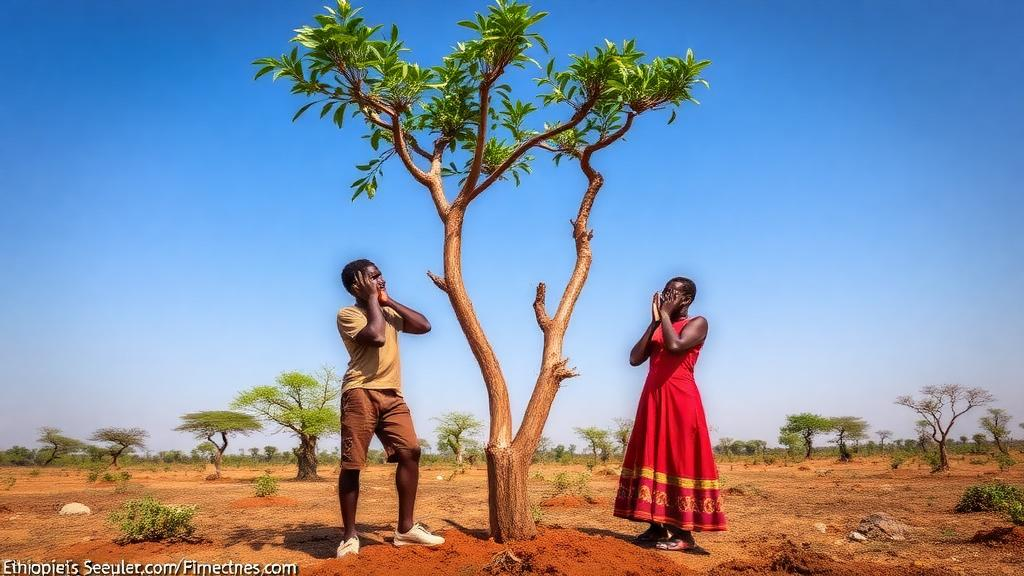
When Ethiopia launched its Green Legacy Initiative in 2019, the world watched with a mixture of admiration and skepticism as the government pledged to plant 20 billion seedlings in just four years. The target was not only met but exceeded, with official figures now pointing to more than 40 billion trees planted over six years. Yet the ecological spectacle of mass planting has long overshadowed a more consequential question: what has this unprecedented campaign actually done for the millions of rural Ethiopians whose livelihoods depend on the land being restored? A new systematic review published in PLOS Sustainability and Transformation offers the most comprehensive answer to date, and the picture it paints is one of genuine promise shadowed by stubborn structural weaknesses.
The review, conducted by Rusha Begna Wakweya of Ethiopian Forestry Development’s Jimma Center, sifted through 291 records drawn from Scopus, Web of Science, Google Scholar, the Directory of Open Access Journals, and gray literature from the FAO, UNDP, World Bank, and Ethiopian government sources. Following PRISMA 2020 reporting standards and a PICOS-based eligibility framework, the analysis narrowed the pool to 21 studies published between the initiative’s launch and 2025 that explicitly linked the Green Legacy to measurable socio-economic outcomes. Studies focused purely on biophysical indicators such as seedling counts or carbon sequestration, without connecting them to human welfare, were excluded. The result is the first systematic synthesis to map the initiative’s outcomes onto specific Sustainable Development Goal targets, and it reveals four principal pathways through which tree planting has touched human lives.
The most frequently documented pathway is livelihood diversification and income generation. Official reports cited in the reviewed literature indicate that more than 767,000 jobs have been created through Green Legacy activities, alongside the establishment of over 120,000 nurseries across the country. These nurseries, often run as decentralized community enterprises, have become small economic engines in their own right, with women’s and youth groups participating in seedling production, tool sales, and related services. The income effects reported in individual studies are striking: households receiving Green Legacy avocado seedlings in North Mecha Woreda earned an average of 18,750 Birr annually, compared with just 4,500 Birr among nonparticipating households, while a separate study found that households receiving fruit-tree seedlings reported 22 to 35 percent higher annual cash income than their counterparts.
But the employment structure tells a more complicated story. Roughly 65 percent of the jobs created are temporary or seasonal, lasting less than six months, and permanent formal employment accounts for less than 5 percent of opportunities. The review frames this as the initiative’s central unresolved tension: a program celebrated as a route to sustainable livelihoods currently functions primarily as a short-term safety net, providing meaningful income supplementation during agricultural lean seasons but falling short of the sustained poverty reduction, decent work, and asset accumulation demanded by SDG 1. Without deliberate policy shifts to convert seasonal planting work into permanent, skills-based green jobs, the review concludes, the initiative’s contribution to poverty alleviation remains an aspiration rather than an empirically demonstrated outcome.
The second pathway runs through community empowerment and social capital. Large-scale public participation in planting campaigns has strengthened collective action and deepened community engagement in environmental management, according to the qualitative studies reviewed. Women’s participation in nursery management was particularly associated with increased economic agency and a greater voice in community decision-making, while collective restoration work correlated with higher levels of trust, reciprocity, and cooperation. Participation also bred environmental awareness, with communities involved in restoration developing a stronger appreciation of tree resources and landscape protection. These findings suggest that the initiative’s social effects extend well beyond the physical act of planting trees, reshaping how communities govern and value their natural surroundings.
Food security and nutrition form the third pathway, and arguably the most tangible one for rural households. The distribution of fruit and multipurpose tree seedlings, including avocado, mango, papaya, and Moringa, has increased the availability of nutrient-rich foods at the household level, contributing to dietary diversification. Agroforestry systems built around nitrogen-fixing species such as Sesbania and Faidherbia have been linked to improved soil organic matter, better water retention, and higher agricultural productivity, supporting staple crop production and reducing risk. Income from fruit and other nontimber forest products allows households to purchase food and agricultural inputs, while diversified tree-based production provides a buffer during periods of agricultural stress. The Ethiopian Ministry of Agriculture has formally linked the fruit-tree component to national food availability and nutrition, a contribution recognized by the United Nations.
The fourth pathway concerns human health and well-being. Urban tree planting has been associated with improved air quality through the removal of particulate matter and gaseous pollutants, while the expansion of parks and green spaces has been linked to recreation, stress reduction, and psychological benefits. Participation in collective environmental activities also appears to foster social connectedness and a sense of shared purpose. Taken together, the review argues, the health dimensions of the initiative extend beyond environmental improvement into social and psychological territory that conventional evaluations of afforestation programs rarely capture.
The ecological evidence underpinning these pathways is dramatic, at least on paper. Geospatial analyses using Landsat and Sentinel-2 imagery processed through Google Earth Engine document a 156.48 percent increase in forestland in the Abay Basin between 2018 and 2025, alongside a 202.04 percent increase in grassland and a 94.29 percent decrease in bare land. Maximum land surface temperatures in the basin fell by 5.8 degrees Celsius and minimum temperatures by 1.3 degrees, while estimated annual soil erosion dropped from 1.9 billion tonnes to 208 million tonnes. National forest cover has risen from 15.5 percent to 23.6 percent, and NDVI analysis in the Guba-lafto District shows high-density vegetation expanding from 0.98 percent to 9.38 percent of total land area between 2013 and 2024. Compared with the African Great Green Wall, which aims to restore 100 million hectares across 11 countries by 2030 with modest progress so far and heavy reliance on donor funding, Ethiopia’s domestically financed, state-driven campaign stands out for its speed and scale.
Yet the review is unsparing about the gaps that separate spectacle from verified impact. Seedling survival averages just 76.50 percent across districts in the available data, and the only district-level study reports an average survival rate of 39.80 percent, ranging from 7.59 to 76.50 percent, a figure that cannot be generalized nationally. More than 70 percent of woredas lack socio-economic data altogether, and survival tracking beyond six months is largely absent, making it impossible to distinguish localized success from widespread failure. Carbon sequestration estimates assume uniform survival across all planting sites, a methodological flaw the review warns could inflate reported climate contributions. Heavy reliance on fast-growing exotic species for quick ground cover may also come at the expense of native species with higher biodiversity value and better long-term economic uses, while inadequate post-planting care, water scarcity, grazing pressure, and species-site mismatches threaten to waste resources and erode public trust.
The way forward, the review argues, requires integrated policies that strengthen rural markets, ensure inclusive participation of women and youth, and above all establish long-term monitoring of both benefits and limitations. Priority measures include standardized survival monitoring extending to five and ten years, control sites to estimate additionality, household panels tracking income trajectories across planting seasons, and market-level data on nontimber forest product value chains, none of which currently exist in the peer-reviewed literature. The December 2024 parliamentary proclamation establishing a Green Legacy Special Fund, allocating 0.5 to 1 percent of federal annual revenue to restoration, provides an institutional foundation, and Ethiopia’s 2025 Voluntary National Review has formally integrated the initiative into its SDG reporting. Whether the Green Legacy ultimately proves to be a transformative engine for sustainable development or a short-lived environmental campaign will depend less on how many billions of seedlings go into the ground, and more on whether the country can finally measure what grows out of them.
Subject of Research: Socio-economic outcomes of Ethiopia's Green Legacy Initiative afforestation program and its contribution to the UN Sustainable Development Goals
Article Title: Socio-economic contributions of the Ethiopian Green Legacy Initiative as a pathway to sustainable development: Systematic Review
Article References: Wakweya, R. B. (2026). Socio-economic contributions of the Ethiopian Green Legacy Initiative as a pathway to sustainable development: Systematic Review. PLOS Sustainability and Transformation, 5(10), e0000299. https://doi.org/10.1371/journal.pstr.0000299
Image Credits: AI Generated
DOI: 10.1371/journal.pstr.0000299
Keywords: Ethiopia, Green Legacy Initiative, afforestation, reforestation, sustainable development, SDGs, livelihoods, food security, community empowerment, seedling survival, systematic review, agroforestry
Cite Scienmag News
Courtney Benton. (October 8, 2026). Ethiopia’s Massive Tree-Planting Campaign Delivers Jobs and Food, but Survival Data Reveal Cracks. Scienmag. https://scienmag.com/ethiopias-massive-tree-planting-campaign-delivers-jobs-and-food-but-survival-data-reveal-cracks/
Courtney Benton. "Ethiopia’s Massive Tree-Planting Campaign Delivers Jobs and Food, but Survival Data Reveal Cracks." Scienmag, 8 October 2026, https://scienmag.com/ethiopias-massive-tree-planting-campaign-delivers-jobs-and-food-but-survival-data-reveal-cracks/. Accessed 8 October 2026.
Courtney Benton. "Ethiopia’s Massive Tree-Planting Campaign Delivers Jobs and Food, but Survival Data Reveal Cracks." Scienmag. October 8, 2026. https://scienmag.com/ethiopias-massive-tree-planting-campaign-delivers-jobs-and-food-but-survival-data-reveal-cracks/


