


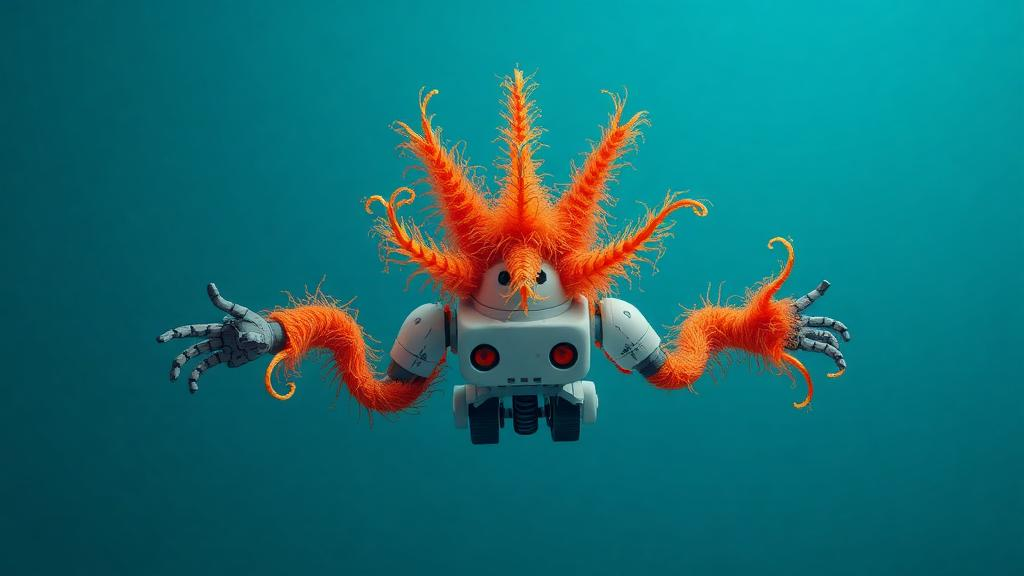
Underwater robots have long faced a frustrating trade-off: the more directions a machine can move, the more actuators it needs, and the more complicated, power-hungry, and failure-prone it becomes. A team of engineers at North Carolina State University has now shown that this trade-off is not as inevitable as it seems. Inspired by feather stars, marine invertebrates that glide through the ocean by coordinating the motion of their many limbs, the researchers have built a soft aquatic robot that can move up and down, travel forward and backward, hover in place, and rotate on its axis, all with just two actuators. The work, published in the journal Science Advances, demonstrates a design philosophy the team calls mechanical intelligence, in which the structure of a robot does much of the computational heavy lifting that would normally require additional motors and control complexity.
Actuators are the components of a machine that generate force or torque, and in conventional robotic design they are the primary currency of mobility. A robot that can translate in three dimensions and reorient itself typically requires at least six independently controlled actuators to achieve that full range of motion. Jie Yin, corresponding author of the paper and a professor of mechanical and aerospace engineering at NC State, explains that the feather star robot achieves the same degrees of freedom with a fraction of that hardware. The key, he says, is intelligent design: by shaping the robot’s body so that its structure and its interaction with the surrounding water govern its behavior, the researchers dramatically reduced the input required from computers or human operators. The robot’s capabilities emerge from its geometry and material properties rather than from an elaborate control system.
The inspiration for the design came from feather stars, crinoid echinoderms that can move in any direction or hold themselves stationary in the water column by coordinating the movements of their flexible, feather-like limbs. The robot distills that biological principle into a remarkably simple architecture: four elastic wings protrude from a central disk that houses the two actuators. Each wing is monostable, a term from mechanics describing a structure that can be bent out of shape but will always snap back to a single preferred resting position. This snap-through behavior is the heart of the robot’s locomotion strategy, converting smooth actuator input into rapid, impulsive wing motion that pushes effectively against the water.
The robot’s repertoire is organized into three distinct modes, each produced by a different pattern of actuator activation. When both actuators are switched on, all four wings snap downward simultaneously; when the actuators are turned off, the monostable wings snap back up. Rapidly cycling the actuators on and off makes the robot flap all four wings in quick succession, driving it upward through the water column. Switching the actuators off entirely stops the flapping and lets the robot descend. And by flapping the wings slowly rather than rapidly, the robot can hover in place, a behavior the researchers have nicknamed jellyfish mode, since the slow pulsing motion and stationary hovering recall the swimming style of a jellyfish.
Horizontal travel relies on an even more economical trick. To move forward or backward, the researchers activate only one of the two actuators. This causes a single wing to flutter, functioning like a tailfin and pushing the robot in the opposite direction. The team calls this fish mode, and it means that steering and translation along the horizontal plane require no additional hardware whatsoever. The third mode, rotor mode, comes from alternating rapidly between the two actuators, which sets the robot spinning on its axis. By combining jellyfish mode, fish mode, and rotor mode, the operators can maneuver the robot through all three dimensions, climbing, descending, translating, hovering, and turning with a machine that carries only two sources of actuation.
The project grew out of an earlier effort that illustrates exactly what mechanical intelligence is meant to solve. Haitao Qing, first author of the paper and a postdoctoral researcher at UC Berkeley who began the project as a Ph.D. student at NC State, previously helped create a soft aquatic robot inspired by the manta ray. That robot could move quickly through the water, but it lacked three-dimensional maneuverability. The goal of the new work was to design a robot with far greater agility without resorting to unduly complicated mechanisms. The feather star concept delivered that agility by shifting the burden from actuator count to structural design, letting the elastic wings and their snap-through dynamics generate a rich set of behaviors from minimal input.
The practical implications of reducing actuator count extend well beyond elegance. Every actuator on an underwater robot adds mass, wiring, power draw, and a potential point of failure, and in marine environments where maintenance is difficult and expensive, simplicity translates directly into reliability and endurance. A two-actuator platform is lighter, easier to seal against water intrusion, cheaper to manufacture, and simpler to control than a six-actuator equivalent. Because the robot’s modes are selected by simple activation patterns rather than complex coordinated control of many motors, the computational demands are correspondingly modest, which matters for small autonomous vehicles with limited onboard processing and battery capacity.
The researchers also demonstrated concrete uses for the robot. In tests, the machines were shown exploring underwater spaces while carrying a camera, and lifting objects underwater, either operating alone or working in concert with other robots. That cooperative capability hints at a future in which fleets of inexpensive, simply actuated soft robots swarm through shipwrecks, aquaculture pens, coral reefs, or submerged infrastructure, performing inspection and light manipulation tasks that would currently require larger, costlier, and more fragile vehicles. Qing describes the design as a versatile platform for integrating with other technologies across a range of underwater applications, and notes that the team’s future directions include developing a fully wireless version of the robot, freeing it from the tether that currently connects it to its power and control source.
Qing also extends an open invitation to other disciplines. The team members are mechanical engineers, he notes, and they have produced a novel design for aquatic robotics; they would welcome collaborations with experts in other fields to explore what the platform might accomplish in practice. That collaborative posture is fitting, because the underlying idea, mechanical intelligence, is relevant far beyond one robot. It suggests a broader design principle in which morphology, elasticity, and environmental interaction substitute for actuation and computation, a lesson that could inform everything from search-and-rescue vehicles to biomedical devices that must navigate constrained, fluid-filled spaces.
The paper, titled Minimal-Actuation Feather Star Inspired Soft Swimmers for Multimodal 3D Maneuverability, was published on October 7 in Science Advances. In addition to Yin and Qing, the co-authors are Caizhi Zhou and Haoze Sun, both Ph.D. students at NC State; Yuanhang Zhu of the University of Virginia and the University of California, Riverside; and Jiacheng Guo, Haibo Dong, and Daniel Quinn of the University of Virginia. The research was supported by the National Science Foundation under grants 2126072 and 2329674, and by the Office of Naval Research under MURI grant N00014-22-1-2616. For a field that has often equated capability with complexity, the feather star robot makes a quietly radical argument: sometimes the smartest machine is the one whose body already knows what to do.
Subject of Research: A feather star-inspired soft underwater robot achieving 3D maneuverability with two actuators through mechanical intelligence
Article Title: Feather star-inspired underwater robot gets 3D maneuverability from only two actuators
Article References: Feather star-inspired underwater robot gets 3D maneuverability from only two actuators. (n.d.). Original publication
Image Credits: AI Generated
DOI: Not provided
Keywords: soft robotics, feather star, underwater robot, mechanical intelligence, actuators, bioinspired design, marine robotics, Science Advances, North Carolina State University, 3D maneuverability, monostable wings, swimming robot
Cite Scienmag News
Denise Maddox. (October 7, 2026). Two Actuators Are All This Feather Star Robot Needs to Swim in 3D. Scienmag. https://scienmag.com/two-actuators-are-all-this-feather-star-robot-needs-to-swim-in-3d/
Denise Maddox. "Two Actuators Are All This Feather Star Robot Needs to Swim in 3D." Scienmag, 7 October 2026, https://scienmag.com/two-actuators-are-all-this-feather-star-robot-needs-to-swim-in-3d/. Accessed 7 October 2026.
Denise Maddox. "Two Actuators Are All This Feather Star Robot Needs to Swim in 3D." Scienmag. October 7, 2026. https://scienmag.com/two-actuators-are-all-this-feather-star-robot-needs-to-swim-in-3d/


