


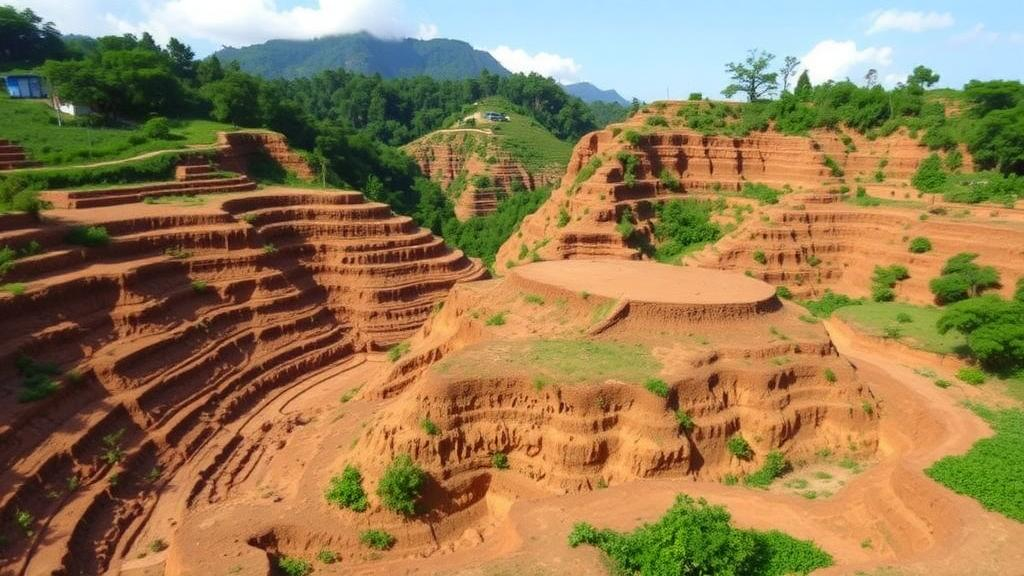
On the Meghalaya Plateau in northeastern India, a landscape whose name translates from Sanskrit as the abode of clouds, some of the heaviest rainfall on Earth hammers soils that are barely holding on. A new study of twelve benchmark soil series has now mapped, with unusual precision, exactly which soils on this high-altitude plateau are most vulnerable to erosion and why. The findings carry weight far beyond the region: globally, soil erosion contributes an estimated 15 to 30 billion tonnes of sediment each year and accounts for roughly 46 percent of total land degradation, while in India about 45 percent of the geographical area is affected by erosion of varying severity.
The research, conducted by soil scientists from ICAR-National Bureau of Soil Survey and Land Use Planning, examined soils developed on the Archaean rocks of the Shillong Group, a terrain uplifted rapidly during the late Cenozoic roughly 8 to 14 million years ago. Working between Mylliem and Pynursla at elevations above 1200 metres, the team described 55 soil profiles along eleven transects and distilled them into twelve representative soil series. These were grouped by land use: pine forest on summits and side slopes, potato cultivation on the northern slopes, deep grassland soils in the south, and seasonally waterlogged rice paddies in valley bottoms. The soils belong mainly to the orders Ultisols, Inceptisols and Entisols, products of intense weathering under a warm, perhumid monsoonal climate.
The climatic backdrop is extreme. The southern escarpment near Cherrapunji receives an average annual rainfall exceeding 12,000 millimetres, and around 80 percent of the plateau’s precipitation falls during the June-to-September monsoon. Against this assault, the practice of shifting cultivation, or jhum, has proven devastating. Previous studies cited in the paper estimate soil losses of about 40 megagrams per hectare per year on slopes of 21 to 26 degrees under shifting cultivation, rising to a staggering 145 to 170 megagrams per hectare per year on steeper slopes of 31 to 37 degrees during the initial cropping years. By contrast, fallow vegetation cuts losses to about 7 megagrams per hectare per year after one year and 2 after ten, while grass-covered slopes lose only around 2.1 megagrams per hectare per year.
The core of the new work lies in a set of erodibility indices that translate soil chemistry and physics into erosion risk. The researchers calculated the critical shear stress, which measures a soil particle’s resistance to detachment by flowing water; the erosion index of organic matter, known as EIROM; the critical limit of organic matter, or CLOM, the minimum organic matter needed to keep soil structure intact; and the soil structural stability index, SSI. They then estimated the soil erodibility factor K, the key parameter of the Universal Soil Loss Equation, using multiple linear regression models built from these indices. The average K value across the plateau was 0.04 plus or minus 0.02 tonnes hectare hour per hectare megajoule per millimetre, with a coefficient of variation of 45.17 percent, signalling considerable spatial variability in erosion processes across the landscape.
The statistical results were striking. A regression model combining CLOM, critical shear stress and very coarse sand content predicted the erodibility factor with a coefficient of determination of 0.97, an exceptionally tight fit for field soil data. A second model expressed structural stability as a function of EIROM, shear stress, the cation-exchange-capacity-to-clay ratio and K, explaining 78 percent of the variance. Critical shear stress emerged as the dominant control, correlating with the erodibility factor at r = 0.96. In plain terms, the soils’ resistance to being scoured by runoff, together with their organic matter reserves and coarse sand content, almost entirely determines how readily they wash away.
Land use proved decisive. Soils under grass cover were found to be only slightly to moderately erodible, whereas soils under pine plantations and potato cultivation showed markedly higher erosion susceptibility. Potato-growing soils on side slopes are generally shallow to moderately shallow, and intensive cultivation there accelerates the decomposition of organic matter, weakening the aggregates that bind the soil. The structural stability index told a consistent story: surface horizons of some potato soils were relatively stable, but subsurface horizons of potato and grassland soils fell below the critical threshold of 5, indicating structural degradation and heightened vulnerability. Exposed clay-enriched Bt horizons showed only moderate structural stability, with a mean SSI of 5.49, and greater susceptibility to erosion in grassland and potato-growing areas.
The chemistry of these soils compounds their fragility. Nearly all profiles were strongly to extremely acidic, with pH values in surface horizons as low as 3.6 under pine, and exchangeable aluminium dominated the exchange complex while base cations generally remained below 1 centimole per kilogram. Cation exchange capacity was mostly very low, below 15 centimoles per kilogram, reflecting the dominance of low-activity silicate clays formed under relentless leaching. Organic carbon correlated almost perfectly with CEC at r = 0.98, underscoring how much these acidic soils depend on their thin organic blankets for fertility and cohesion. Notably, the erodibility factor showed a significant negative relationship with the exchangeable calcium-to-aluminium ratio, suggesting that calcium helps stabilise aggregates while aluminium dominance under acidity weakens them.
Texture added a geomorphic twist. Elevation correlated negatively with fine sand and total sand but positively with silt, meaning higher ground carries finer-textured soils. Many grassland profiles showed abrupt lithological discontinuities, evidence of buried horizons and episodic colluvial deposition from landslides and slope wash. The researchers attribute the heterogeneous textures, roughly 50 percent silt, 30 percent sand and 20 percent clay in the dominant loamy matrix, to repeated mass-movement events rather than purely in-place soil formation, with coarse sand fractions possibly produced by mechanical crushing of rock fragments at landslide bases.
K-means clustering of eleven erodibility parameters sorted the soils into three groups that mirrored these patterns. The first cluster, dominated by pine-forest horizons, showed high variability in structural stability and organic matter; the second, mostly grassland and potato horizons, displayed moderate structural stability with a mean SSI of 5.49; the third, drawn mainly from the southern plateau, revealed structural degradation, organic matter depletion and the highest variability of all. Across clusters, the depletion of organic carbon and sand fractions in profiles with higher erodibility indices confirmed that land management leaves a measurable fingerprint in the soil’s erosion resistance.
The study’s authors argue that detailed pedological datasets at the soil-series level, such as the benchmark sites established under India’s National Agricultural Technology Project, are essential for monitoring erodibility across agro-ecological regions and for calibrating conservation strategies. With an estimated 5.3 billion tonnes of soil lost to erosion in India each year and nearly two-thirds of Meghalaya’s population dependent on agriculture, the message is urgent: protecting the organic-rich surface layers, maintaining vegetative cover and tailoring interventions to the specific soil series could determine whether the abode of clouds keeps its soil, or watches it slide toward the Bay of Bengal.
Subject of Research: Pedological controls on soil erodibility in high-altitude Ultisols of the Meghalaya Plateau, India
Article Title: Pedological controls on soil erodibility in high-altitude ultisols and associated soils of the Meghalaya plateau, India
Article References: Bhaskar, B. P., Sharma, R. P., Baruah, U., & Butte, P. S. (2026). Pedological controls on soil erodibility in high-altitude ultisols and associated soils of the Meghalaya plateau, India. Discover Soil, 3(1), Article 113. https://doi.org/10.1007/s44378-026-00274-1
Image Credits: AI Generated
DOI: 10.1007/s44378-026-00274-1
Keywords: soil erosion, soil erodibility, Meghalaya Plateau, Ultisols, shifting cultivation, critical shear stress, soil organic carbon, USLE K-factor, soil structural stability, land use, Northeast India, soil conservation
Cite Scienmag News
Alan Morgan. (October 5, 2026). Cloud Country’s Fragile Soils: Scientists Decode Why Meghalaya’s Hills Wash Away. Scienmag. https://scienmag.com/cloud-countrys-fragile-soils-scientists-decode-why-meghalayas-hills-wash-away/
Alan Morgan. "Cloud Country’s Fragile Soils: Scientists Decode Why Meghalaya’s Hills Wash Away." Scienmag, 5 October 2026, https://scienmag.com/cloud-countrys-fragile-soils-scientists-decode-why-meghalayas-hills-wash-away/. Accessed 5 October 2026.
Alan Morgan. "Cloud Country’s Fragile Soils: Scientists Decode Why Meghalaya’s Hills Wash Away." Scienmag. October 5, 2026. https://scienmag.com/cloud-countrys-fragile-soils-scientists-decode-why-meghalayas-hills-wash-away/


