


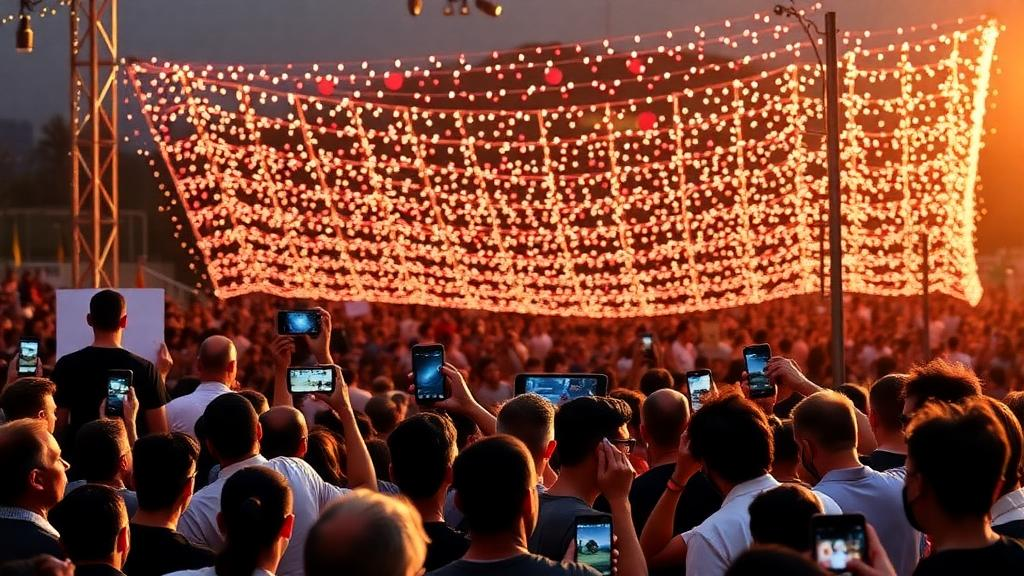
When millions of people converge on a single location—whether for the Hajj pilgrimage, a New Year’s Eve celebration, a music festival, or a political demonstration—the health and safety of the crowd depends on information moving faster than the crowd itself. A new systematic review published in Discover Social Science and Health argues that social media has quietly become one of the most powerful instruments available to event organizers and public health authorities, while simultaneously introducing risks that many event managers remain dangerously unprepared to handle. The review, led by Azadeh Tahernejad of Mashhad University of Medical Sciences together with Katayoun Jahangiri and Behnam Esbakian of Shahid Beheshti University of Medical Sciences in Iran, synthesizes a decade of evidence on how platforms like Twitter and Facebook shape the health management of mass gathering events, and it concludes that these platforms are no longer optional communication tools but core operational infrastructure.
The research team conducted their review with unusual methodological rigor. Registered in PROSPERO under code CRD42025641093 and following the PRISMA 2020 reporting guidelines, the study searched PubMed, Scopus, Web of Science, and Google Scholar for literature published up to January 2025. The initial search returned 6,352 records, which the researchers whittled down through duplicate removal, title and abstract screening, and full-text review until only ten studies remained. Each of those ten was assessed with the Mixed Methods Appraisal Tool, and all scored between 80 and 100 percent on methodological quality, meaning they met at least four of the tool’s five criteria. Two reviewers independently performed study selection, quality assessment, and data extraction, with disagreements resolved by a third author—a design intended to minimize bias in a field where subjective judgments about digital behavior are easy to make.
The ten included studies covered a strikingly diverse range of mass gatherings: the Hajj pilgrimage, music festivals, a professional boxing match, the Shanghai New Year’s Eve celebration, and social demonstrations. Using thematic analysis, the researchers coded the findings line by line and grouped them into three overarching domains: the benefits of social media integration, the challenges and risks it poses, and the strategic recommendations that follow. This structure allowed the team to move beyond anecdotal lessons from individual events and build a consolidated framework that organizers across different cultural and risk contexts could apply.
The benefits fall into two broad categories, the first of which is real-time monitoring and safety. One of the most compelling case studies comes from the 2014 Shanghai New Year’s Eve stampede, where researchers demonstrated that data from the Chinese microblogging platform Sina Weibo allowed for real-time detection of crowd aggregation and the reconstruction of the event’s timeline after the fact. In a separate study focused on high-profile sporting events, analysis of Twitter data enabled timely detection of crowd emotions—a capability the review identifies as vital for emergency management when tens of thousands of people are packed into a single venue. The emotional temperature of a crowd, in other words, can now be read from the stream of posts it produces, giving operators a window into shifting sentiment before it translates into dangerous physical behavior.
The public health implications may be even more significant. One included study demonstrated the feasibility of using search engine and Twitter data for the early detection of disease outbreaks during mass gatherings such as the Hajj and large music festivals. Because mass gatherings concentrate people from around the world in dense conditions ideal for pathogen transmission, the ability to spot an emerging outbreak from digital signals—before clinical surveillance systems catch it—represents a genuine advance in mass gathering medicine. The review also highlights how social media enables bidirectional communication: official accounts push information downward to attendees, while grassroots posts flow upward to organizers, and event-specific hashtags allow participants to become active co-creators of the experience, transforming them into co-marketers and community builders who enhance the emotional and functional value of the event itself.
Yet the same platforms that detect a forming crowd crush can also spread the misinformation that triggers one. The review identifies three clusters of challenges. The first is data accuracy: user-generated content depends on accurate geotagging, natural language processing models struggle with diverse languages, and health monitoring systems risk false positives—as when post-event fatigue is misinterpreted as disease symptoms, sending public health officials chasing an outbreak that does not exist. The second cluster involves security and ethics. A lack of platform oversight can allow misinformation to spread and violence to be incited during demonstrations, while the collection and analysis of personal crowd data without explicit consent raises ethical dilemmas that the review’s authors treat as far from settled. Privacy, they argue, remains a paramount concern that current monitoring practices have not adequately resolved.
The third cluster is social and behavioral. The review documents a phenomenon the researchers call value co-destruction: the digital counterpart to the co-creation of event value, in which excessive engagement with screens actually diminishes the live experience. Empirical studies cited in the review show that heavy social media use during events reduces attendees’ engagement and satisfaction, decreases the quality of face-to-face interaction, and can increase feelings of isolation—even in the middle of a joyful crowd. The paradox is sharp: the platforms that connect people to the event online can disconnect them from the people standing beside them.
From this evidence, the authors build a three-tiered set of strategic recommendations. To maximize benefits, they call for real-time digital communication protocols with official accounts and pre-approved messaging templates; the integration of social listening tools with artificial intelligence-driven dashboards and formal crowd models to improve prediction of patient presentation rates for emergency medical services; event-specific hashtags and digital touchpoints to encourage value co-creation; and the incorporation of search and social media data into public health surveillance for early outbreak warning. To mitigate risks, they recommend centralized verified information hubs to combat misinformation, collaboration with platforms to flag false content, clear privacy policies with anonymized monitoring data, investment in advanced natural language processing models to reduce false positives, and the promotion of mindful device usage—including media-free zones and offline activities at events.
The discussion section of the paper is notably candid about implementation barriers. Integrating social media analytics into crowd monitoring is technically feasible, but the high cost of AI-driven infrastructure and the data silo problem—where information is not shared in real time between event organizers and emergency services—remain serious obstacles. The effectiveness of verified information hubs depends heavily on public trust in official institutions; in volatile contexts such as protests, attendees may favor peer-to-peer information over official channels, rendering top-down protocols less effective. The authors also flag a digital blind spot: the reviewed literature relies heavily on Twitter and Facebook data, while modern attendees increasingly migrate toward visual-centric platforms like Instagram and TikTok and encrypted services like WhatsApp and Telegram. If management protocols do not evolve to capture visual and private-group dynamics, organizers risk missing the emotional signals that matter most.
Perhaps the review’s most important insight is that context changes everything. Value co-creation is a benefit at a music festival, but the same participatory dynamic can manifest as mobilization for unrest at a political demonstration. A sentiment analysis strategy that works for a boxing match may fail against the strategic misinformation circulating during a protest. The authors urge organizers to distinguish between recreational crowds and contested crowds, and they call for national and organizational guidelines defining usage standards and ethical boundaries, scenario-based simulation training for staff in digital communication and misinformation control, and cross-sector collaboration among organizers, health authorities, security agencies, and technology providers. The review acknowledges its own limitations—the synthesis is primarily conceptual, and the fast-moving nature of social platforms means findings may not capture emerging trends—but its conclusion is unambiguous. Social media can either enhance or disrupt the health management of mass gatherings, and the difference lies in structured strategy and adaptive governance. Embedded properly into operational planning, these platforms can be transformed from a volatile factor into a resilient asset for safe, engaging, and well-managed events.
Subject of Research: The role of social media in the health management of mass gathering events
Article Title: The role of social media in health management of mass gathering events including opportunities risks and strategic implications
Article References: Tahernejad, A., Jahangiri, K., & Esbakian, B. (2026). The role of social media in health management of mass gathering events including opportunities risks and strategic implications. Discover Social Science and Health, 6(1), Article 99. https://doi.org/10.1007/s44155-026-00434-2
Image Credits: AI Generated
DOI: 10.1007/s44155-026-00434-2
Keywords: social media, mass gatherings, public health, crowd monitoring, misinformation, systematic review, disease surveillance, event management, privacy, sentiment analysis, emergency management, digital governance
Cite Scienmag News
Courtney Benton. (October 5, 2026). Social Media Emerges as Critical Health Infrastructure for Mass Gathering Events. Scienmag. https://scienmag.com/social-media-emerges-as-critical-health-infrastructure-for-mass-gathering-events/
Courtney Benton. "Social Media Emerges as Critical Health Infrastructure for Mass Gathering Events." Scienmag, 5 October 2026, https://scienmag.com/social-media-emerges-as-critical-health-infrastructure-for-mass-gathering-events/. Accessed 5 October 2026.
Courtney Benton. "Social Media Emerges as Critical Health Infrastructure for Mass Gathering Events." Scienmag. October 5, 2026. https://scienmag.com/social-media-emerges-as-critical-health-infrastructure-for-mass-gathering-events/


