


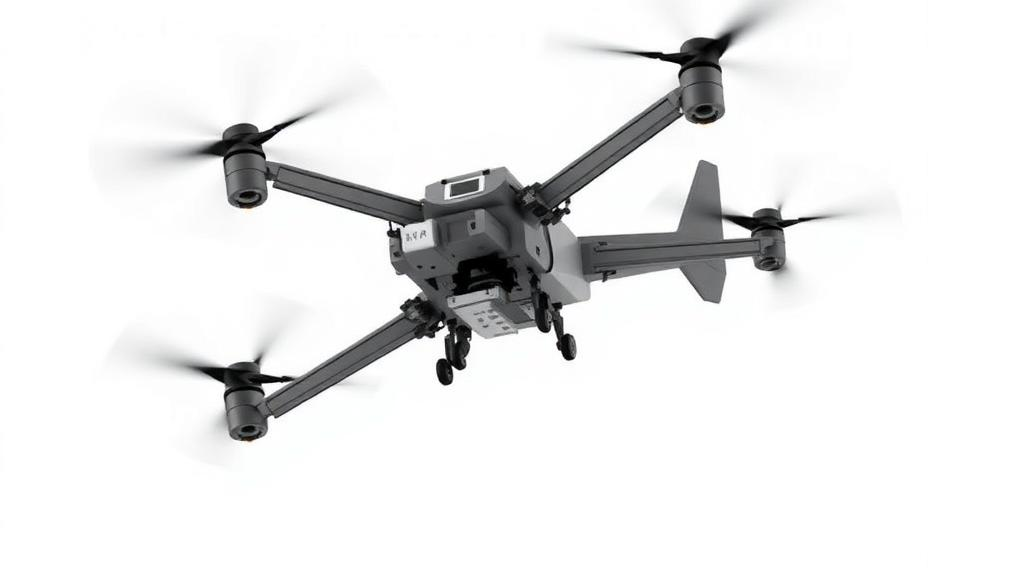
Every rotorcraft that has ever lifted off the ground carries within it a small forest of hinges, bearings, and joints. Gimbals let a rotor head tilt, see-saw mechanisms let blades teeter, and flapping and lagging hinges allow each blade to bend out of plane and lead or trail in response to aerodynamic loads. For decades, engineers who wanted to simulate how such machines would fly had to build a bespoke mathematical model for each configuration, carefully encoding the geometry of every hinge into the equations of motion. A new study published in the International Journal of Aeronautical and Space Sciences by Jun-Young An and Chang-Joo Kim of Konkuk University in Seoul proposes a way out of this laborious cycle: a generalized rotor kinematics modeling approach that treats the bewildering variety of rotor head architectures as variations on a single, unified theme.
The core insight of the work is deceptively simple. Rather than writing separate equations for each hinge type, the researchers describe every hinge as a rigid-body kinematic connection, a rotation or translation between successive reference frames. Gimbals, see-saw mechanisms, pre-cone, pre-sweep, droop, flap, lag, and pitch hinges all reduce to the same mathematical language: a sequence of coordinate transformations linking the hub to the blade. Once the rotor is broken down this way, its dynamics decompose naturally into a chain of interconnected subsystems, each one contributing its own kinematic relationship to the whole. Changing the rotor configuration then becomes a matter of rearranging the chain, not rewriting the model from scratch.
This framework has been integrated into the Helicopter Trim, Linearization, and Simulation flight dynamic model, a tool the same authors developed in earlier work. The integration matters because flight dynamic models are the workhorses of rotorcraft design: they predict how an aircraft trims into steady flight, how it responds to control inputs, and where its stability boundaries lie. A modeling environment that can switch between radically different rotor architectures without extensive reconfiguration promises to shorten the path from concept study to simulation for next-generation vertical flight vehicles, including the coaxial compounds and tilt-rotors now being considered for high-speed transport and urban air mobility.
To prove the concept, the team validated the approach on two of the most celebrated experimental rotorcraft in aviation history. The first is the Sikorsky XH-59A, the demonstrator for the Advancing Blade Concept, a coaxial helicopter whose two rigid rotors counter-rotate on a common shaft. Because the rotors are hingeless and stiff, the advancing blade on one side of the disk carries a disproportionate share of the lift, a phenomenon known as lift offset. This asymmetry is precisely what allows coaxial compounds to fly fast without the retreating-blade stall that limits conventional helicopters, but it also makes their flight dynamics notoriously difficult to model.
An and Kim used their unified model to examine how control phase angles and lift offset shape the behavior of the XH-59A across the forward speed range, extending to 300 knots. Their formulation incorporates inflow interference between the upper and lower rotors as well as differential controls, meaning the two rotors can be commanded independently. By sweeping through the operating envelope, the model identifies control schedules that minimize power at each forward speed, effectively mapping out the most efficient way to fly the aircraft at every condition. The ability to predict such scheduling strategies before any hardware is built is exactly the kind of capability that could accelerate the design of fast, efficient coaxial rotorcraft.
The second validation case is the Bell XV-15, the tilt-rotor demonstrator that paved the way for the V-22 Osprey. Tilt-rotors face a fundamentally different challenge: they must behave like helicopters at low speed and like turboprop airplanes at high speed, rotating their engine pylons through much of the flight envelope to convert between the two modes. During transition, the control system must mix helicopter-mode commands, such as cyclic and collective pitch, with airplane-mode surfaces, such as flaperons, so that the aircraft always generates adequate forces and moments with sufficient control margin. The researchers analyzed how flap deflection and pylon tilt angle influence this delicate balancing act, using their model to verify that control mixing between the two modes remains effective throughout the conversion corridor.
What makes the kinematic formulation powerful is its generality. In a conventional modeling approach, a gimbaled rotor, a teetering rotor, and an articulated rotor each demand their own derivation, and subtle geometric details like pre-cone angles or blade droop are often handled with ad hoc corrections. In the new framework, these features are simply additional elements in the kinematic chain, each described by the same rigid-body transformation formalism. The authors show that this enables a sequential breakdown of rotor dynamics into subsystems that can be assembled, modified, or swapped with minimal effort. For a design team exploring dozens of candidate configurations in the early phases of a program, that flexibility translates directly into saved engineering time and fewer opportunities for modeling errors.
The study is candid about its boundaries. The current formulation omits aeroelastic effects, the coupled interaction between aerodynamic loads and structural flexibility that becomes increasingly important for large, slender blades and for the whirl flutter phenomena that can plague tilt-rotors at high speed. Comprehensive analyses used in industry, such as those that model blade elasticity in detail, remain necessary for final loads and certification work. The authors note that incorporating aeroelasticity is planned as future work, which would broaden the applicability of the unified approach to the full spectrum of rotorcraft design problems, from compact electric air taxis to large high-speed compound helicopters.
The timing of such a tool is hardly accidental. The rotorcraft community is in the midst of a renaissance driven by urban air mobility, in which dozens of novel vertical takeoff and landing configurations are competing for market share. Many of these concepts borrow from the historical playbook: coaxial rotors for compact footprints, tilt-rotors for speed and range, compound arrangements with auxiliary propulsion for the best of both worlds. Earlier work by the same group applied their high-fidelity flight dynamic modeling to conceptual urban air mobility configurations, and the new generalized kinematics extends that capability to the hinge-level detail that separates one rotor architecture from another. A modeling environment that treats configuration diversity as a parameter rather than a redesign effort is well matched to an era of rapid concept iteration.
For the broader field of flight dynamics, the study is a reminder that sometimes the most consequential advances come not from more computing power or higher-fidelity physics, but from better mathematical structure. By grounding rotor modeling in the classical mechanics of rigid bodies, An and Kim have shown that the apparent zoo of rotor head designs obeys a common grammar. Their trim analyses of the XH-59A and XV-15 demonstrate that this grammar is not merely elegant but predictive, capable of identifying the power-optimal control schedules of a coaxial speed machine and the transition control margins of a tilt-rotor within a single framework. If the promised extension to aeroelastic effects materializes, the approach could become a standard starting point for the next generation of vertical flight vehicles, letting engineers spend less time deriving equations and more time inventing aircraft.
Subject of Research: Unified rigid-body kinematics modeling of rotor systems for coaxial and tilt-rotor aircraft flight dynamics
Article Title: Generalized Rotor Kinematics Modeling for Coaxial and Tilt-Rotor Aircraft
Article References: An, J.-Y., & Kim, C.-J. (2026). Generalized Rotor Kinematics Modeling for Coaxial and Tilt-Rotor Aircraft. International Journal of Aeronautical and Space Sciences. https://doi.org/10.1007/s42405-026-01215-6
Image Credits: AI Generated
DOI: 10.1007/s42405-026-01215-6
Keywords: rotorcraft, coaxial rotor, tilt-rotor, flight dynamics, rigid-body kinematics, unified rotor model, XH-59A, XV-15, lift offset, trim analysis, urban air mobility, rotor hinge modeling
Cite Scienmag News
Grant Pearson. (October 4, 2026). One Model, Many Rotors: Unified Kinematics Framework Tames Coaxial and Tilt-Rotor Flight Dynamics. Scienmag. https://scienmag.com/one-model-many-rotors-unified-kinematics-framework-tames-coaxial-and-tilt-rotor-flight-dynamics/
Grant Pearson. "One Model, Many Rotors: Unified Kinematics Framework Tames Coaxial and Tilt-Rotor Flight Dynamics." Scienmag, 4 October 2026, https://scienmag.com/one-model-many-rotors-unified-kinematics-framework-tames-coaxial-and-tilt-rotor-flight-dynamics/. Accessed 4 October 2026.
Grant Pearson. "One Model, Many Rotors: Unified Kinematics Framework Tames Coaxial and Tilt-Rotor Flight Dynamics." Scienmag. October 4, 2026. https://scienmag.com/one-model-many-rotors-unified-kinematics-framework-tames-coaxial-and-tilt-rotor-flight-dynamics/


