


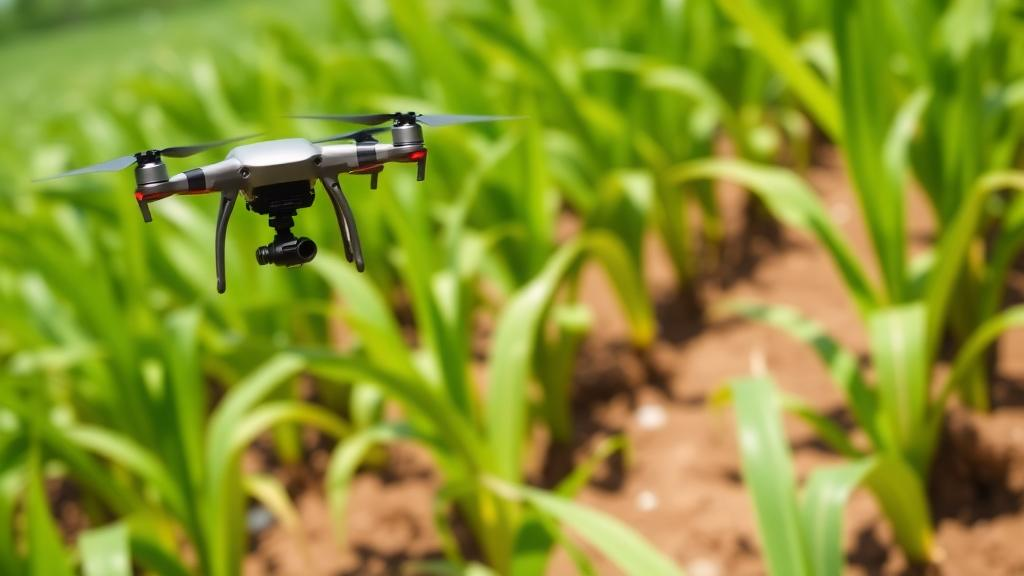
In the sprawling sugarcane fields of Ratchaburi Province, Thailand, a drone hovers forty meters above the crop, its multispectral cameras quietly reading the health of every five-by-five-meter patch of cane below. What happens next is a glimpse of farming’s future: an artificial intelligence system translates those aerial readings into a precise nitrogen prescription for each zone, and a fertilizer spreader on the ground delivers exactly that amount, no more and no less. According to a new field-validated study published in Smart Agricultural Technology, this end-to-end pipeline cut nitrogen fertilizer consumption by 21.8 percent, improved nitrogen-use efficiency by 27.4 percent, and increased sugarcane yield by 11.6 percent compared with conventional farmer practice. The results, statistically significant across replicated field trials, suggest that explainable AI and drone remote sensing have matured from research curiosities into tools that can pay for themselves in one growing season.
The problem the researchers set out to solve is deceptively simple to describe and notoriously hard to fix. Sugarcane is one of the world’s most important industrial crops, feeding sugar, bioethanol, and bioenergy industries in Brazil, India, China, and Thailand. Conventional fertilization treats entire fields as uniform blocks, applying the same rate everywhere regardless of soil fertility, moisture, topography, or crop vigor. The consequence is a double failure: over-fertilized zones waste money and leak nitrogen into groundwater and the atmosphere, while under-fertilized patches starve silently, dragging down overall yield. In Thailand, where rising fertilizer costs and labor shortages have squeezed growers, the economic and environmental stakes of getting this wrong have never been higher.
The technical heart of the new framework is a two-phase cyber-physical architecture. In the pre-application phase, a DJI Phantom 4 Multispectral drone flies automated missions at 40 meters altitude, capturing imagery in five spectral bands from blue to near-infrared, alongside thermal infrared readings of canopy temperature. With 80 percent forward and 75 percent side image overlap, the flights achieve a ground sampling distance of 3.2 centimeters per pixel, and RTK-GNSS positioning keeps orthomosaic alignment error below roughly four centimeters. The imagery is stitched into orthomosaics, segmented into 5-by-5-meter management zones, and converted into vegetation indices: NDVI, GNDVI, and SAVI, plus a green chlorophyll index. Field teams add ground-truth soil moisture from time-domain reflectometry probes, interpolated across the grid using inverse distance weighting.
Those features feed an XGBoost model, a gradient-boosted decision-tree ensemble chosen for its predictive power, robustness against overfitting, and, crucially, its suitability for embedded hardware. Trained on 180 management-zone samples drawn from six UAV surveys during the fertilization window, with targets ranging from 50 to 150 kilograms of nitrogen per hectare based on leaf diagnostics and Thai Department of Agriculture guidelines, the model achieved a testing R-squared of 0.918, with a root-mean-square error of 15.6 kilograms of nitrogen per hectare. In head-to-head benchmarking against random forest, artificial neural network, and support vector machine models, XGBoost delivered the highest accuracy and the lowest error, with differences that reached statistical significance. Its residuals clustered tightly around zero, with roughly 72.5 percent of predictions falling within ten kilograms of the reference rate, and the largest deviations confined to transitional crop zones where canopy conditions changed abruptly.
What distinguishes this work from a growing pile of AI-in-agriculture papers is the insistence on transparency. Rather than accepting the model as a black box, the team integrated SHAP, SHapley Additive exPlanations, a technique rooted in cooperative game theory that quantifies exactly how much each input feature pushed any given prediction up or down. The analysis revealed that NDVI alone accounted for 28.4 percent of the model’s total influence, with canopy temperature contributing another 23.1 percent, meaning crop vigor and physiological stress together drove more than half of every fertilizer decision. Higher NDVI values reduced recommended nitrogen, while elevated canopy temperatures, a signature of stressed, less transpiring plants, pushed recommendations upward. SHAP dependence analysis even uncovered threshold-like behavior: below an NDVI of roughly 0.52, recommendations rose sharply, while above 0.72 they plateaued, a nonlinear pattern that linear agronomic rules would miss entirely.
The explainability is not merely academic. Because every prescription can be traced back to specific, agronomically interpretable variables, farmers and agronomists can audit why a particular zone received 154 kilograms of nitrogen while its neighbor received 82. The researchers report that the SHAP layer improved detection of abnormal predictions, enabled spatial inconsistency diagnosis, and increased operator confidence, addressing one of the most persistent barriers to AI adoption in agriculture: distrust of opaque recommendations. In a low-vigor zone, for example, low NDVI and GNDVI combined with high canopy temperature produced positive SHAP contributions that raised the nitrogen rate, while stronger chlorophyll indices partially offset the increase, a narrative any trained agronomist can follow.
Execution happens at the field edge, not in the cloud. The trained model and a GPS-referenced prescription map are deployed on an NVIDIA Jetson Nano, a credit-card-sized computer running in its standard 10-watt mode, paired with an ESP32 microcontroller that drives the fertilizer metering hardware. During application, the Jetson Nano looks up the current GNSS position, retrieves the zone’s target rate, and sends commands to the ESP32, which converts the rate into an auger rotational speed using a laboratory-calibrated linear relationship, Q = 0.0575ω − 0.35, that achieved an R-squared of 0.999 across speeds from 20 to 100 rpm. Pulse-width modulation at 0.1 percent duty-cycle resolution regulates a DC motor driving the auger, delivering between 0.8 and 5.4 kilograms of fertilizer per minute. The measured latencies are striking: 82 milliseconds for AI inference, 28 milliseconds for communication, and 92 milliseconds for the embedded control loop, fast enough that at a 4-meter-per-second travel speed the system can update fertilizer rates every 32.8 centimeters of travel.
The agronomic payoff was tested in a randomized complete block design with three treatments and four replications. Conventional farmer practice applied an average of 148.6 kilograms of nitrogen per hectare; the AI-driven variable-rate system applied 116.2, a 21.8 percent reduction, while cutting over-application zones from 31.5 percent of the field to 8.7 percent. Nitrogen-use efficiency climbed from 43.1 to 54.9 percent, estimated runoff nitrogen losses fell by 42.3 percent, and fertilizer costs dropped by roughly 21.9 percent per hectare. Yields rose from 82.4 to 91.9 tonnes per hectare, and the benefits extended beyond raw tonnage: the standard deviation of plant height fell by 69.1 percent, stem-diameter variability by 63.9 percent, and chlorophyll-index variability by 65.9 percent, producing a more uniform crop that synchronizes better with mechanized harvesting and sugar processing. Low-vigor zones, which received up to 4.8 percent more fertilizer than conventional practice, recovered most dramatically, gaining 15.8 percent in yield.
The authors are candid about the study’s limits. Validation covered a single commercial field and one growing season, and the test set came from the same field and season as the training data, meaning the evaluation represents internal rather than independent spatial or temporal validation. Environmental benefits such as reduced nitrate leaching and greenhouse-gas emissions were modeled rather than directly measured, the applicator relied on calibrated feedforward control without closed-loop flow sensors, and dynamic response behavior and field distribution uniformity remain uncharacterized. The team’s stated contribution is deliberately positioned at the system level: not a new sensor, algorithm, or GIS method, but the first field-validated pathway linking UAV sensing, explainable machine learning, edge computing, and physical variable-rate actuation in commercial sugarcane.
Even with those caveats, the implications ripple outward. Fertilizer production is among the most carbon-intensive industrial processes on Earth, and nitrogen that leaves fields as nitrate or nitrous oxide imposes costs far beyond the farm gate. A framework that trims inputs by more than a fifth while raising yields, and that explains every decision in terms a farmer can verify, offers a template that could extend to maize, wheat, rice, and other row crops. The researchers point toward multi-site, multi-season validation, multi-nutrient management, and autonomous spatiotemporal decision-making as next steps. If those follow-up trials hold, the sight of a drone prescribing fertilizer zone by zone, with an AI that shows its work, may soon be as ordinary in sugarcane country as the harvest itself.
Subject of Research: Explainable AI-driven UAV remote sensing for variable-rate nitrogen fertilization in precision sugarcane nutrient management
Article Title: Field-validated explainable AI-based UAV remote sensing for variable-rate fertilization in precision sugarcane nutrient management
Article References: Sangpradit, K., & Samseemoung, G. (2026). Field-validated explainable AI-based UAV remote sensing for variable-rate fertilization in precision sugarcane nutrient management. Smart Agricultural Technology, 15, Article 102585. https://doi.org/10.1016/j.atech.2026.102585
Image Credits: AI Generated
DOI: 10.1016/j.atech.2026.102585
Keywords: precision agriculture, UAV remote sensing, explainable AI, XGBoost, SHAP, variable-rate fertilization, sugarcane, nitrogen-use efficiency, edge computing, multispectral imaging, Jetson Nano, sustainable farming
Cite Scienmag News
Alan Morgan. (October 2, 2026). Drone AI Cuts Fertilizer Use by 22 Percent While Boosting Sugarcane Yields. Scienmag. https://scienmag.com/drone-ai-cuts-fertilizer-use-by-22-percent-while-boosting-sugarcane-yields/
Alan Morgan. "Drone AI Cuts Fertilizer Use by 22 Percent While Boosting Sugarcane Yields." Scienmag, 2 October 2026, https://scienmag.com/drone-ai-cuts-fertilizer-use-by-22-percent-while-boosting-sugarcane-yields/. Accessed 2 October 2026.
Alan Morgan. "Drone AI Cuts Fertilizer Use by 22 Percent While Boosting Sugarcane Yields." Scienmag. October 2, 2026. https://scienmag.com/drone-ai-cuts-fertilizer-use-by-22-percent-while-boosting-sugarcane-yields/


