


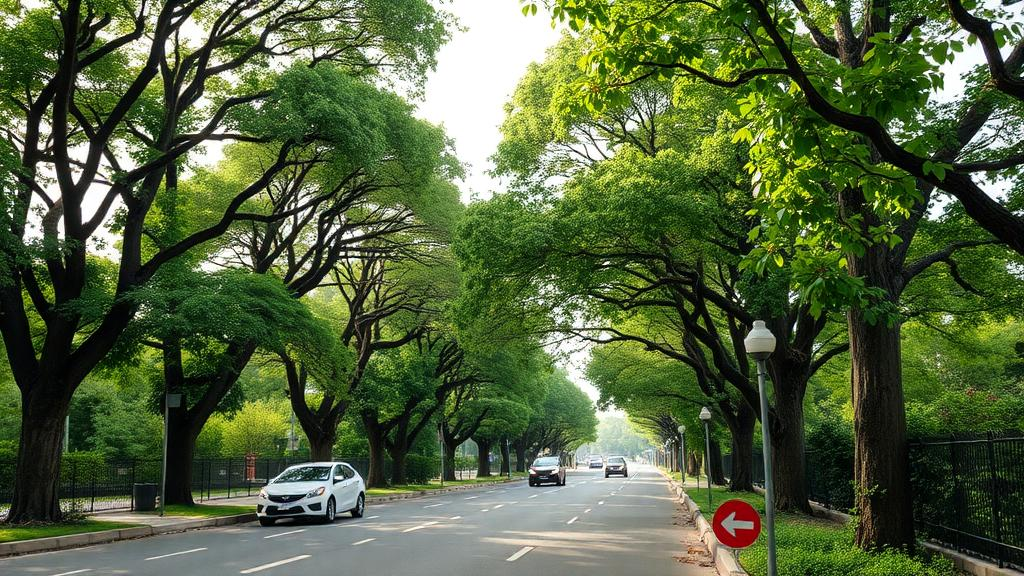
Along the busy arterial roads of Winneba, a rapidly urbanizing coastal town some 56 kilometers west of Accra, the trees lining the asphalt are quietly keeping a record of everything the traffic throws at them. A new study published in BMC Environmental Science has read that record at the microscopic level, revealing that vehicle emissions leave measurable fingerprints in both the size and the internal anatomy of roadside leaves. The research, conducted by Francis Kwaku Nkansah of the University of Education, Winneba, examined four abundant street tree species—Albizia lebbeck, Azadirachta indica, Khaya senegalensis, and Senna siamea—growing along three major roads with different traffic volumes, and compared them with trees on the relatively unpolluted university campus that served as a control site.
The technical approach combined straightforward field measurements with accessible laboratory methods. Ambient concentrations of fine particulate matter (PM2.5), coarse particulate matter (PM10), carbon monoxide, and nitrogen oxides were monitored five days a week over three months using EPAM-7500 particle monitors and Aeroqual Series 500 gas analyzers, with instruments positioned about one meter above the ground to capture pollutants originating from vehicle exhaust. Sampling sessions rotated purposively among the roads during morning, afternoon, and evening peak-traffic windows, and two-hour means were computed from one-minute averages. Leaf samples, meanwhile, were collected in triplicate from the traffic-facing side of each tree at a standardized height of 1.9 meters, always taking the third leaf from the tip in the phyllotaxis sequence—a choice that ensures every measured leaf sits at the same developmental stage, neither too young nor too old.
In total, 300 leaves per site were gathered between May and July 2024, during the early rainy season and at least 48 hours after any rainfall, to guarantee uniform hydration and comparable surface conditions. Leaf length and breadth were measured with a metric ruler, while surface area was quantified by tracing each leaf onto graph paper and counting full and partial squares. For the microscopic work, the team used the so-called lasting impressions method: a section of the leaf surface is coated with clear nail polish, allowed to dry in successive layers, and then peeled away with forceps to produce an exact replica of the epidermis. These peels were mounted in glycerin, photographed under a Leica DM750 light microscope, and analyzed in the open-source ImageJ software to count stomata and calculate stomatal density and total stomatal area.
The results paint a picture of stress written in plant tissue. At the high-traffic sites, leaf dimensions shrank in the more sensitive species. Azadirachta indica, the familiar neem, showed a mean leaf area of 20.0 square centimeters at the control site but only 11.5 square centimeters at Arterial Road III, a statistically significant decline. Senna siamea followed the same pattern, dropping from 13.0 square centimeters at the control to 8.17 square centimeters at the busiest road. In contrast, Albizia lebbeck and Khaya senegalensis maintained relatively stable macroscopic traits across sites, and in some cases even recorded their largest leaves at high-traffic locations—a counterintuitive result the study links to compensatory growth, in which tolerant species expand their photosynthetic surface to offset pollution-induced losses in efficiency, or to nitrogen-rich pollutants such as NO2 inadvertently acting as a fertilizer for species with high tolerance thresholds.
The microscopic data were even more striking. Stomata, the adjustable pores on leaf surfaces that regulate gas exchange, responded sharply to pollution. Albizia lebbeck recorded a stomatal density of 296.7 stomata per square millimeter at the control site but only 63.0 at Arterial Road II. Khaya senegalensis fell from 206.7 per square millimeter at the control to just 20.0 at Arterial Road I, where its total stomatal area collapsed from 35,446 square millimeters to 5,071.7. Senna siamea showed significant reductions in both metrics across all arterial roads, while Azadirachta indica reached its lowest stomatal density, 31.0 per square millimeter, at Arterial Road III. Reduced stomatal density is widely interpreted as a defensive strategy: by closing down the number of openings, a leaf limits the entry of gaseous toxins and particulates, though the price is reduced capacity for photosynthesis and cooling.
To disentangle which pollutants were driving these changes, the study employed multiple regression analysis together with variance inflation factor (VIF) diagnostics, a statistical tool that quantifies how strongly predictor variables are intercorrelated, with values above 10 signaling problematic multicollinearity. Here the findings became species-specific. For Khaya senegalensis, NO2 produced a VIF of 31.077 and PM2.5 a VIF of 25.016 for micro-morphological traits, both far above the threshold, indicating that these two pollutants are tightly intertwined with the observed stomatal changes in that species. For macro traits, NO2 again dominated, with a VIF of 15.764 in Khaya senegalensis. Carbon monoxide, by contrast, consistently showed low VIF values between 1.358 and 1.429, suggesting it acts relatively independently and exerts minimal direct influence on leaf structure. PM10 showed only mild associations across the board.
The regression results align with established mechanisms of pollution injury. Nitrogen dioxide, a signature component of vehicular exhaust, triggers oxidative stress in plant tissues that can lead to stomatal dysfunction, while fine particles deposit on leaf surfaces and inside stomatal pores, physically obstructing gas exchange and reducing photosynthetic efficiency. The strong co-occurrence of NO2 and PM2.5 in urban air, driven by shared emission sources such as traffic, means the two often act in concert. For Khaya senegalensis, carbon monoxide and PM10 emerged as significant influences on stomatal traits, consistent with evidence that prolonged carbon monoxide exposure disrupts cellular respiration and stress responses, and that coarse particles cause mechanical damage to leaf surfaces.
Not every species responded the same way, and that variation is precisely what makes the findings useful. Azadirachta indica and Senna siamea displayed greater sensitivity, with significant reductions in leaf area and stomatal traits, marking them as promising bioindicators—living sensors whose anatomy registers pollution levels that would otherwise require expensive instrumentation to detect. Khaya senegalensis, despite showing the strongest statistical association with NO2 and PM2.5, maintained comparatively stable macroscopic traits and total stomatal area at moderately polluted sites, suggesting genuine tolerance mechanisms. Senna siamea’s muted stomatal response may reflect protective traits such as thick cuticular layers and efficient antioxidant defenses, reinforcing its reputation as a resilient urban tree.
The practical implications extend well beyond Winneba. In rapidly urbanizing regions of West Africa and other developing areas where continuous air-quality monitoring networks are sparse, roadside trees could serve as a low-cost, distributed biomonitoring infrastructure. The study recommends prioritizing Khaya senegalensis and Albizia lebbeck in roadside planting schemes to strengthen the ecological buffering capacity of urban corridors, while integrating micro-morphological assessments into greenbelt management to guide species selection. The author acknowledges limitations, including a short sampling window, the absence of physiological and soil data, and uneven species presence across roads. Even so, the work demonstrates that the anatomy of an ordinary street tree can carry a detailed, quantifiable archive of the air it breathes—and that reading that archive may be one of the most accessible tools cities have for understanding their own pollution.
Subject of Research: Morphological and anatomical responses of roadside trees to vehicular air pollution
Article Title: Air pollution and plant responses: a study on morphological and anatomical changes in roadside trees along traffic-dense roads
Article References: Nkansah, F. K. (2025). Air pollution and plant responses: a study on morphological and anatomical changes in roadside trees along traffic-dense roads. BMC Environmental Science, 2(1), Article 16. https://doi.org/10.1186/s44329-025-00031-9
Image Credits: AI Generated
DOI: 10.1186/s44329-025-00031-9
Keywords: air pollution, roadside trees, leaf morphology, stomatal density, PM2.5, nitrogen dioxide, biomonitoring, urban greening, vehicular emissions, Ghana, Khaya senegalensis, plant anatomy
Cite Scienmag News
Russell Cooper. (October 2, 2026). Roadside Trees Reveal Hidden Scars of Traffic Pollution in Their Leaves. Scienmag. https://scienmag.com/roadside-trees-reveal-hidden-scars-of-traffic-pollution-in-their-leaves/
Russell Cooper. "Roadside Trees Reveal Hidden Scars of Traffic Pollution in Their Leaves." Scienmag, 2 October 2026, https://scienmag.com/roadside-trees-reveal-hidden-scars-of-traffic-pollution-in-their-leaves/. Accessed 4 October 2026.
Russell Cooper. "Roadside Trees Reveal Hidden Scars of Traffic Pollution in Their Leaves." Scienmag. October 2, 2026. https://scienmag.com/roadside-trees-reveal-hidden-scars-of-traffic-pollution-in-their-leaves/


