


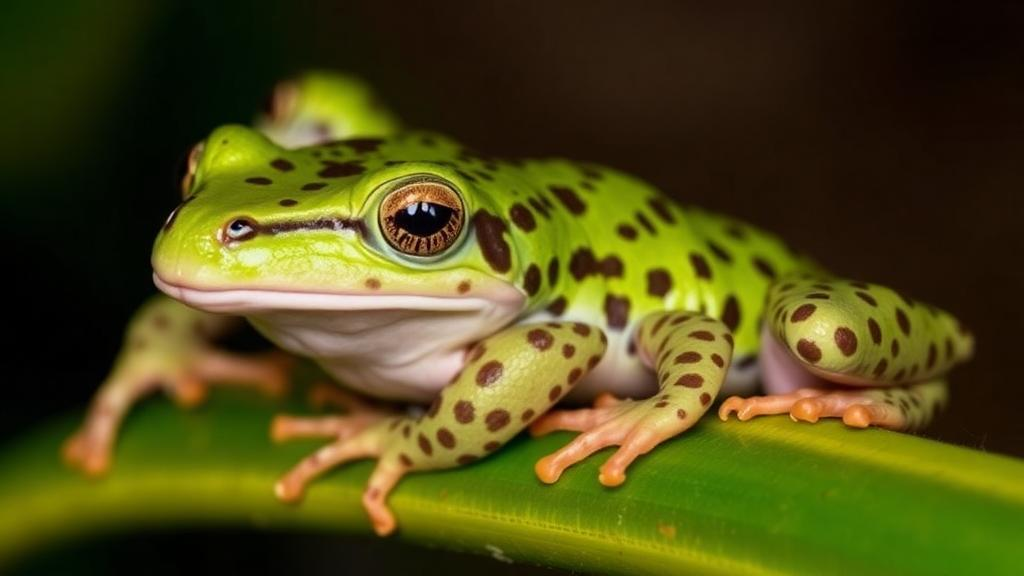
Brazil is home to the richest frog fauna on Earth, with more than 1,200 species of anuran amphibians hopping through its rainforests, savannas, and wetlands. Yet a sweeping new review reveals that scientists know almost nothing about what the vast majority of these animals actually eat. A team led by Camila Fernanda Moser of the State University of Campinas combed through more than five decades of published research and found that dietary information exists for only 233 Brazilian frog species, roughly 19 percent of the country’s anuran fauna. For a group that plays a central role in food webs as both predator and prey, the gap is more than an academic embarrassment. It is a blind spot that complicates conservation planning in a country where the number of threatened frog species has surged from 35 in 2004 to 184 in 2022.
The review, published in the journal Discover Ecology, followed the PRISMA framework for systematic reviews, searching four major databases in both English and Portuguese for studies on the diets of post-metamorphic frogs in Brazil. The team screened out work on tadpoles, gray literature such as conference abstracts and theses, and single predation records, ultimately retrieving 221 studies published between 1971 and June 2025. The very first Brazilian frog diet study appeared in 1971, when Ivan Sazima described marine invertebrates in the stomach contents of the frog Thoropa miliaris in the journal Ciência e Cultura. Remarkably, only nine additional dietary studies appeared during the entire twentieth century. The field only began to accelerate after 2000, and between 2019 and 2023 alone, researchers published 69 studies, nearly a third of everything ever written on the topic in Brazil.
That recent surge, the authors suggest, may have less to do with renewed scientific enthusiasm and more to do with austerity. Brazil’s research funding crisis in the late 2010s squeezed laboratory-based science hard, and dietary studies, which require little more than fieldwork, a dissection kit, and patience, became an accessible alternative for cash-strapped researchers. The pattern is visible in where the results are published. Of the 56 journals that have carried Brazilian frog diet studies, about a third have no impact factor at all, and the single most prolific outlet, Herpetology Notes, which published 26 studies, lacks one as well. Only 11 studies, about 5 percent, appeared in journals with an impact factor above two. Natural history research, the authors note, tends to be undervalued by high-profile journals, discouraging scientists from investing in it even as it underpins every hypothesis they test.
The taxonomic and geographic biases in the literature are stark. Hylidae, the treefrog family, dominates the record with 84 species studied, followed by Leptodactylidae with 55, Bufonidae with 23, and Microhylidae with 15. For two entire families, the Alsodidae and Centrolenidae, not a single Brazilian species has a documented diet. Geographically, the Atlantic Forest accounts for 110 studies, nearly half the total, followed by the Amazon with 47, the Cerrado with 32, the Caatinga with 23, the Pampa with 10, and the Pantanal with just 8. The imbalance extends to endemism. Brazil hosts 907 frog species found nowhere else, yet only 91 of them, about 10 percent, have had their diets described. Fifty of those are Atlantic Forest endemics and 32 are Amazonian, while just three Caatinga endemics and a single Pantanal endemic appear in the record.
The species that have been studied repeatedly share a predictable profile: they are common, widespread generalists. Leptodactylus fuscus and Physalaemus cuvieri lead the tally with 14 studies each, followed by Boana raniceps with 12 and Leptodactylus macrosternum with 11. Dendropsophus minutus and Leptodactylus fuscus occur in all six of Brazil’s major ecoregions, making them easy targets for fieldwork. Most of these well-studied frogs are opportunistic feeders, but the literature does contain striking exceptions. Physalaemus cicada is a termite specialist, Amazophrynella minuta appears to specialize in mites, and Phyllodytes edelmoi feeds mainly on ants. Boana raniceps favors beetles, while Scythrophrys sawayae and the pumpkin toadlet Brachycephalus brunneus show a marked preference for mites. Ontogenetic shifts have been documented too, with juveniles of Dendropsophus minutus and Leptodactylus podicipinus taking smaller prey than adults.
The most extraordinary dietary story in the Brazilian literature belongs to Xenohyla truncata, a Vulnerable treefrog endemic to the restinga habitats of coastal Rio de Janeiro. Unlike virtually every other frog on Earth, X. truncata actively eats fruit, nectar, and plant parts. Recent observations recorded it feeding on nectar from Iris x germanica and Cordia taguahyensis flowers, with pollen adhering to its body, raising the tantalizing possibility that this frog acts as a pollinator, a role almost unheard of among amphibians. Such discoveries illustrate why dietary research matters: without it, ecologists cannot map predator-prey interactions, estimate niche overlap among sympatric species, or understand the functional roles frogs play in their ecosystems. Yet only 34 of the 221 studies reviewed, about 15 percent, even measured prey availability in the environment, the baseline needed to distinguish true dietary preference from simple opportunity.
The conservation implications are sobering. Of Brazil’s 184 globally threatened frog species, only 12 have had their diets described, across just 15 studies. Those 12 include two Critically Endangered species, Adelophryne maranguapensis and Proceratophrys ararype, five Endangered species, and five Vulnerable ones. The picture is even bleaker for poorly known species: not one of the 62 species classified as Data Deficient by the IUCN has a documented diet, and nearly all of them are Brazilian endemics, with 40 confined to the Atlantic Forest. Among the seven threatened species with known diets, most turned out to be generalists, but Brachycephalus brunneus and Brachycephalus garbeanus feed primarily on mites, suggesting active foraging, while Adelophryne maranguapensis is an active forager and Crossodactylus timbuhy switches between active hunting and sit-and-wait tactics depending on whether prey is mobile or stationary.
Methodology is another frontier. A striking 81 percent of the reviewed studies relied on dissection, which requires killing the animals examined. Only 40 studies, about 18 percent, used stomach flushing, a non-lethal technique refined for anurans by Mirco Solé and colleagues in 2005 that induces frogs to regurgitate their stomach contents unharmed. Just one study applied flushing to a threatened species, the bromeliad-dwelling treefrog Phyllodytes tuberculosus. Nine studies mined museum specimens instead of collecting new animals, and only two used pure behavioral observation. The authors argue strongly for wider adoption of non-lethal methods, particularly for small, declining, or hard-to-access populations. More advanced tools remain rare: stable isotope analysis, which can trace whether a frog’s diet derives from terrestrial or aquatic food webs, has appeared in only a handful of studies, largely because its cost is prohibitive for researchers in middle-income countries facing chronic funding shortfalls. DNA-based techniques such as next-generation sequencing, which can identify prey from partially digested fragments with high taxonomic resolution, are almost entirely absent from Brazilian herpetology so far.
The review’s authors close with a call to action that doubles as a diagnosis of a discipline. Natural history, they argue, is the foundation on which all ecology rests, informing hypothesis development, data interpretation, and conservation decisions, yet it is increasingly neglected as researchers chase molecular and computational approaches that journals reward with prestige. They urge fieldwork using non-lethal methods across as many species as possible, greater use of scientific collections, and intensified effort in the Atlantic Forest, Amazon, and Cerrado, which despite ranking as the most-studied biomes still host hundreds of species with unknown diets, as well as in the Caatinga, Pampa, and Pantanal, where knowledge is nearly absent. Dietary data, they suggest, could even serve as an early-warning indicator of ecosystem change and anthropogenic impact. With amphibians now the most threatened vertebrate class on the planet, understanding what Brazil’s frogs eat is no longer a curiosity of natural history. It is a prerequisite for keeping them alive.
Subject of Research: Dietary ecology and knowledge gaps of Brazilian anuran amphibians
Article Title: Current state of the art in anuran dietary studies in Brazil
Article References: Moser, C. F., Ceron, K., Schuck, L. K., Santana, D. J., Solé, M., Iop, S., & Tozetti, A. M. (2025). Current state of the art in anuran dietary studies in Brazil. Discover Ecology, 1(1), Article 9. https://doi.org/10.1007/s44396-025-00008-7
Image Credits: AI Generated
DOI: 10.1007/s44396-025-00008-7
Keywords: anurans, frogs, diet, trophic ecology, Brazil, Atlantic Forest, Amazon, conservation, natural history, stomach flushing, biodiversity, threatened species
Cite Scienmag News
Daisy Hatcher. (October 2, 2026). Brazil’s Frogs Remain a Dietary Mystery as Most Species Go Unstudied. Scienmag. https://scienmag.com/brazils-frogs-remain-a-dietary-mystery-as-most-species-go-unstudied/
Daisy Hatcher. "Brazil’s Frogs Remain a Dietary Mystery as Most Species Go Unstudied." Scienmag, 2 October 2026, https://scienmag.com/brazils-frogs-remain-a-dietary-mystery-as-most-species-go-unstudied/. Accessed 2 October 2026.
Daisy Hatcher. "Brazil’s Frogs Remain a Dietary Mystery as Most Species Go Unstudied." Scienmag. October 2, 2026. https://scienmag.com/brazils-frogs-remain-a-dietary-mystery-as-most-species-go-unstudied/


