


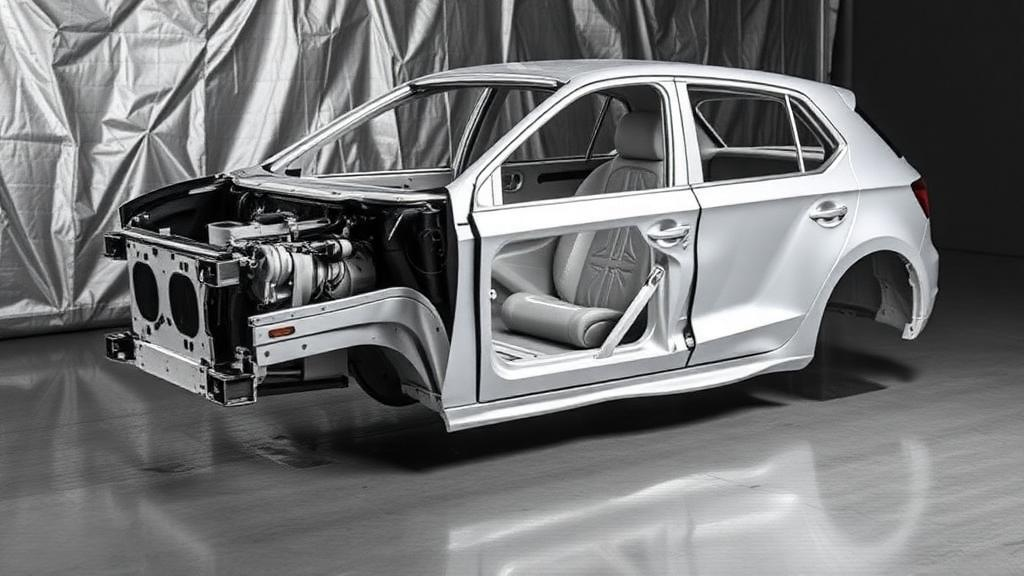
Aluminum has become the quiet hero of the electric vehicle revolution. Lighter than steel by roughly half for equivalent components, aluminum body panels help battery-powered cars travel farther on every charge, and their use in North American light-duty vehicles has grown by about three percent every year since 2000. But this lightweighting success story carries a heavy carbon shadow. Producing the primary aluminum that goes into automotive body sheet emits around 8.5 kilograms of carbon dioxide equivalent per kilogram of ingot, roughly eighteen times more than secondary aluminum made from scrap. Now a new study published in the Journal of Industrial Ecology maps out, in unusually precise detail, how the United States could break that dependence on virgin metal and turn retired cars into the raw material for new ones.
The research, led by Alissa Tsai of Northwestern University’s Trienens Institute for Sustainability and Energy together with Yongxian Zhu, Mohammadreza Heidari and Daniel R. Cooper, tackles a stubborn paradox at the heart of automotive aluminum recycling. America is remarkably good at collecting old vehicles: about 95 percent of end-of-life vehicles are recycled. Yet almost none of the aluminum body sheet recovered from them finds its way back into new body sheet. Under business-as-usual practices, the study finds, the post-consumer recycled content of US aluminum automotive body sheet would crawl from a mere 1.5 percent today to just 1.9 percent by 2050, even as a mountain of scrap accumulates.
The reason is chemistry, not apathy. Automotive body sheet relies on two families of wrought alloys. The 5xxx series, rich in magnesium, offers the strength and formability needed for inner panels, while the 6xxx series, built on a magnesium-silicon system, delivers the surface finish demanded of visible outer panels. When old vehicles are crushed and shredded, their aluminum emerges as a mixed stream known as Twitch, contaminated with silicon-rich castings, copper, zinc, and iron from embedded fasteners. The stringent compositional specifications that make body sheet safe and formable simply cannot tolerate these residuals. The optimization model reveals that the binding constraints are the silicon limit in 5xxx alloys and the zinc limit in 6xxx alloys, and these caps keep recycled content pinned near zero regardless of how much scrap is available.
To quantify what could be achieved, the team built a composition-specific dynamic material flow analysis tracking sheet demand and scrap availability from 2025 to 2050, coupled with a linear optimization framework that allocates every kilogram of metal, virgin or scrap, to seven alloy demands under volumetric, compositional, and furnace-charge constraints. A supply chain emissions model then translates recycled-content gains into greenhouse gas savings. The headline finding is striking: by 2050, scrap from retired US vehicles could physically supply up to 33 percent of the ingot demand needed to make American body sheet components. The material will be there. The question is whether the supply chain can chemically digest it.
The study evaluates eleven strategies spanning the entire life cycle, and the results expose how little any single actor can accomplish alone. Sheet mills could develop high-residual-content, recycle-friendly alloys that tolerate the elevated iron, copper, and silicon found in scrap. In isolation this raises recycled content to only 4.6 percent by 2050. Automakers could shift 5xxx-series component designs to silicon-tolerant 6xxx alloys, a move that alone lifts the figure to just 2.3 percent, because 6xxx chemistry still cannot absorb the roughly one percent zinc present in mixed Twitch. Even swapping standard primary aluminum for a purer diluent barely moves the needle, reaching 2.4 percent under a theoretical pure-aluminum case. Switching away from ferrous self-piercing rivets, tested in a Ford F-150 case study, proved nearly irrelevant, since most iron contamination comes from aluminum castings rather than fasteners.
The single most powerful intervention belongs to the recyclers. Sorting shredded scrap by alloy series, using laser-induced breakdown spectroscopy to zap each flake with a laser and read its elemental fingerprint, removes the silicon, copper, and zinc-laden castings that poison the stream and prevents cross-contamination between the 5xxx and 6xxx families. With realistic 93 percent sorting accuracy, this alone could push recycled content to 22.9 percent by 2050; with perfect sorting, 23.3 percent. An alternative recycler strategy, disassembling aluminum-rich sub-assemblies such as hoods, doors, and tailgates before shredding, achieved 19 percent in the Ford case study, producing clean 6xxx-rich streams that can be remelted with minimal dilution. Removing castings alone, or processing only the larger wrought-rich Zorba size fractions, delivered far more modest gains.
The real breakthrough emerges when stakeholders act in concert. Combining alloy-series sorting with the deployment of high-residual-content alloys proves synergistic, each measure amplifying the other: better-sorted scrap meets alloys designed to absorb its remaining impurities. Together they raise post-consumer recycled content to 28 percent by 2050, with a post-consumer recycling rate of 90.3 percent, pushing total scrap content, including the production scrap already fully cycled through rolling and stamping operations, to 76 percent of all ingot input. That figure approaches the 33 percent physical ceiling, beyond which only improvements in collection efficiency and melt recovery can push the system. Intriguingly, some combinations work against each other: pairing high-residual-content alloys with a wholesale shift to 6xxx alloys yields less than the sum of its parts, because the new alloys were designed around 5xxx chemistries that the design shift would phase out.
The climate stakes are substantial. Under a scenario where industrial processes and the electricity grid remain frozen at today’s carbon intensity, achieving 28 percent recycled content would avoid 2,838 kilotonnes of carbon dioxide equivalent annually by 2050, a 42 percent cut relative to business-as-usual body sheet production, which would otherwise emit 6,771 kilotonnes. Even under an aggressive decarbonization pathway aligned with the Aluminum Association’s roadmap, featuring inert anodes, hydropowered smelting, and a clean grid by 2035, the relative savings remain impressive at 33 percent, because recycled scrap continues to displace whatever emissions-intensive primary metal remains in the mix.
The analysis is not without caveats. The authors assume aggressive but realistic adoption timelines, with new alloys commercialized by 2030 and sorting technologies deployed by 2026, and they do not model the costs of implementation or the possibility of delayed adoption. Rising demand for Twitch scrap could also erode its price advantage over primary aluminum over time. Still, the core message is unambiguous and, in its way, radical: no single company, however well-intentioned, can decarbonize automotive aluminum on its own. Sheet mills must design alloys for the scrap that will exist, not the scrap they wish existed. Automakers must choose alloys and joining methods with the shredder in mind. Recyclers must invest in sensors that can tell a 5xxx flake from a 6xxx one in milliseconds.
As aluminum-intensive vehicles from the past decade begin retiring in growing numbers, the United States stands at a decision point. The scrap wave is coming whether the industry is ready or not; the study projects it could cover 33 percent of ingot demand by mid-century. Capturing that value, and the emissions savings that come with it, requires a coordinated redesign of alloys, vehicles, and recycling infrastructure that has, until now, existed only in fragments across separate corporate silos. This research stitches those fragments into a single quantitative roadmap, and its verdict is clear: the circular car is chemically possible, but only if the whole supply chain builds it together.
Subject of Research: Increasing post-consumer recycled content in US aluminum automotive body sheet through cross life cycle recycling strategies
Article Title: Cross life cycle opportunities for increasing the post-consumer recycled content of aluminum automotive body sheet in the United States
Article References: Tsai, A., Zhu, Y., Heidari, M., & Cooper, D. R. (2026). Cross life cycle opportunities for increasing the post-consumer recycled content of aluminum automotive body sheet in the United States. Journal of Industrial Ecology. https://doi.org/10.1007/s44498-026-00119-8
Image Credits: AI Generated
DOI: 10.1007/s44498-026-00119-8
Keywords: aluminum recycling, automotive body sheet, post-consumer recycled content, end-of-life vehicles, dynamic material flow analysis, linear optimization, recycle-friendly alloys, scrap sorting, LIBS, greenhouse gas emissions, circular economy, lightweighting
Cite Scienmag News
Sloane Callahan. (October 2, 2026). Recycled Aluminum Could Supply a Third of US Car Body Sheet by 2050. Scienmag. https://scienmag.com/recycled-aluminum-could-supply-a-third-of-us-car-body-sheet-by-2050/
Sloane Callahan. "Recycled Aluminum Could Supply a Third of US Car Body Sheet by 2050." Scienmag, 2 October 2026, https://scienmag.com/recycled-aluminum-could-supply-a-third-of-us-car-body-sheet-by-2050/. Accessed 4 October 2026.
Sloane Callahan. "Recycled Aluminum Could Supply a Third of US Car Body Sheet by 2050." Scienmag. October 2, 2026. https://scienmag.com/recycled-aluminum-could-supply-a-third-of-us-car-body-sheet-by-2050/


